By Shai Tsarfati, Co-Founder and CEO of Surplus International
The chemical can be right for the buyer, and the container can still make the deal wrong.
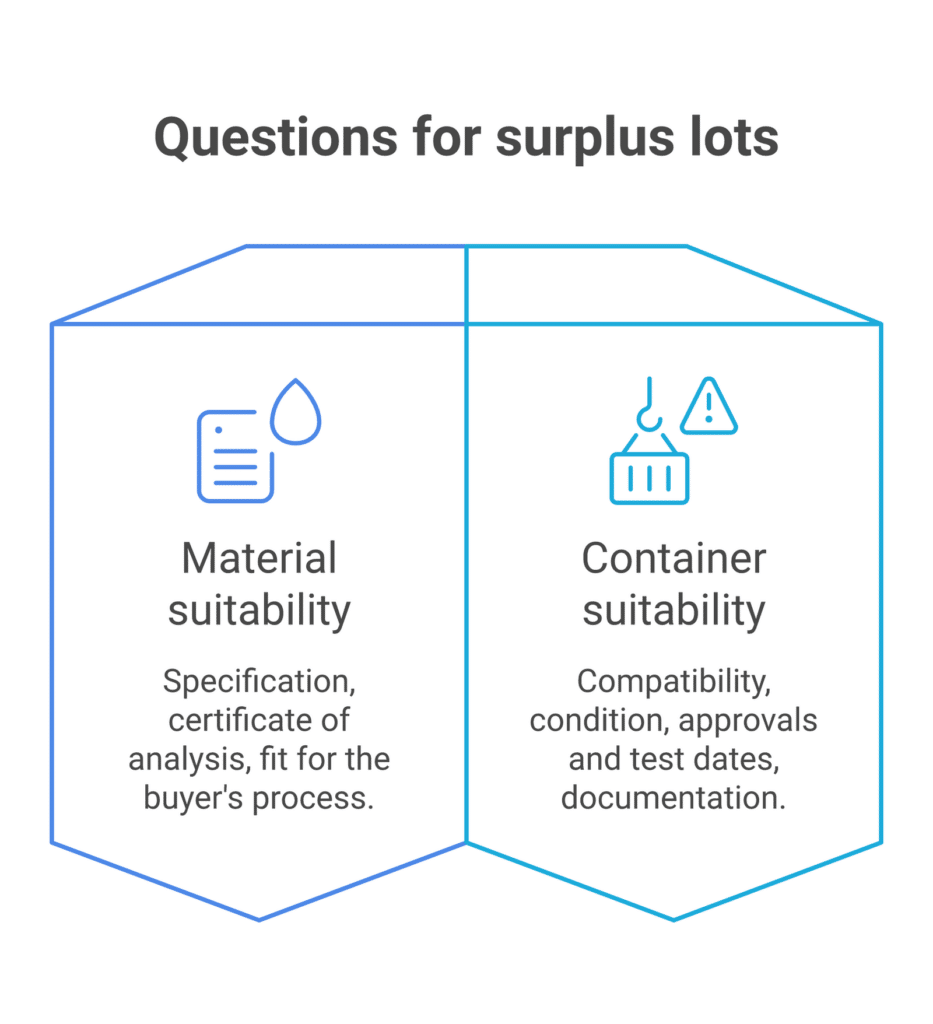
Surplus material rarely arrives in packaging chosen for its next journey. It comes in IBCs filled years ago, drums that were opened for sampling and resealed, and partial containers left over when a production line changed. The material inside may meet the buyer’s specification. Whether its container is fit to carry it to the buyer’s site is a separate question, and it can change the economics of the whole deal.
In our previous article, we looked at the records behind a lot’s origin. This article looks at the drum or IBC the lot sits in, and at a European regulation that now makes packaging a closer part of the conversation.
What changed on 12 August 2026
The EU Packaging and Packaging Waste Regulation, Regulation (EU) 2025/40, known as PPWR, entered into force on 11 February 2025 and has applied since 12 August 2026. The European Commission describes it as a harmonised, directly applicable regime covering all packaging placed on the EU market, regardless of material or origin. 1
The scope is not limited to consumer packs. Article 2 applies the Regulation to all packaging and packaging waste, whether used or arising in industry, manufacturing, retail, distribution, offices, services or households. Article 3 defines transport packaging as packaging designed to make handling and transport easier and prevent damage to the product, excluding road, rail, ship and air containers. Drums and IBCs moving chemicals between businesses fall squarely within that world. 2
What did not happen in August is just as important. The obligations that would most change how drums and IBCs are handled are phased in later. Design-for-recycling requirements start in 2030 at the earliest. Minimum recycled content for plastic packaging starts in 2030 at the earliest. The reuse targets for transport packaging, which name pallets, IBCs, pails, drums and canisters, start on 1 January 2030. 2 No reuse target became mandatory in August 2026.
Two rulebooks, two different questions
Packaging for chemicals answers to two separate sets of rules, and it helps to keep them apart.
- PPWR deals with the environmental performance and labelling of packaging: whether it can be recycled, how much recycled plastic it contains, whether it is reusable and whether reuse targets are met.
- Dangerous-goods transport rules deal with safety in carriage: whether a particular packaging is approved, compatible and in good enough condition to carry a particular material. In Europe these are ADR for road and RID for rail; in the United States, the Hazardous Materials Regulations in Title 49 of the Code of Federal Regulations.
PPWR itself sets the order between them. Article 2 states that the Regulation applies without prejudice to Union requirements on the safety, quality and health of packaged products and to transport rules, and that where it conflicts with Directive 2008/68/EC on the inland transport of dangerous goods, the Directive prevails. 2 In practice, a container that suits PPWR’s goals but fails a dangerous-goods requirement still cannot carry that material.
The dangerous-goods exemptions are narrower than they look
For drums and IBCs, the exemptions that matter most sit in three articles. Packaging used for the transport of dangerous goods under Directive 2008/68/EC is exempt from:
- the recyclability requirements of Article 6 (Article 6(11)(f))
- the minimum recycled content targets for plastic packaging in Article 7(1) and (2) (Article 7(4)(f))
- the transport packaging reuse obligations in Article 29(1) to (3) (Article 29(4)(a)) 2
Two limits follow from the wording. First, each exemption switches off a named requirement in a named article. It does not take the packaging out of the Regulation, whose scope still covers all packaging. Second, each exemption depends on how the packaging is used: for the transport of dangerous goods. Many surplus chemicals are not classified as dangerous goods for transport. A non-hazardous lot moving in IBCs between companies in the same Member State would generally fall under the reuse provisions from 2030, not under the exemption. 2 The transport classification of the material therefore matters for packaging planning, not only for shipping documents.
“Reusable” under PPWR is not the same as “fit to refill”
Article 11 sets out when packaging counts as reusable. Among other conditions, it must be designed to complete as many rotations as possible, be capable of being emptied without damage that prevents reuse, be refillable without compromising the quality and safety of the product, and be capable of reconditioning while keeping its function. Article 3 defines reconditioning as the operations listed in Annex VI that restore reusable packaging to a functional state for reuse. 2
These conditions describe a type of packaging and the system around it. They do not say that a particular used drum standing in a warehouse is ready for its next fill. That decision belongs to inspection, and for dangerous goods, to the transport rules. An intact-looking container is not automatically suitable for reuse.
Five checks before a surplus lot is priced
The dangerous-goods rules give a useful template for every surplus lot, hazardous or not. The examples below come from U.S. regulations and from ADR as explained by the UK Department for Transport. The detailed rules differ by jurisdiction, mode of transport and material.
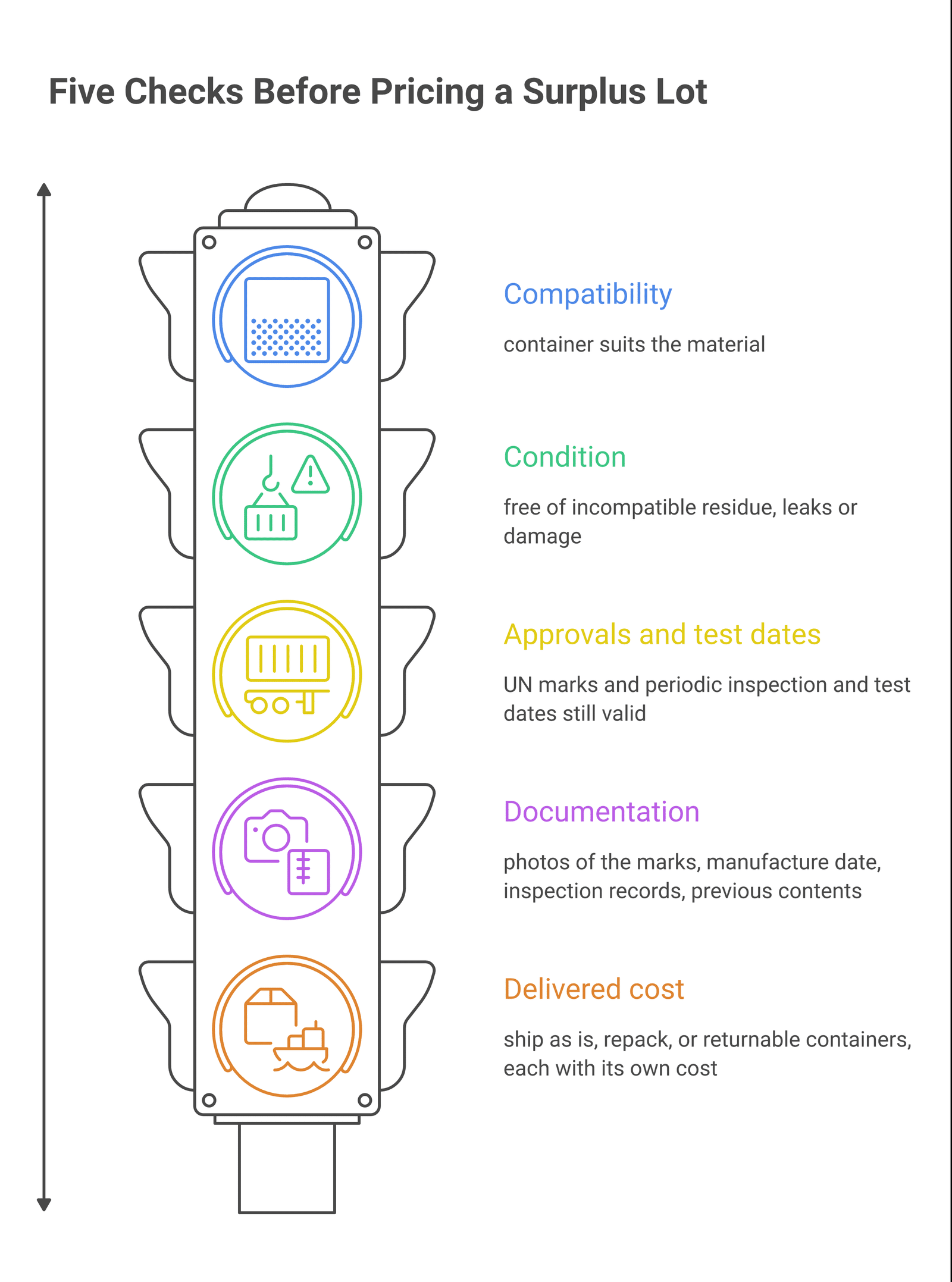
- Compatibility. The container must suit the material, and the material must not have degraded the container. U.S. rules make the person offering hazardous material for transport responsible for ensuring the packaging is compatible with its contents, naming corrosivity, permeability, softening, premature aging and embrittlement in particular. 3 A lot stored for several years in plastic deserves a closer look than one filled last quarter. So does any container whose previous contents are unknown.
- Condition. Before reuse, U.S. rules require each packaging to be inspected, and it may not be reused unless free from incompatible residue, rupture or other damage that reduces its structural integrity. 4 ADR similarly requires every IBC to be inspected before it is filled and handed over for carriage. 5 Check dents, corrosion, closures, gaskets and valves, not just whether the container leaks today.
- Approvals and test dates. For metal, rigid plastics and composite IBCs, ADR requires an inspection before first use and at intervals of no more than five years covering design-type conformity, marking, internal and external condition and service equipment, plus an inspection of external condition and service equipment at least every two and a half years. IBCs for liquids also need a leakproofness test at least every two and a half years. 5 U.S. rules set similar intervals and state that an IBC may not be filled and offered for transport until a due test or inspection has been completed. 6 Surplus stock can sit long enough for those dates to pass. For reused drums, U.S. rules add a leakproofness retest for many packagings before reuse, marked with the letter “L” and the test year, and allow metal and plastic drums to be reused only when permanently marked with their material thickness. 4
- Documentation. Ask for photographs of the UN packaging marks, the date of manufacture, the most recent inspection and test records, and the previous contents. Under ADR, the IBC owner must keep inspection and test reports at least until the next inspection or test, so they often exist if someone asks early. 5 If the lot has been repacked, batch numbers should link each new container to the original batch, the same chain of records that supports an origin review.
- Delivered cost. Decide early whether the lot ships as it is, is repacked, or moves in returnable containers. Each route has costs: new or reconditioned packaging, labour, product lost in transfers, cleaning or disposal of the old containers, and the return of empties. Empties are not automatically free of rules either. Under U.S. rules, an empty packaging containing only the residue of a hazardous material must generally be transported in the same manner as when it held a greater quantity. 7
None of these checks is new. What surplus trading changes is the starting point. A manufacturer filling new drums controls every one of them. A surplus buyer inherits decisions made years earlier by someone else, and the documents that explain those decisions do not always travel with the stock.
One lot, two delivered costs
Consider a hypothetical lot: a liquid intermediate held in IBCs in a European warehouse, offered well below the price of new material. The specification fits the buyer’s process, and a fresh certificate of analysis confirms it.
Then the packaging questions start. Some IBCs are past their two-and-a-half-year inspection date. The buyer’s site handles drums, not IBCs. The material is classified as a dangerous good for transport, so any new packaging must be approved for it. Repacking means new drums, labour, some product loss and the cleaning or return of the old IBCs, which still contain residue.
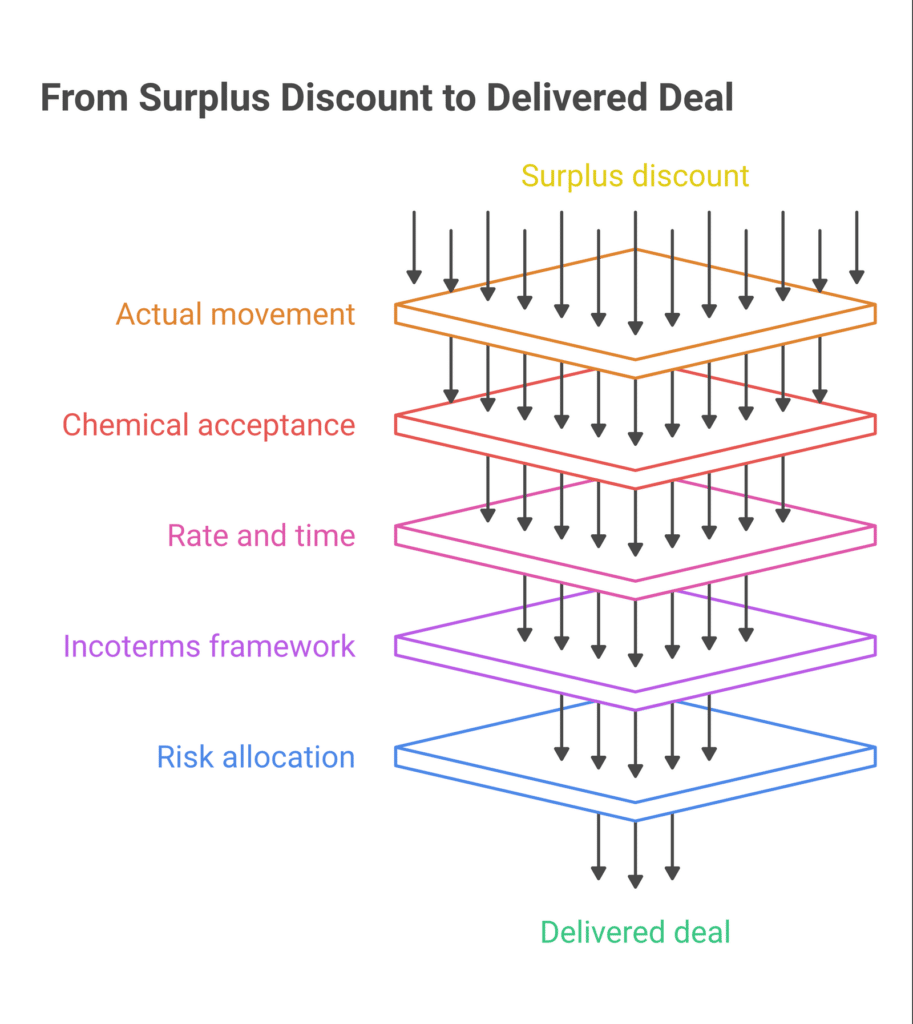
The price per tonne has not changed. The delivered cost has. In some cases the lot remains an excellent buy once these costs are included. In others, the discount is gone before the material leaves the warehouse. Either way, the right comparison is delivered cost against delivered cost, made before a price is agreed.
What applies now, and what comes later
Now, since 12 August 2026:
- PPWR applies, and its scope includes transport and industrial packaging. 1 2
- Dangerous-goods transport rules continue to decide which packaging may carry which material, and Directive 2008/68/EC prevails over PPWR where they conflict. 2
From 1 January 2030 (for some requirements, later if the implementing or delegated acts they depend on arrive late): 2
- Packaging placed on the market must meet design-for-recycling criteria.
- Plastic packaging must meet minimum recycled content targets; for plastic packaging that is neither contact-sensitive nor a single-use beverage bottle, the minimum is 35%.
- Economic operators using transport packaging such as IBCs, drums, pails and canisters within the EU must ensure at least 40% of it is reusable within a re-use system. For transport between their own sites or affiliated companies, and for deliveries to another business in the same Member State, all such packaging must be reusable within a re-use system.
- Packaging used for the transport of dangerous goods under Directive 2008/68/EC is exempt from these three requirements.
Later still: from 2038, packaging must reach a higher recyclability grade, and from 2040 the recycled content targets rise and operators are to aim for 70% reusable transport packaging. 2
Packaging belongs in the offer
For sellers, the practical step is to describe the packaging as carefully as the material: container type and size, UN marks, date of manufacture, last inspection and test dates, previous contents, condition photographs and whether the lot can ship as it is. A lot described that way is easier to price and quicker to move through qualification.
For buyers, it means asking about the container in the same conversation as the specification, agreeing who pays for any repacking or return, and comparing delivered cost rather than price per tonne. A lot is ready to trade only when both the material and its packaging have answers.
Packaging and dangerous-goods obligations depend on the material, the jurisdiction, the mode of transport and the facts of each case. This article is general information, not legal or transport-compliance advice. Classification and packaging decisions for dangerous goods should be made by a qualified dangerous goods safety adviser or equivalent specialist.
Manufacturers and distributors holding surplus chemical inventory can contact Surplus International to discuss a potential outlet and the information needed to assess the lot and its packaging.
Frequently asked questions
Did PPWR make reusable drums and IBCs mandatory in August 2026?
No. PPWR has applied since 12 August 2026, but its reuse targets for transport packaging, including drums and IBCs, start on 1 January 2030. Packaging used to transport dangerous goods under Directive 2008/68/EC is exempt from those targets.
Is packaging for dangerous goods exempt from PPWR?
Only from specific requirements. PPWR exempts it from the recyclability requirements, the plastic recycled content targets and the transport packaging reuse obligations. The packaging remains within the Regulation’s scope, and dangerous-goods transport rules continue to apply in full.
Can a used IBC be refilled if it looks intact?
Not on appearance alone. It needs to be compatible with the new contents, inspected, within its periodic inspection and test dates, and correctly marked. For dangerous goods, the applicable transport rules decide whether it may be filled and shipped.