By Shai Tsarfati, Co-Founder and CEO of Surplus International
A chemical manufacturer can have a sound reason to keep inventory. A confirmed production requirement, a customer commitment or a documented supply-continuity need may justify holding material.
Waiting for the entire chemical market to recover is a different proposition.
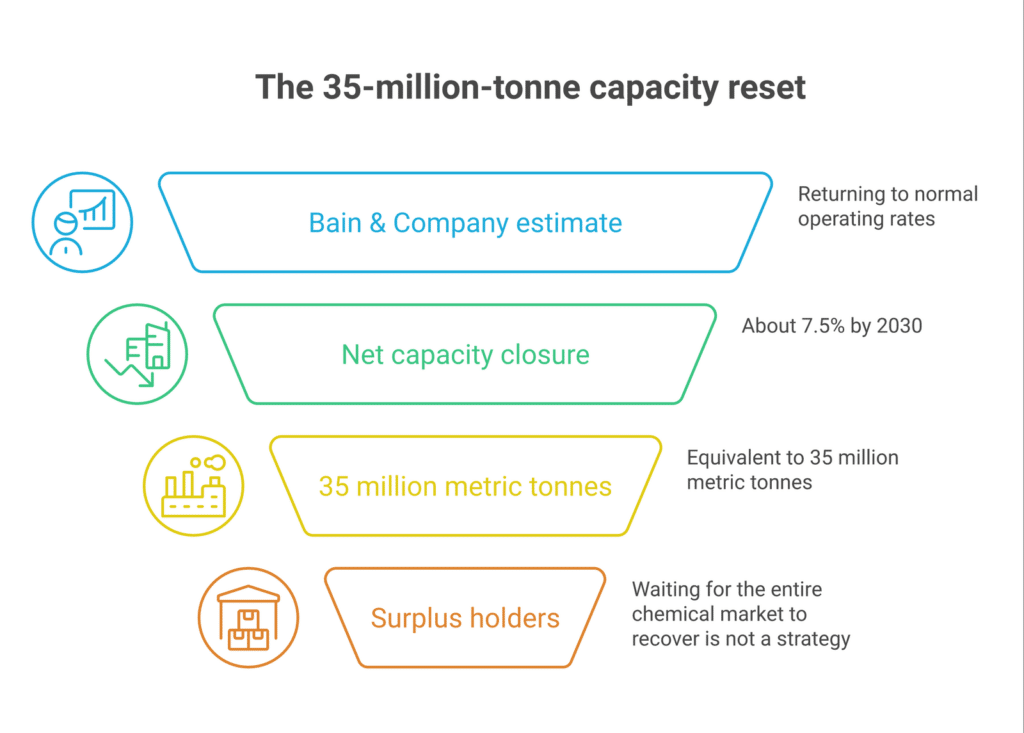
On 19 October 2026, Bain & Company estimated that returning to normal operating rates would likely require the net closure of about 7.5% of global olefin production capacity by 2030, equivalent to 35 million metric tonnes. Its analysis projects utilization below historical averages through 2030 and concludes that baseline demand growth will not close the gap. 1
For businesses holding surplus chemicals, this is not a forecast of what their stock will fetch. It is a reason to question whether a hoped-for recovery is doing too much work in their inventory decisions.
What the 35-million-tonne estimate actually means
Bain is discussing olefin production capacity, including the building blocks used across many chemical value chains. The figure is not a measurement of surplus chemicals in warehouses. It is an estimate of the net capacity reduction likely needed, not an announcement that those closures will happen. It also cannot be applied uniformly to every solvent, additive, resin or specialty formulation. 1
The underlying argument is nevertheless important: an industry can announce significant plant closures and still face excess capacity if additions elsewhere outpace those reductions. Bain identifies that imbalance between closures in established producing regions and continuing Chinese capacity additions. 1
Other recent evidence also points to an uneven market rather than a broad recovery. Cefic’s 5 October report says EU27 chemical production fell 2.0% in January to July 2026 against the same period in 2025. It identifies greater pressure in upstream segments, while parts of specialty and consumer chemicals were more resilient. Those are European observations, not a measure of North American inventories. 2
My conclusion for surplus management is narrower than either industry report: a business should not assume that a general recovery will restore the original commercial role of every lot it owns.
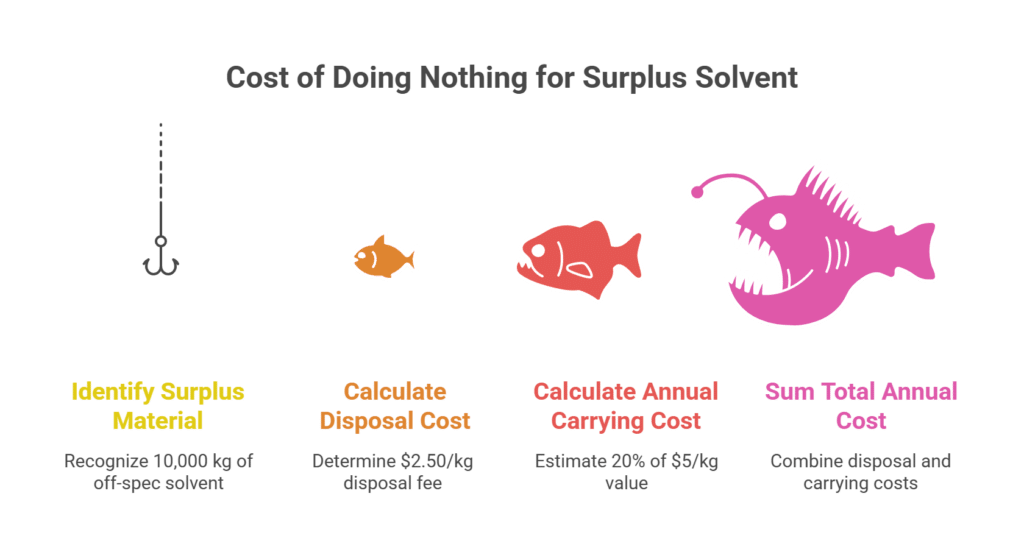
Holding surplus is a decision with a cost
A better selling price later is possible. The useful question is whether that improvement would outweigh the cost and risk of waiting.
For an individual lot, relevant costs may include storage, insurance and financing. Depending on the material and its condition, waiting may also introduce further testing, packaging or handling requirements. These should be assessed specifically, not assumed to apply equally to all chemicals.
The comparison should start with credible options. What net proceeds could a qualified sale generate now? What realistic internal use or external sale is expected later? What additional costs would arise before that later outcome, and what happens if the expected demand fails to appear?
An old purchase price does not answer those questions. Nor does an optimistic target price without a buyer, a time horizon or a clear basis.
Holding can still be the right decision. But it should be justified by the material’s expected role and economics, not simply by reluctance to accept that its original purpose has changed.
Replace “wait and see” with a defined hold decision
The alternative to passive holding is not immediate liquidation. It is an explicit decision that can be revisited.
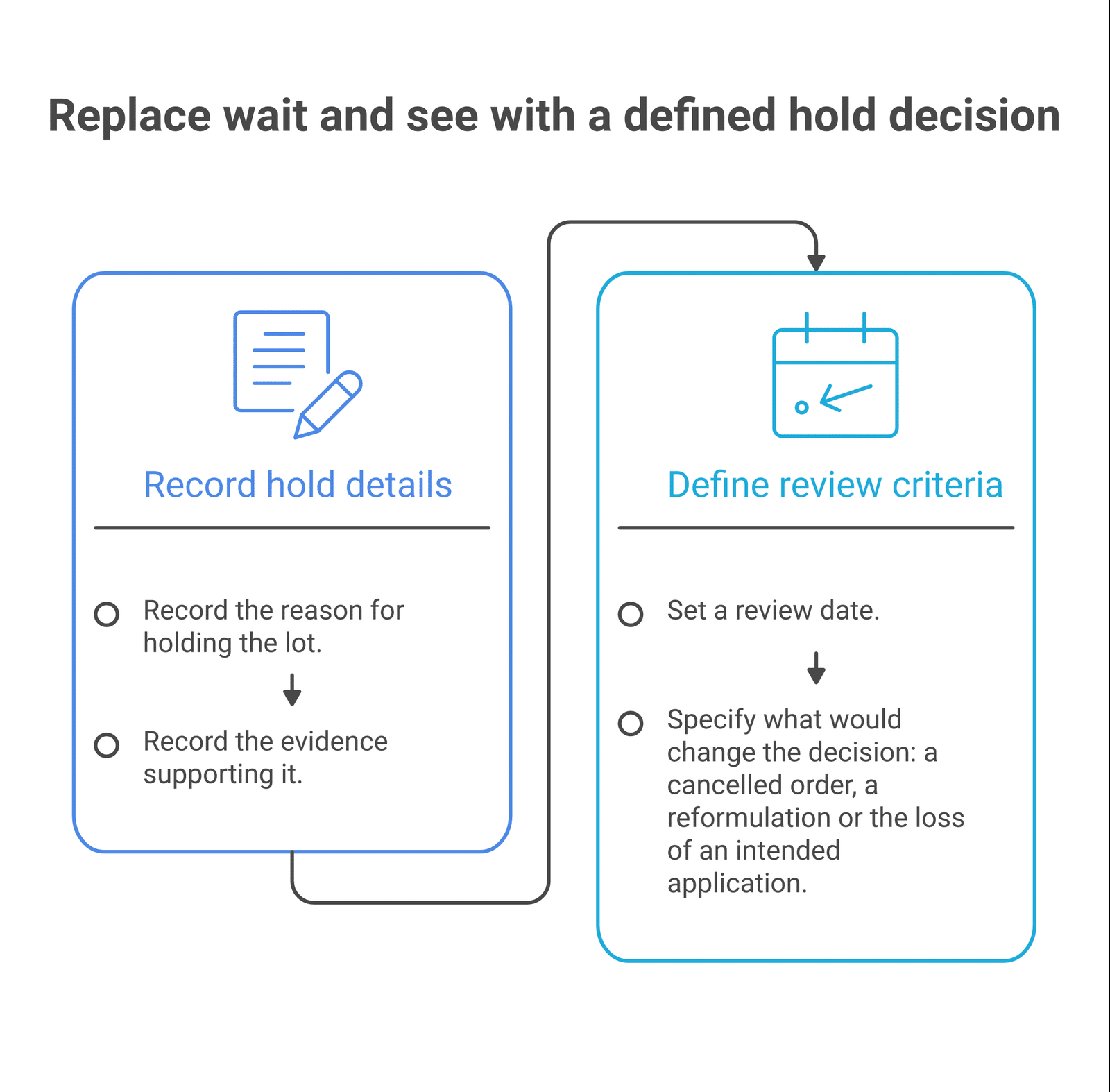
Where a business retains non-core stock, I would ask the person responsible to record the reason, the evidence supporting it and a review date. A production forecast should identify a plausible requirement. A prospective sale should be distinguished from a customer commitment. A continuity reserve should be linked to an actual supply risk.
The review should also specify what would change the decision. A cancelled order, a reformulation or the loss of an intended application may matter more than another month passing on a warehouse report.
For illustration, consider a raw material retained after a formulation change. A confirmed, technically approved use in another product may justify keeping it. A vague possibility that the old formulation will return does not provide the same basis. The material may be identical in both cases; the quality of the commercial evidence is not.
This discipline does not require anyone to predict the industry’s turning point. It requires the business to state what it believes about its own stock and when that belief will be tested.
Start before portfolio changes create urgency
Bain’s analysis also calls for companies to reconsider where they compete and to exit or consolidate positions without a credible path to advantage. Those are strategic recommendations, not evidence that any named company has surplus stock available. 1
The inventory implication is worth considering early. A product withdrawal, line conversion or portfolio change can alter which materials a business needs. A planning discussion should therefore include the stock affected by the proposed decision, rather than leave it until operations have already changed.
For North American manufacturers, this remains relevant even where production economics are favorable. Bain identifies a structural advantage for ethane-based production in the United States and Middle East. That regional advantage does not establish a future use or customer for every non-core lot held by a manufacturer or distributor. 1
Early review preserves time to assess internal redeployment or a possible external use. It does not guarantee either outcome, but it can make the decision less dependent on a rushed clearance deadline.
Secondary-market demand must be real, not assumed
Surplus trade is one possible response to a mismatch between an owner’s inventory and its future requirements. It is not a solution to global overcapacity.
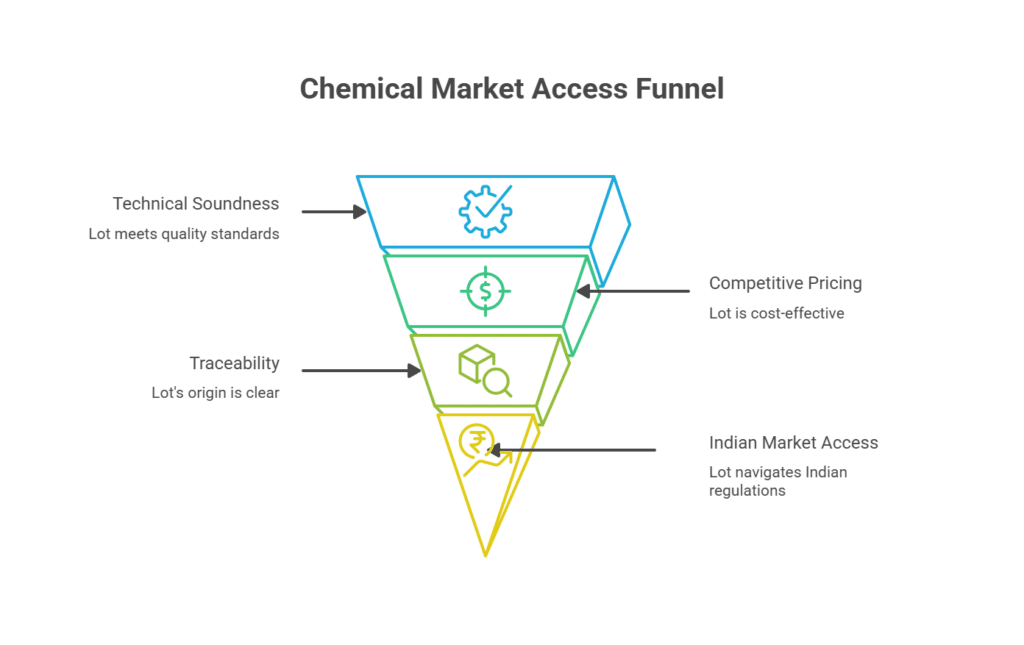
A seller needs a credible route for the specific material. A buyer needs a legitimate production requirement. This applies to Indian industrial buyers as much as to buyers elsewhere: an attractive offer should not create an inventory problem at the receiving end.
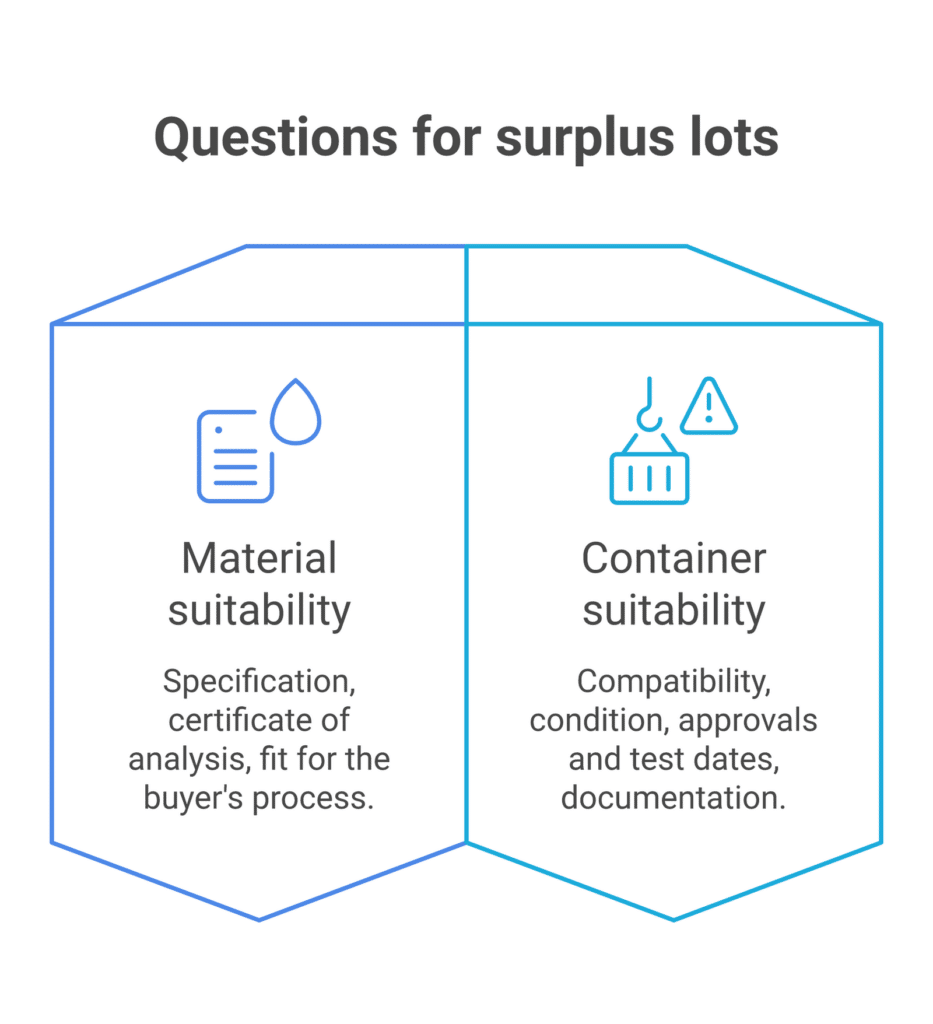
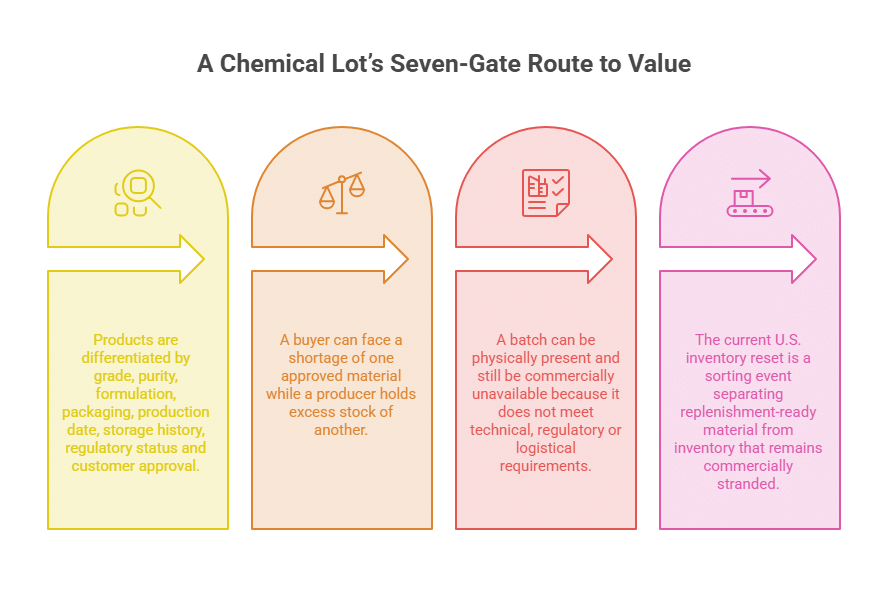
Technical suitability, safety, remaining usable life and lawful market access remain essential. We examined those transaction-level questions in our earlier article on a chemical lot’s seven-gate route to value. The question here comes earlier: has management made a deliberate decision about whether to keep holding the material?
Some lots should remain in stock. Others may have a qualified secondary-market use. Material without a defensible use needs an appropriate, compliant route; calling it surplus does not change its legal status.
The chemical industry’s adjustment may take years. Businesses do not have to wait years to decide why they are holding a particular lot.
If your business is retaining non-core chemical inventory without a defined use or review date, contact Surplus International to discuss whether a qualified secondary-market opportunity may exist.