

Preliminary U.S. Census Bureau data adds another layer. In July, chemical materials-and-supplies inventories decreased by 0.7% from June. Chemical work-in-process inventory increased by 0.5%, while finished-goods inventory rose by 0.3%. Total chemical inventory was therefore broadly flat, even though its composition changed.2
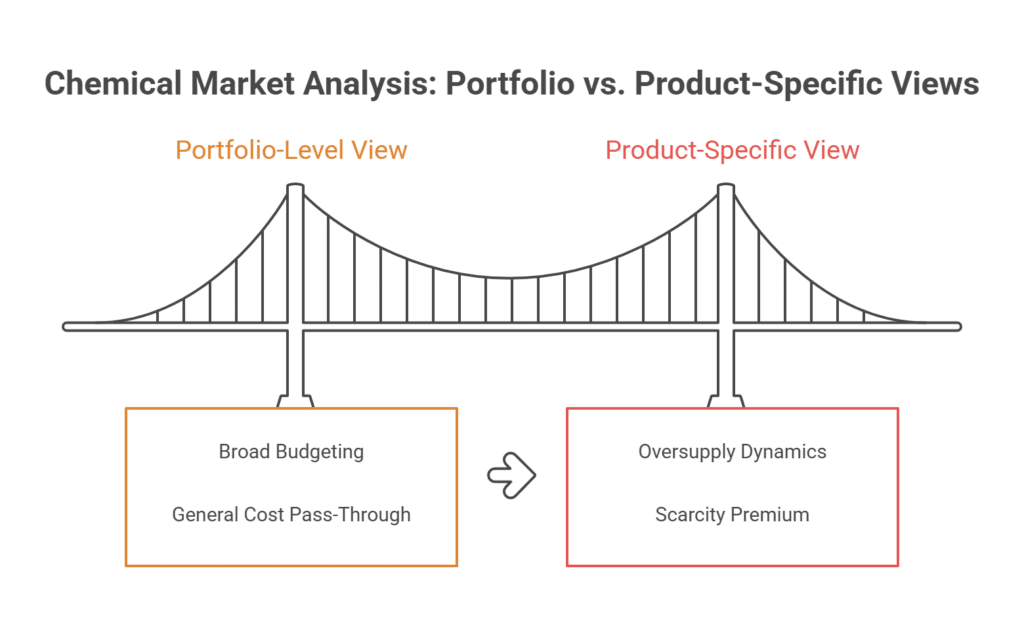
This is not a contradiction. It is a reminder that the chemical industry does not have one inventory.
It has thousands of products differentiated by grade, purity, formulation, packaging, production date, storage history, regulatory status and customer approval. A buyer can face a shortage of one approved material while a producer holds excess stock of another. A batch can be physically present and still be commercially unavailable because it does not meet the next user’s technical, regulatory or logistical requirements.
The current U.S. inventory reset is therefore not a blanket shortage call. It is a sorting event. It is separating replenishment-ready material from inventory that remains commercially stranded.
Availability Is Not the Same as Supply
A warehouse quantity becomes meaningful supply only when a real buyer can use it safely, lawfully and economically.
This distinction matters for both sides of the surplus market. A North American manufacturer may see an ageing or discontinued lot as tied-up working capital. An Indian buyer may see an opportunity to secure a useful raw material at an attractive price. Both views can be correct, but only if the material survives a disciplined qualification process.
A low price cannot compensate for the wrong grade. A valid certificate of analysis cannot compensate for insufficient remaining usable life. A technically suitable product cannot create value if freight, duties, port delays or hazardous-goods restrictions make the delivered cost uncompetitive.
The key question is therefore not, “Is the material available?”
It is, “Can this exact lot become usable supply for this exact buyer?”
The Seven Gates Between Surplus and Value
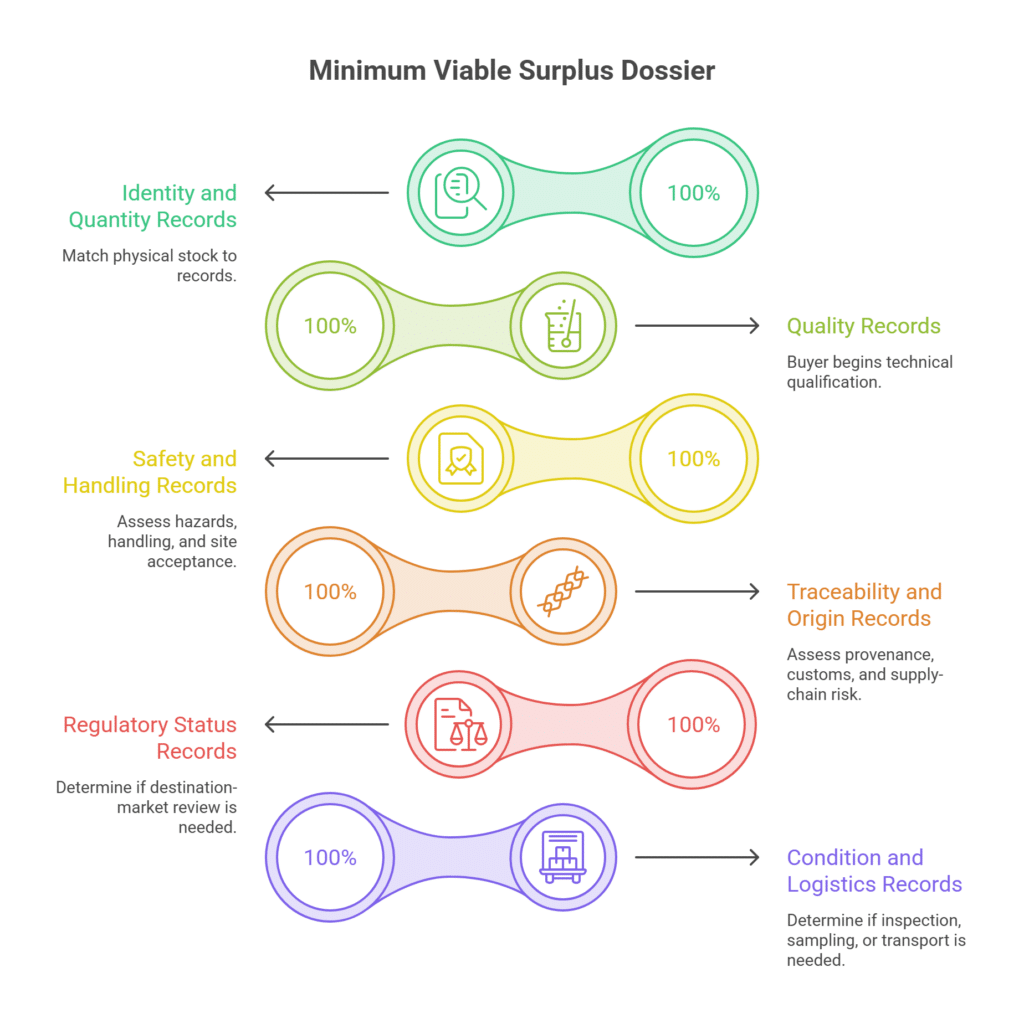
At Surplus International, we use the following seven-gate commercial due-diligence framework before presenting a lot as a credible supply option. It does not replace product-specific technical, environmental, health and safety, legal or regulatory review.
| Gate | What must be established | Why it affects value |
|---|---|---|
| 1. Identity and quantity | Exact product identity, grade, Chemical Abstracts Service (CAS) number where applicable, batch or lot numbers, available quantity and physical location. | A generic product name can hide material differences. Buyers need to know exactly what is being offered and whether the volume suits their operation. |
| 2. Specification and analysis | Current specification, batch-linked certificate of analysis, test methods, known deviations and any relevant impurity or performance data. | “On-spec” only has meaning against a defined specification. An acceptable deviation in one application may be unacceptable in another. |
| 3. Remaining usable life | Manufacturing date, retest or expiry date, stability basis and enough remaining life for booking, transit, clearance, testing and consumption. | A material can be usable at origin but commercially impractical if too much of its remaining life is consumed before the buyer can process it. |
| 4. Storage and packaging condition | Storage history, temperature excursions where relevant, packaging type, seal and container condition, and compatibility with onward transport. | Product quality and safety depend on how the material has been stored and whether its packaging remains fit for movement and use. |
| 5. Safety and regulatory status | Current safety data sheet, dangerous-goods classification, origin, chain of custody, destination-country requirements and product-versus-waste status. | A saleable product must have a legitimate use and a lawful route. Surplus trade must never become disposal by export. |
| 6. Buyer and application qualification | Intended end use, customer specification, sample or trial requirements, approved-manufacturer constraints and technical acceptance criteria. | Chemical equivalence cannot be assumed from a product label. The buyer’s application determines whether the material is genuinely fit for purpose. |
| 7. Delivered economics | Freight, insurance, duties, port and storage costs, testing, financing, expected delays and the seller’s net recovery. | The relevant number is not the ex-works price. It is the buyer’s delivered usable cost and the seller’s qualification-adjusted netback. |
A lot that clears these gates may function as replenishment inventory, bridge supply or an approved lower-cost alternative. A lot that fails them may require reprocessing, return to the producer or compliant waste management. The responsible outcome is not always a sale.
What the Reset Means for North American Sellers
The latest inventory signals do not justify discounting every lot in a warehouse. They support better segmentation.
Manufacturers should first identify material that is in specification, fully traceable, adequately dated and compatible with a known application. These lots may deserve targeted outreach to existing domestic customers with low stocks, or to qualified international buyers seeking supply diversity.
The offer should include an evidence package rather than only a product name and price. At minimum, that package should establish the batch, specification, certificate of analysis, manufacturing or retest date, storage history, packaging, quantity, location and applicable safety information.
Sellers should separately classify wrong-grade, short-dated, unsupported, returned, reworked or genuinely off-spec inventory. Such material may have a lawful, technically approved use only after transparent disclosure and application-specific qualification. Otherwise, it requires an appropriate reprocessing, return or compliant waste-management route. A macro story about low inventory does not turn it into standard replenishment stock.
This discipline also improves pricing. A buyer-ready lot with sufficient remaining life and a clear logistics route should not be valued like unidentified residual material. Conversely, a nominally high market price does not rescue a lot whose qualification, freight or compliance costs consume its economic value.
What the Reset Means for Indian Buyers
For Indian buyers, the U.S. data may indicate a selective sourcing opportunity. It does not prove that abundant, low-cost chemical inventory is waiting for export.
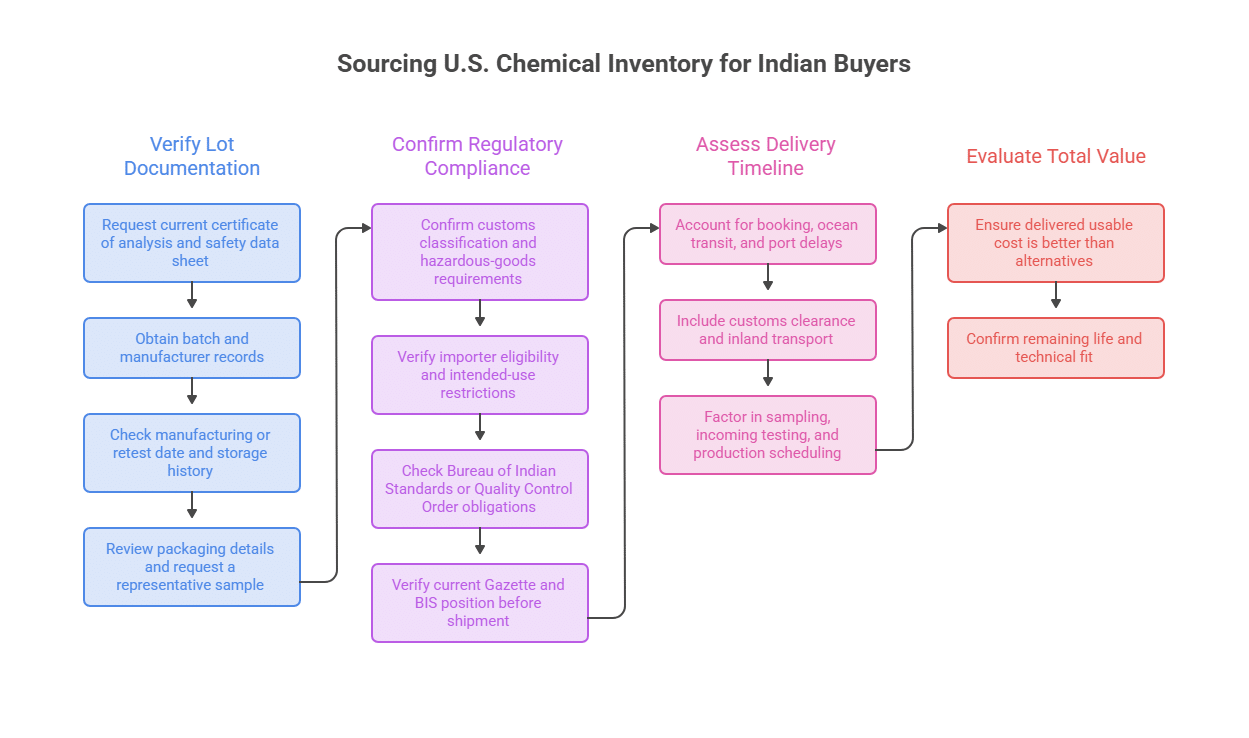
The most credible opportunities will be manufacturer-traceable lots that meet a defined application and remain usable after the full delivery timeline. That timeline must include booking, ocean transit, potential port delays, customs clearance, inland transport, sampling, incoming testing and production scheduling.
Buyers should request the current certificate of analysis and safety data sheet, batch and manufacturer records, manufacturing or retest date, storage history, packaging details and a representative sample where appropriate. They should also confirm the customs classification, hazardous-goods requirements, importer eligibility, intended-use restrictions and any applicable Bureau of Indian Standards or Quality Control Order obligations before shipment.
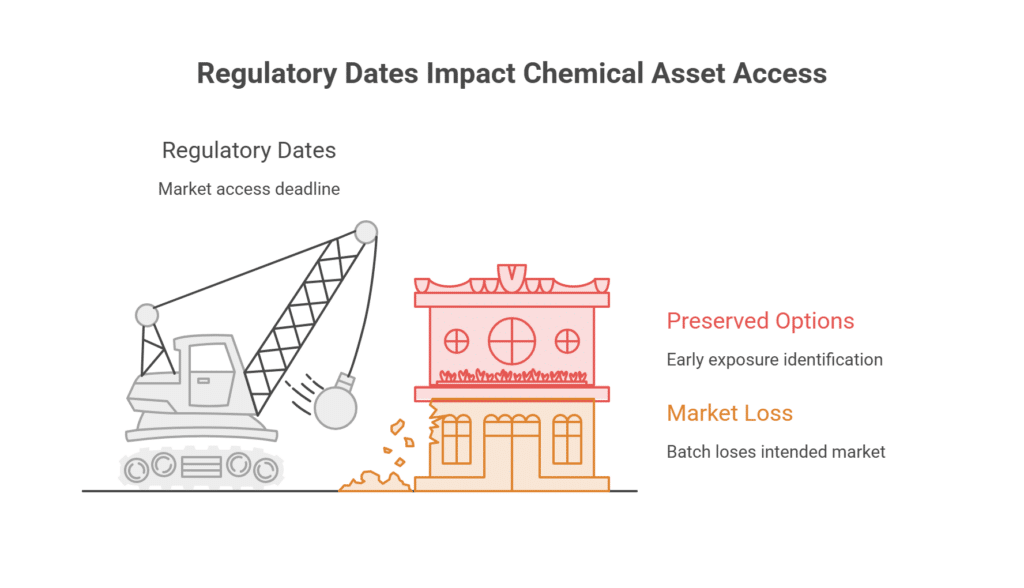
This destination-specific review is essential. For example, the Bureau of Indian Standards’ 4 August advance-information list showed Linear Alkyl Benzene, IS 12795:2020, with an indicated 30 September 2026 enforcement date.3 That listing is not a clearance determination. Before shipment, the parties must verify the current Gazette and BIS position, exact product scope and expected clearance-date requirements for the cargo.
The discount is therefore not the opportunity by itself. The opportunity is a documented lot whose delivered usable cost, remaining life and technical fit are better than the buyer’s available alternatives.
Why Better Qualification Supports Circularity
Surplus trade is often discussed as an environmental solution. It can be one—but only when the material remains a legitimate product and a qualified user can apply it responsibly.
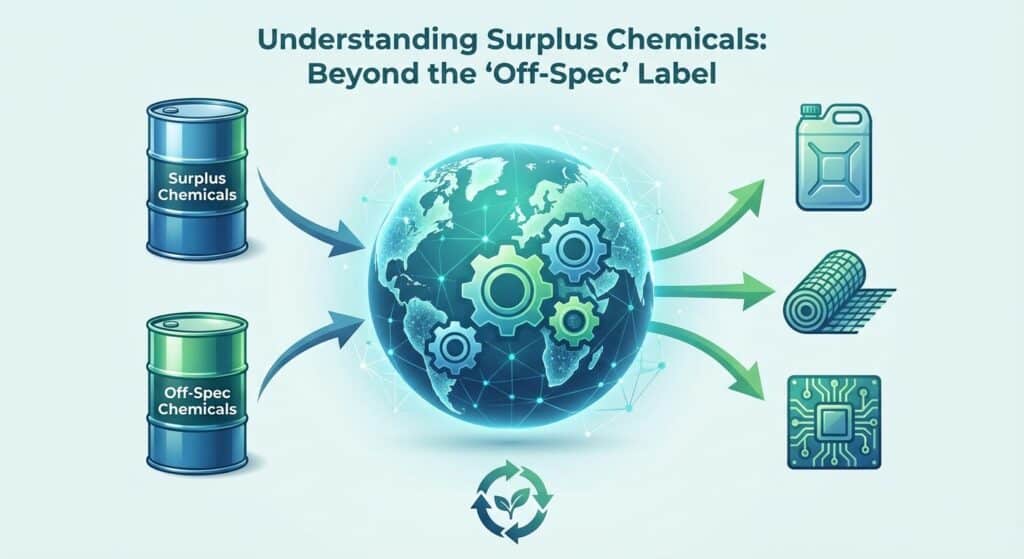
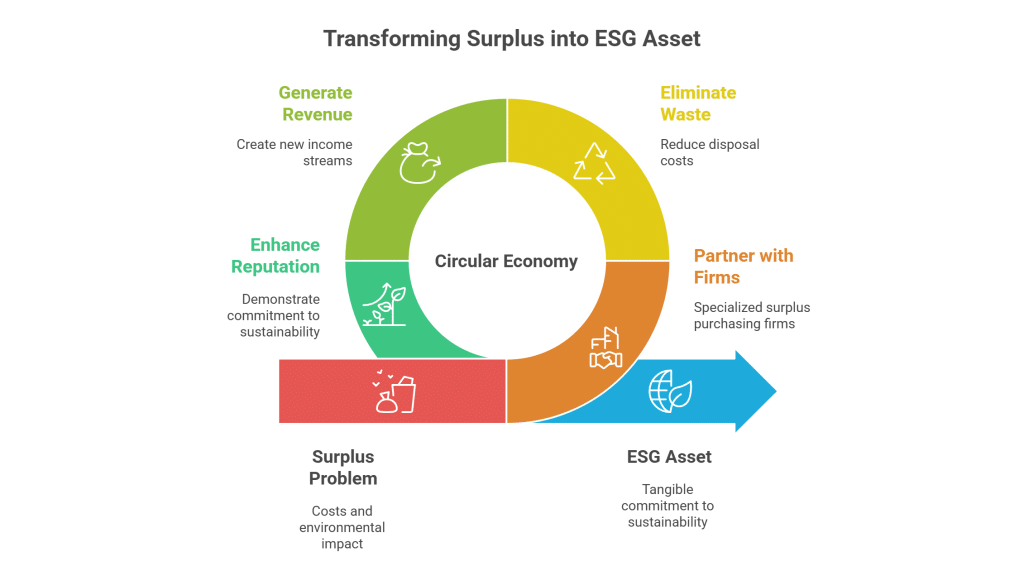
Where a lot remains a legitimate product, reaches a qualified user and displaces an equivalent new purchase, direct reuse can avoid disposal of usable material and may reduce demand for replacement production. It can also release warehouse capacity and recover working capital for the original holder. However, these benefits depend on honest classification. “Surplus,” “off-spec,” “expired,” “retest,” “reworked,” “product” and “waste” are not interchangeable terms.
Responsible circularity begins with evidence. A batch-linked analytical record, storage history, known end use and lawful logistics route are not administrative details. They are what distinguish useful secondary supply from an unacceptable transfer of risk.
This is also why better qualification can increase market value. Buyers do not pay only for molecules. They pay for confidence that those molecules will perform, comply and arrive in usable condition.
The Market Is Sorting Lots, Not Labels
The August and July data should not be read as proof of a universal chemical shortage. The Institute for Supply Management measures the breadth of respondent experience rather than physical tonnage, and Census inventory values are preliminary, revisable and not adjusted for price changes.1 2
The more useful conclusion is operational.
Lower customer stocks can increase the value of material that fits an approved need. Softer orders and higher finished-goods inventory can simultaneously create excess elsewhere in the chain. Both conditions can exist in the same industry, the same product family and even the same company.
The winners in this reset will not be those who treat every available lot as equivalent. They will be those who identify the precise gap between what a seller holds and what a buyer can actually use.
At Surplus International, our role is to bring lot-level discipline to that gap: documentation, qualification, compliance and delivered economics must support the proposed match between seller and buyer.
The premium does not belong to every lot sitting in a warehouse. It belongs to inventory that is qualified, documented and deliverable.
If your company holds excess, discontinued, ageing or off-spec chemical inventory, Surplus International can help determine whether it has a lawful, application-specific reuse or reprocessing route- or requires another responsible disposition. If you are seeking a qualified alternative supply, begin with the evidence needed to match the material to your technical, regulatory and logistical requirements.
Contact Surplus International to start with the evidence behind the lot- not just the name on the drum.
References
ISM Manufacturing PMI Report, August 2026
[2] U.S. Census Bureau M3 Preliminary Table 6p, July 2026 Manufacturing Inventories
[3] Bureau of Indian Standards: Upcoming Quality Control Orders Notified and Due for Implementation