
On 20 July 2026, the European Commission’s Digital Product Passport Registry became operational. The event was not a chemical regulation, but it still matters to the chemical industry. It marked the transition of the Digital Product Passport, or DPP, from policy architecture to functioning infrastructure.1
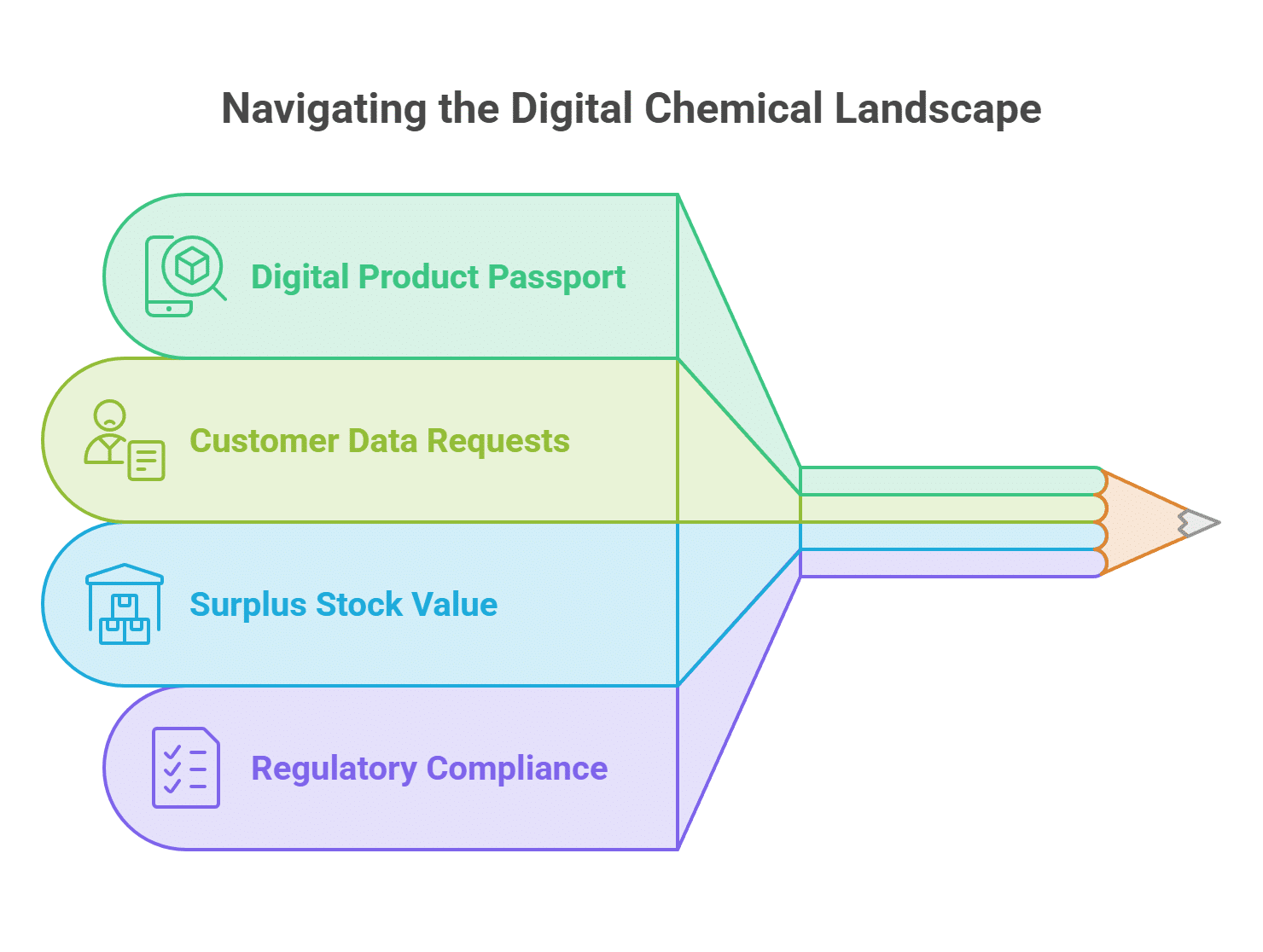
The DPP is a digital container for product information that can support transparency, circularity and compliance. Its legal basis is the Ecodesign for Sustainable Products Regulation, Regulation (EU) 2024/1781, while specific obligations come through delegated acts or other EU laws.1 3
For companies managing surplus chemicals, the important question is not, “When will every chemical need a passport?” It is, “What information will a buyer need before it can qualify this batch?”
First, Correct the Deadline Misconception
There is no general mandatory 2029 DPP deadline for chemicals. The Commission’s indicative rollout begins with certain batteries from 18 February 2027 and points to product-specific work for iron and steel, textiles, tyres, aluminium, furniture and mattresses. ESPR delegated acts are expected to provide at least 18 months for transition.1
A forecast should not be presented as an enacted duty. Chemical companies should prepare for stronger data expectations without inventing a deadline.
The practical pressure is arriving through customers instead.
Data Requirements Travel Upstream
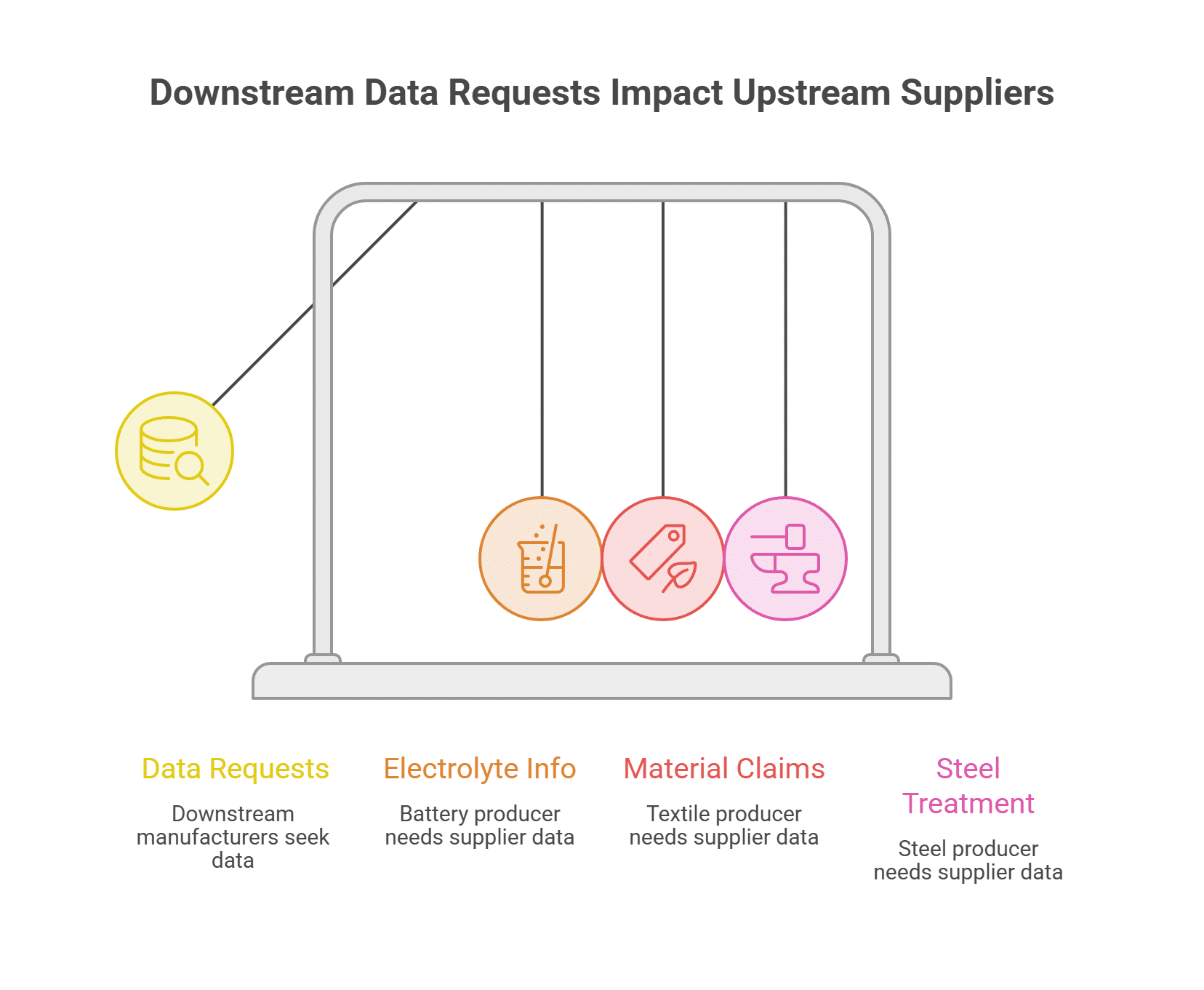
A battery producer cannot document its product without information from the companies supplying electrolytes, binders, additives, coatings and processing materials. A textile producer cannot substantiate material and environmental claims without data from dye, pigment and finishing-chemical suppliers. The same pattern applies to steel treatment, aluminium finishing, tyre compounding, furniture coatings and construction products.
Exact requests will depend on the legislation, product and customer programme, but many downstream manufacturers will seek more structured and auditable supplier data.
Cefic and the European Association of Chemical Distributors have already identified interoperability, standard templates, data assurance, accessibility for smaller companies and a phased implementation timetable as central issues for the chemical value chain.2 Their discussion is not a chemical DPP mandate, but it shows that the industry is preparing for a different information environment.
For prime material moving through a current supply agreement, responding to a new data request may be manageable. The producer, quality team and enterprise systems are still available. For surplus inventory, the situation is different. The material may have been manufactured years earlier, stored at a site scheduled for closure, transferred during an acquisition, or disconnected from the system in which its original records were created.
That is where documentation becomes a commercial asset.
The Batch and the Dossier Are One Saleable Unit
In secondary trade, physical condition is only one part of qualification. A prospective buyer also needs to establish what the material is, whether it conforms to the specification required for the proposed use, how it has been stored, which hazards apply, and whether it may legally be imported and used in the destination market.
A clear label is not enough. A Safety Data Sheet is not a Certificate of Analysis. Neither document, by itself, is a dangerous-goods transport document or proof that a specific application is permitted. Each record answers a different question.
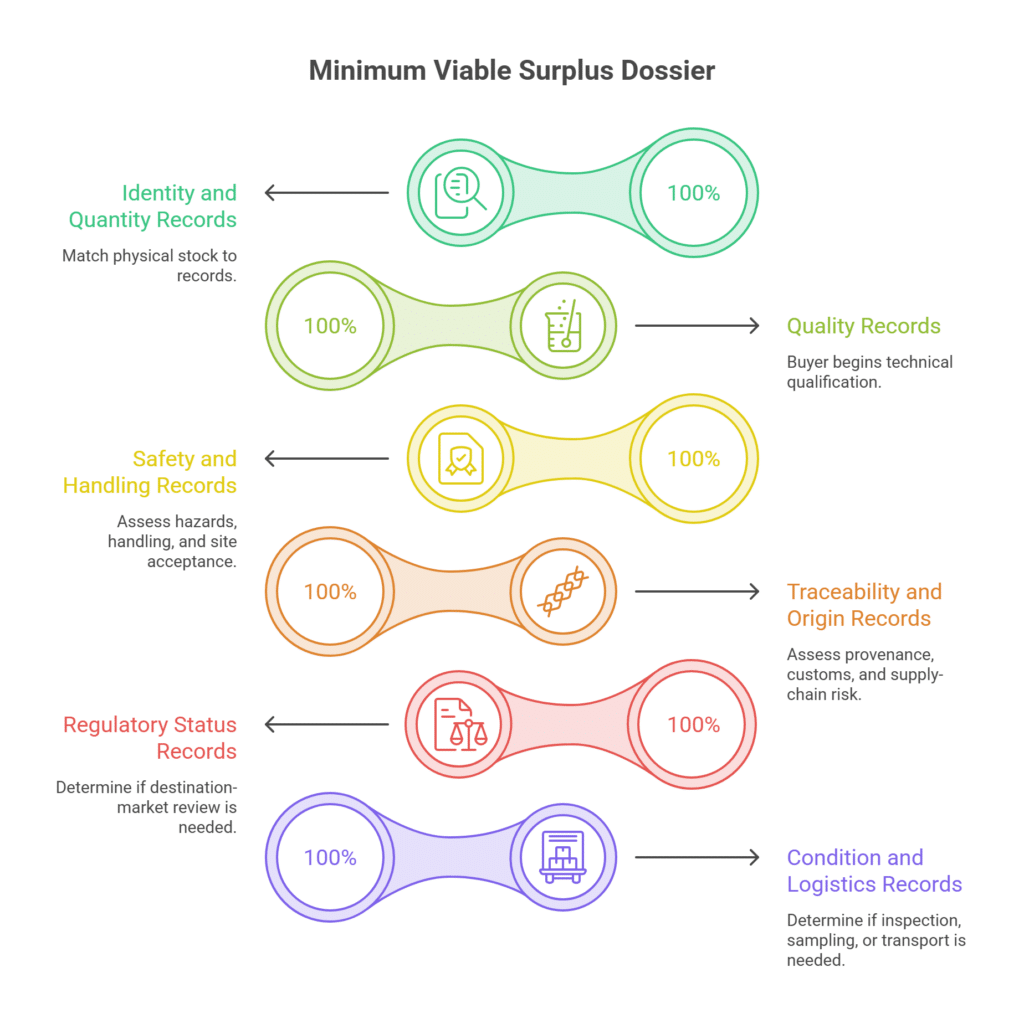
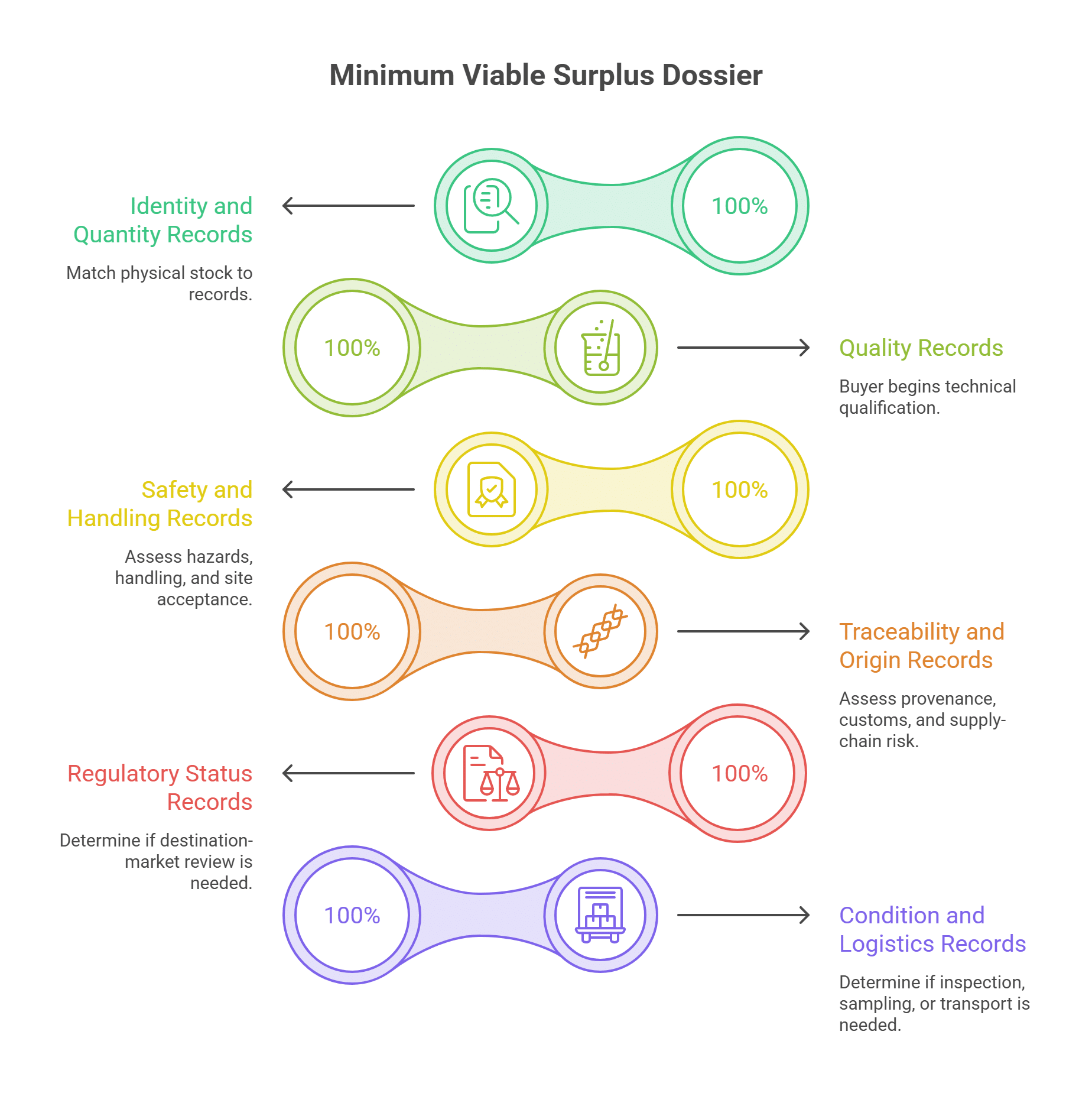
At Sur+, we use the idea of a minimum viable surplus dossier as a practical commercial checklist. It is not a statutory list and it does not replace a seller’s, buyer’s, carrier’s or regulatory professional’s responsibilities.
| Information group | Practical records to preserve | Commercial question it helps answer | Important limitation |
|---|---|---|---|
| Identity and quantity | Product name, manufacturer, grade, batch or lot number, container count and net weight | Can the physical stock be matched unambiguously to its records? | A trade name alone may not establish composition or equivalence. |
| Quality | Batch-specific COA, applicable specification, test methods, manufacture date, retest or expiry information where relevant | Can the buyer begin technical qualification for its intended process? | A COA does not guarantee suitability for a different application. |
| Safety and handling | Current SDS, classification information, packaging details and available storage history | Can the parties assess hazards, handling and site-acceptance requirements? | An SDS alone is not a shipment approval or complete transport file. |
| Traceability and origin | Producer and site information, country of origin, purchase records and chain-of-custody documents available to the seller | Can the buyer assess provenance, customs treatment and supply-chain risk? | Origin and preferential-origin determinations require specific evidence. |
| Regulatory status | Available REACH or other market-status information, restriction screening and intended-use information | Is further destination-market review required before a transaction proceeds? | Status can depend on importer, tonnage, use and jurisdiction. |
| Condition and logistics | Photographs, seal status, packaging condition, storage location and handling constraints | Is inspection, sampling, repacking or specialist transport likely to be needed? | Visual condition does not establish chemical quality. |
The stronger the link between the physical batch and this dossier, the easier it is for a prospective buyer to perform due diligence. If that link is broken, even usable material may become too expensive or too uncertain to qualify.
Why Surplus Records Disappear
Documentation loss rarely happens in one dramatic event. It usually occurs through ordinary organisational change.
Historical attachments may be left behind during a system migration. A specialist may leave after a product is discontinued. Inventory and quality records may move to different owners during a sale. Partly used lots may be consolidated under a generic description. Each event weakens the link between batch and evidence.
None of these events necessarily changes the chemical. They change the cost and confidence of proving what the chemical is.
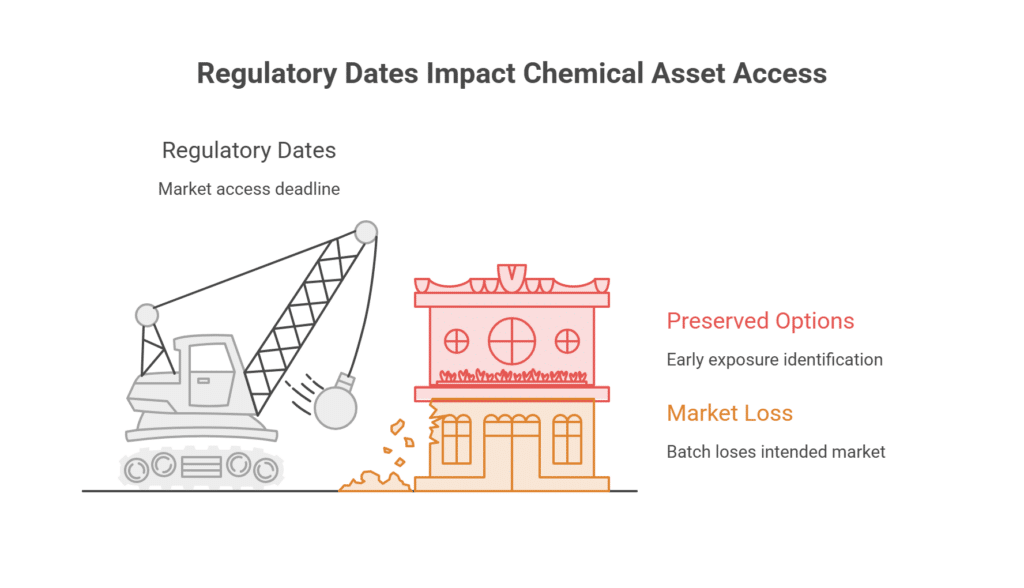
This is why documentation preservation must begin when stock first becomes slow-moving, not after a disposal decision has been made. Waiting compresses the time available for inspection, sampling, buyer qualification, regulatory review and compliant logistics.
A New Value Split Is Emerging
The DPP will not make undocumented chemical inventory illegal by itself. The more immediate effect is economic. Markets increasingly reward material that can move through a buyer’s qualification and governance process with less uncertainty.
Fully linked records do not guarantee a sale, but they expand the set of buyers able to consider the stock. Incomplete records do the opposite. They may limit the material to lower-value applications, require additional testing, prevent acceptance at a regulated site or make disposal the only responsible option.
For sellers, this creates a preventable form of depreciation. The company may have paid to manufacture or purchase the material, paid to store it, and maintained its physical condition, only to lose recoverable value because the associated data was not retained.
For buyers, better documentation does not remove the need for qualification. It makes qualification possible. Buyers in India and other global markets still need to verify specification, importability, local registration or use requirements, shelf-life expectations and process suitability. A well-organised dossier gives their technical and regulatory teams a credible starting point.
What Each Party Should Do Now
Sellers should connect slow-moving inventory reviews with quality and regulatory records. When a batch is flagged as excess, the company should immediately preserve its batch identity, COA, governing specification, current SDS, storage history and available origin documentation. It should also prevent physical relabelling or consolidation from breaking traceability.
Buyers should define minimum information requirements before reviewing opportunities. A clear checklist reduces wasted time and helps distinguish a potentially useful secondary batch from material that cannot enter the qualification process.
Intermediaries should organise information, identify gaps and route enquiries to appropriate buyers. A responsible intermediary does not certify legal compliance, rewrite a manufacturer’s documents, guarantee reuse or decide technical suitability on the buyer’s behalf. Its role is to improve matching and transparency while the responsible parties complete their own reviews.
A practical 90-day programme can be simple. Select the oldest or highest-value slow-moving inventories. Confirm that each physical batch links to a digital record. Recover missing documents while the original teams and systems are still accessible. Classify gaps by whether they can be resolved through records, inspection or legitimate testing. Then decide whether to retain, redistribute, reprocess or dispose of the material through the appropriate route.
Documentation Is Part of Circularity
Circularity is often described as a physical challenge: how to keep molecules and materials in productive use. It is equally an information challenge.
A buyer cannot responsibly reuse what it cannot identify. A carrier cannot safely move what is not correctly classified and documented. A regulator cannot accept a claim that cannot be substantiated. Product data therefore helps preserve the option to reuse material, even before a formal passport requirement reaches the chemical itself.
The DPP Registry going live should be treated as a signal, not as a reason to invent a chemical deadline. The signal is that structured product information will matter more across industrial value chains. For surplus chemicals, that future begins with a very practical task today: keep the batch and its dossier together.
If your company is reviewing slow-moving or surplus inventory, Sur+ can help organise the information needed to present suitable material to qualified buyers. The earlier the review begins, the more options the responsible parties can evaluate, where permitted, technically suitable and fully documented.
References
- European Commission, “Digital Product Passport,” current page and indicative implementation timeline.
- Cefic and FECC, “Unpacking the Digital Product Passport for the Chemical Industry: New paper is out,” 8 December 2025.
- EUR-Lex, Regulation (EU) 2024/1781 establishing a framework for setting ecodesign requirements for sustainable products, 13 June 2024.