
A chemical batch does not need to degrade to lose value.
It can retain its appearance, composition and batch-test results while a new classification, labelling duty or use restriction changes whether it can be placed on the market for its original purpose. For companies holding slow-moving material, this creates a second kind of shelf life.
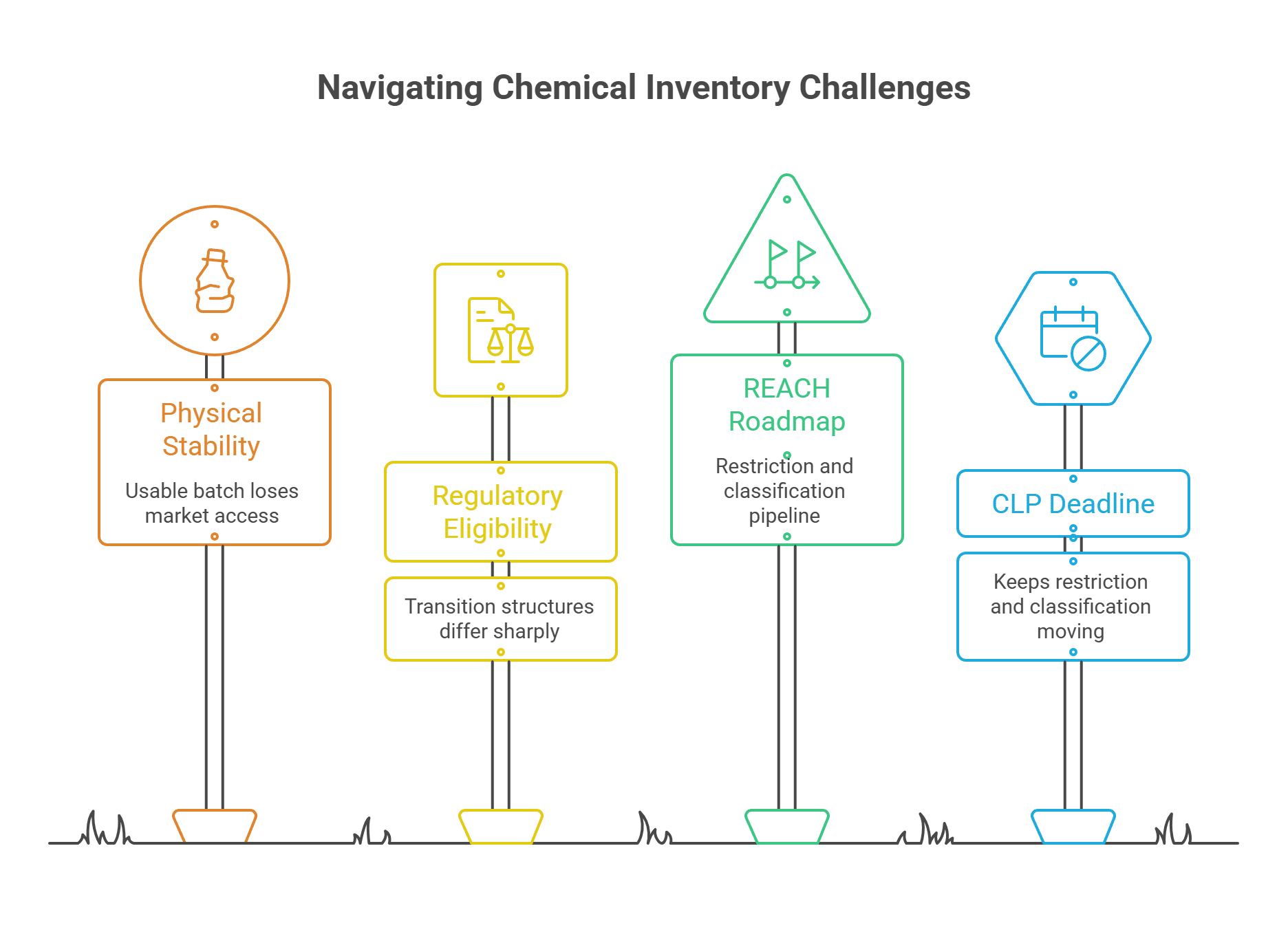
The first clock is familiar: physical stability. Quality teams monitor manufacture dates, retest dates, expiry periods, storage conditions, moisture, contamination, polymerisation, phase separation and other factors relevant to the product.
The second clock is regulatory eligibility. It is controlled by application dates, transition rules, classification changes and restrictions that may differ by substance, mixture, end use and jurisdiction.
Not every regulation creates a sudden cutoff, and not every affected raw material becomes unusable. The important point is that a warehouse review based only on physical age can miss a deadline that changes market access before the material changes chemically.
One Regulation, Two Very Different Transition Models
Commission Regulation (EU) 2026/78 was adopted on 12 January 2026 and applies from 1 May 2026. It amended the EU Cosmetics Regulation to reflect harmonised classifications for substances that are carcinogenic, mutagenic or toxic for reproduction, commonly described as CMR substances.1
The measure does not treat every substance identically. It prohibits silver in specified massive and nano forms, allows micron-sized silver under defined restrictions, restricts Hexyl Salicylate by product category and concentration, and updates the treatment of other substances covered by the measure.1
For inventory management, the notable feature is timing. The regulation states that it applies from 1 May 2026 and contains no separate staged sell-through mechanism in its operative provisions.1 That does not mean every drum of an affected raw material instantly became waste. It means companies supplying cosmetic products into the EU needed to assess their formulations, uses and market status against the rules applying from that date.
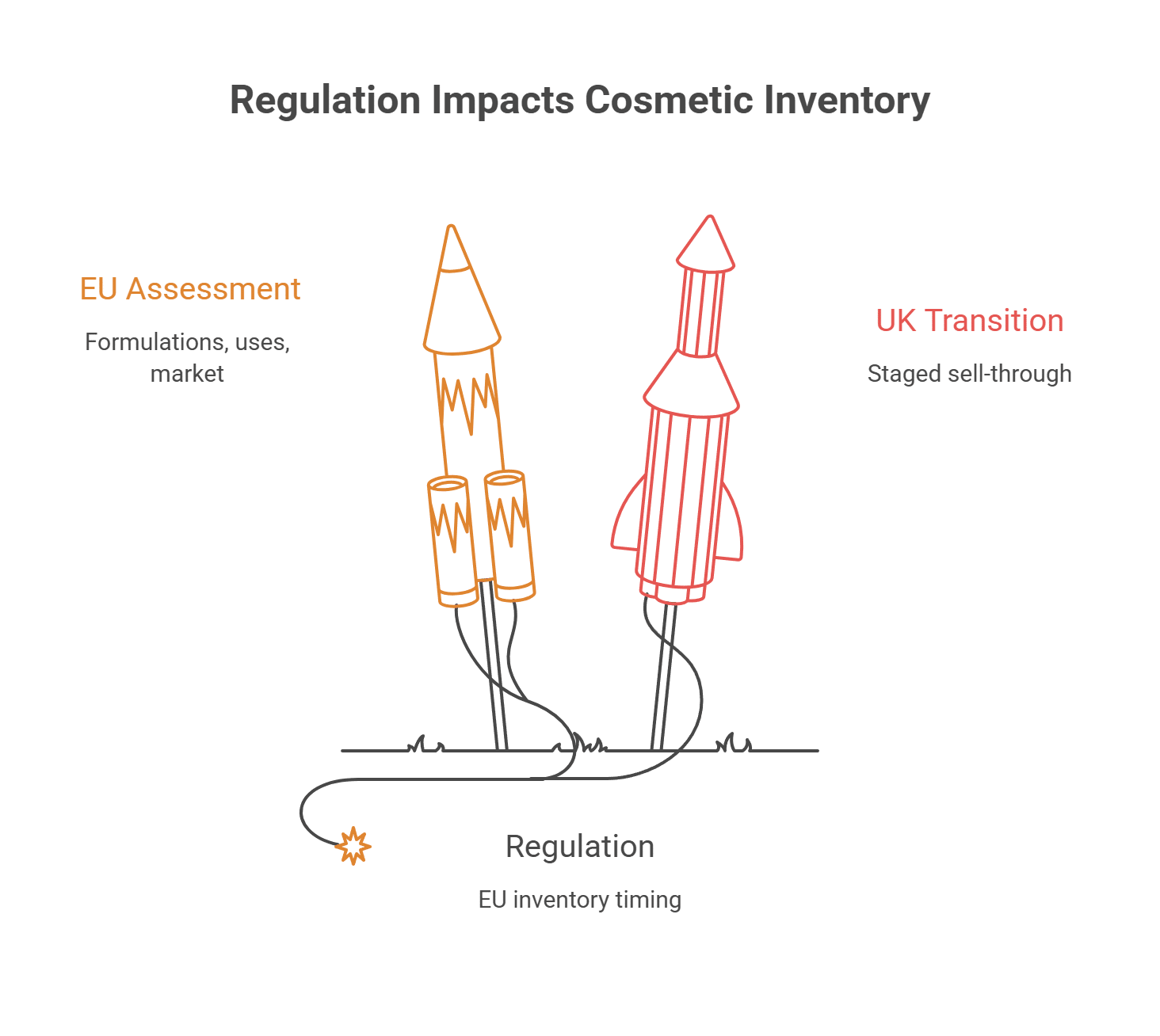
The United Kingdom used a different transition structure in SI 2026/23. The instrument prohibited 3-(4′-methylbenzylidene)-camphor, also known as 4-MBC or Enzacamene, in cosmetic products and changed the warning-labelling threshold associated with formaldehyde-releasing preservatives from 15 July 2026. It also added 16 listed CMR substances to the prohibited list from 15 August 2026.2
Products placed on the Great Britain market before the relevant dates could continue to be made available until the end of 14 January 2027 for the 4-MBC and labelling changes, and until the end of 14 February 2027 for the listed CMR substances.2
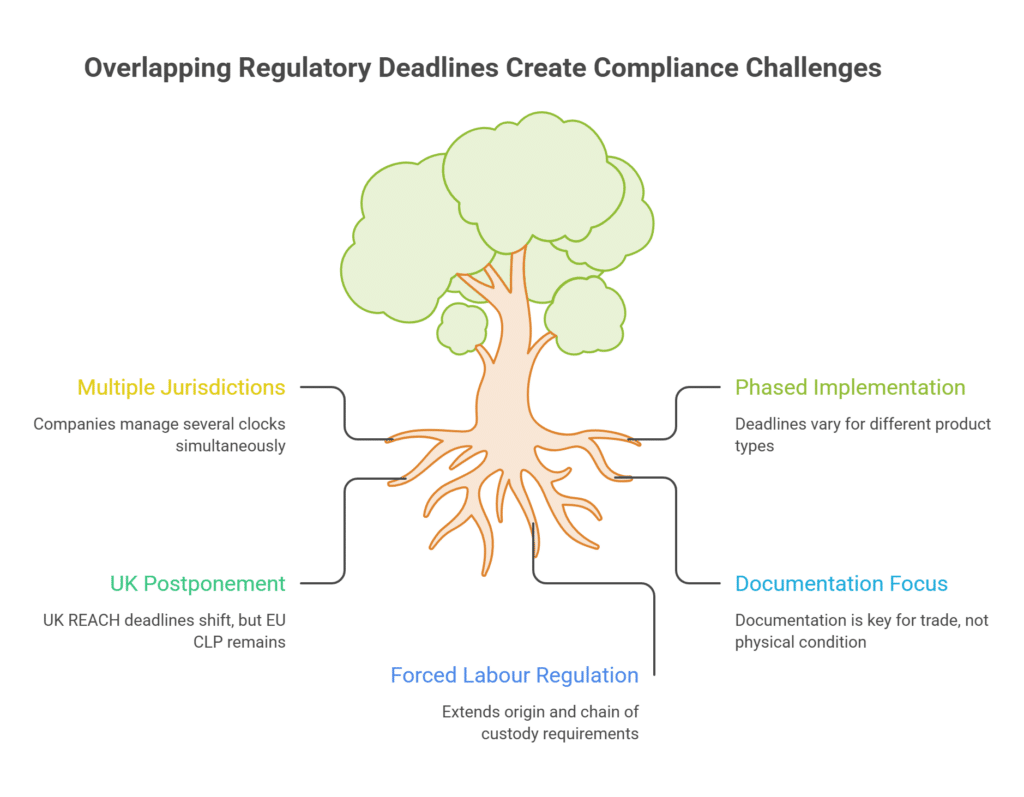
The comparison matters because the phrase “regulatory deadline” can refer to several different events.
| Regulatory event | What it changes | Inventory question | Example from 2026 |
|---|---|---|---|
| Application date | The new legal requirements begin to apply | Is the product, substance or use within scope on that date? | EU Regulation 2026/78 applies from 1 May 2026. |
| Placing-on-market cutoff | New product may no longer enter the market under the previous rules | Was the product lawfully placed before the cutoff? | UK SI 2026/23 uses 15 July and 15 August 2026 dates for different changes. |
| Continued making-available period | Product already placed may move through the market for a limited time | Can the seller prove when and where it was placed on the market? | UK periods end 14 January and 14 February 2027. |
| Classification or labelling transition | Existing stock must be reassessed against new hazard communication rules | Do classification, labels and safety information remain current? | The CLP transition for existing substances reaches 1 November 2026. |
| Restriction pipeline milestone | A possible future restriction moves through evaluation | Which inventories and uses need monitoring before a final rule? | The July 2026 REACH Restrictions Roadmap lists adopted and advancing work. |
This is why “no sell-through is the new normal” would be too broad. Some measures contain no staged provision. Others distinguish placing on the market from continued availability. Still others allow years for specified categories. The common business challenge is not one uniform deadline. It is a portfolio of different clocks.
The Restriction Pipeline Is an Inventory Signal
On 2 July 2026, the European Commission published a revised rolling list under its REACH Restrictions Roadmap. The Commission said that 11 restrictions covering hundreds of hazardous substances had been adopted since 2022, six more were in the final stages of evaluation, and work continued on PFAS, hexavalent chromium substances, octocrylene and other persistent, bioaccumulative, toxic or endocrine-disrupting substances.3
Inclusion in a roadmap is not the same as a final ban. Scope, timing, derogations and transition provisions can change during the process. Even so, the roadmap gives inventory owners a reason to identify where proposed or advancing restrictions intersect with stored material and intended uses.
The question should not be, “Can we sell this today?” It should also be, “What decision is approaching, and how long would a responsible transaction take?”
A legitimate secondary sale may require sampling, technical review, buyer qualification, an updated SDS, packaging inspection, dangerous-goods assessment, export and customs review, and confirmation of destination-market requirements. If an inventory owner begins that work a few weeks before a cutoff, the commercial window may already be too narrow.
The 1 November 2026 CLP Clock
Commission Delegated Regulation (EU) 2023/707 introduced new CLP hazard classes, including endocrine disruption and persistent, mobile and toxic properties. The transition timetable distinguishes substances from mixtures and new placing on the market from material already on the market.4
For substances already on the market, the relevant transition reaches 1 November 2026.4 Companies holding affected substance inventory should not assume that an older label and documentation set remains adequate simply because the material was manufactured earlier. They need to assess the applicable classification and hazard-communication duties for their role and transaction.
This extends the idea of regulatory shelf life beyond outright restrictions. A product may remain marketable, but the work and cost required to bring its documentation and packaging into line can affect whether a transaction is practical.
Who Owns the Second Clock?
Regulatory inventory risk often sits between functions.
Regulatory and EHS teams monitor legislation, but they may not know which slow-moving lots remain at each site. Supply chain teams know what is in the warehouse, but not always which regulatory milestone could affect a product’s use. Finance sees a carrying value, while operations sees occupied storage and quality sees a retest date.
A workable control connects those views. The slow-moving inventory register should include, at minimum, the material identity, batch, quantity, physical review date, intended and possible alternative uses, applicable jurisdictions, documentation status, and the next known regulatory milestone requiring assessment.
The purpose is not to predict every legal outcome. It is to create enough lead time for qualified people to make the right decision.
A Practical 90-Day Regulatory-Expiry Review
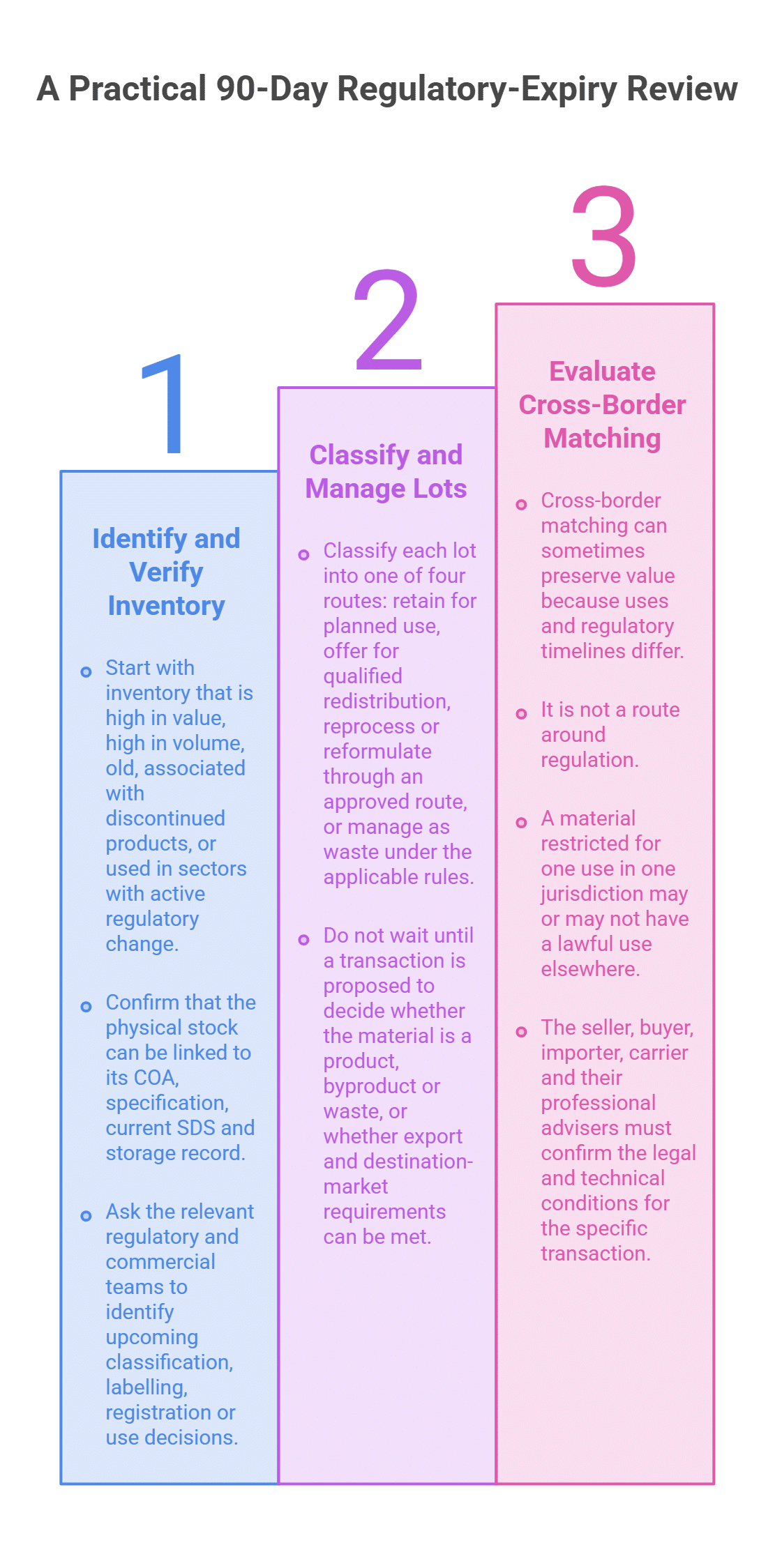
Start with inventory that is high in value, high in volume, old, associated with discontinued products, or used in sectors with active regulatory change. Confirm that the physical stock can be linked to its COA, specification, current SDS and storage record. Then ask the relevant regulatory and commercial teams to identify upcoming classification, labelling, registration or use decisions.
Classify each lot into one of four routes: retain for planned use, offer for qualified redistribution, reprocess or reformulate through an approved route, or manage as waste under the applicable rules. Do not wait until a transaction is proposed to decide whether the material is a product, byproduct or waste, or whether export and destination-market requirements can be met.
Cross-border matching can sometimes preserve value because uses and regulatory timelines differ. It is not a route around regulation. A material restricted for one use in one jurisdiction may or may not have a lawful use elsewhere. The seller, buyer, importer, carrier and their professional advisers must confirm the legal and technical conditions for the specific transaction.
Sur+ helps connect suitable inventory with qualified buyers and organise the commercial information needed for that review. We do not certify legal compliance, guarantee reuse, alter third-party documents or determine the buyer’s specification.
Inventory Has Two Expiry Dates
The practical conclusion is simple: physical stability is no longer enough to describe the life of a chemical asset.
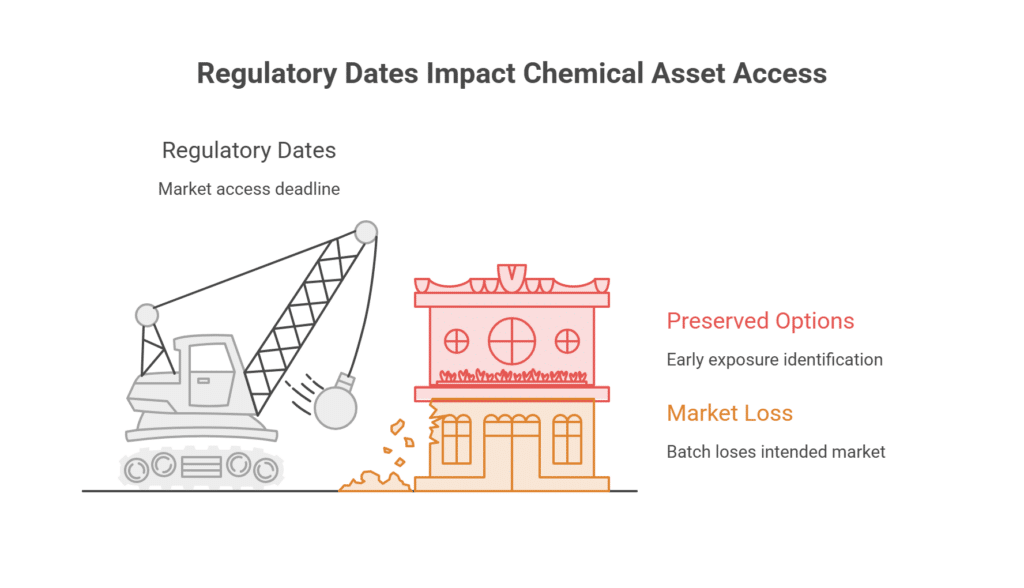
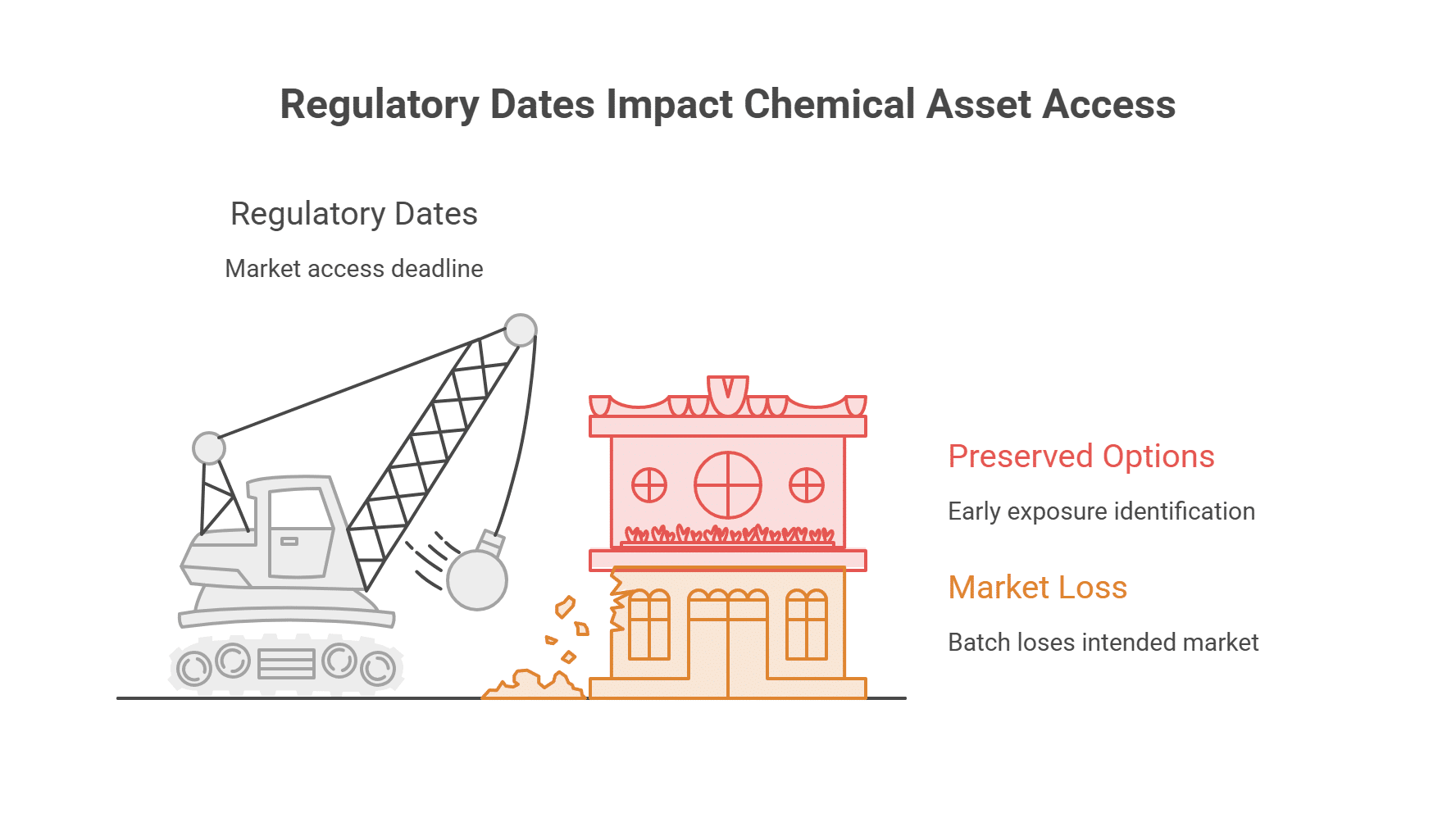
A technically sound batch can lose access to its intended market because a regulatory date arrives first. Some changes provide a transition window and others do not. In both cases, companies preserve more options when they identify exposure early.
If your organization is reviewing dormant or slow-moving stock, add the regulatory clock to the report. The best time to assess a secondary route is while the material, documents, responsible teams and legal market window are still available.
References
- EUR-Lex, Commission Regulation (EU) 2026/78 amending the Cosmetics Regulation as regards certain CMR-classified substances, 12 January 2026.
- UK legislation.gov.uk, SI 2026/23, The Cosmetic Products Regulation (EC) No 1223/2009 (Restriction of Chemical Substances) (Amendment and Transitional Provisions) Regulations 2026, 12 January 2026.
- European Commission, “The Commission advances work on restrictions of hazardous chemical substances,” 2 July 2026.
- EUR-Lex, Commission Delegated Regulation (EU) 2023/707 introducing new CLP hazard classes and transition periods.