
What Was Actually Established
As of June 2026, the Commission’s Directorate-General for Internal Market, Industry, Entrepreneurship and SMEs has a new unit called the Critical Raw Materials Centre. It is described as the first stage in accomplishing a full-fledged European Critical Raw Materials Centre, as envisaged by the Clean Industrial Deal and the RESourceEU Action Plan [1].
The published description of what it will do is worth reading closely:
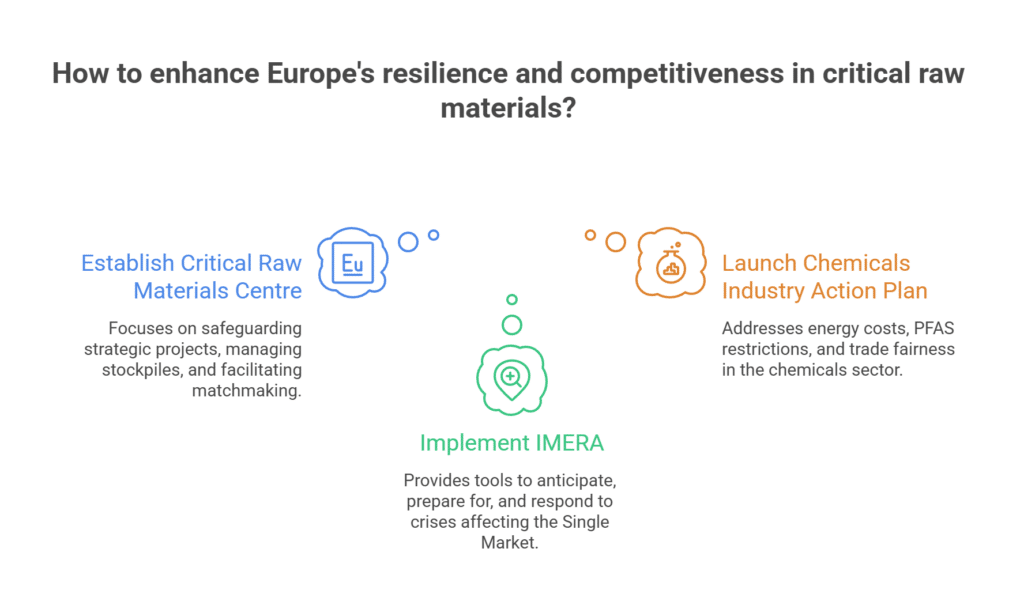
“It will work to safeguard the viability of strategic projects required for Europe’s competitiveness and resilience, from extraction to recycling, and help build and manage strategic stockpiles of strategic raw materials. It will also facilitate matchmaking by linking supply and demand across value chains, enable joint purchasing initiatives to strengthen security of supply, and develop an Observatory for data gathering and analysis.” [1]
Four functions: hold material, connect supply with demand, aggregate purchasing, and improve visibility into who has what.
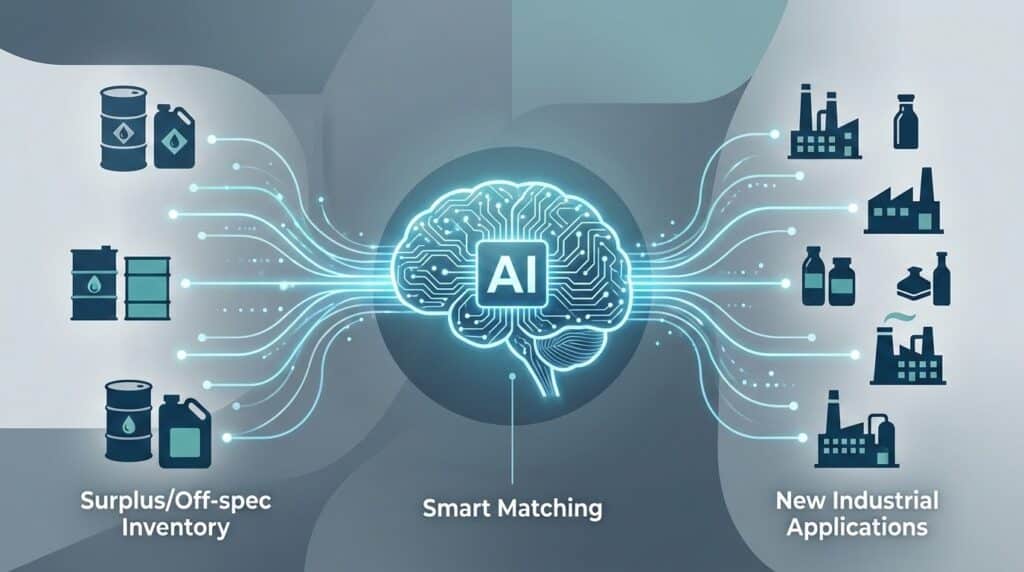
Those are the four functions of a materials exchange. The Commission has arrived at them independently, through an analysis of supply chain fragility rather than an analysis of trade, and it has arrived at them for critical raw materials rather than for chemicals broadly. But the logic is transferable, and it is the same logic that underpins commercial surplus redistribution.
This did not arrive alone. The Internal Market Emergency and Resilience Act, known as IMERA, entered into application on 29 May 2026, providing the Commission and member states with tools to anticipate, prepare for and respond to crises threatening the Single Market and affecting the free movement of goods, services and people. It enables risk monitoring, early information sharing, coordinated action during crises, and it is explicitly designed to prevent member states from adopting fragmented national measures that would undermine Single Market integrity [1].
The Commission has separately launched a Chemicals Industry Action Plan addressing energy costs, PFAS restrictions and trade fairness, in response to sustained pressure from a sector that has been, as one summary of the European position put it, buried by imports.
The Situation That Prompted It
The policy response is proportionate to the damage. Cefic’s Closures and Investments Radar, produced with Roland Berger and updated quarterly, found that European chemical plant closures surged sixfold since 2022, reaching a cumulative 37 million tonnes of capacity by 2025, approximately 9 per cent of European production capacity [2]. Twenty thousand direct jobs have been lost and roughly 89,000 indirect jobs are considered at risk [2]. Announced annual investment capacity fell from 2.7 million tonnes in 2022 to 0.3 million tonnes, with a total of around 7 million tonnes announced across the whole 2022 to 2025 period [2].
Cefic’s Director General Marco Mensink did not soften it:
“The sector is under severe stress and breaking. The rate of closures has doubled in a year, while annual investments are half and close to zero.” [2]
The financial picture supports that assessment. C&EN’s Global Top 50 survey, published in July 2026, recorded combined chemical sales of $965.8 billion for the largest fifty companies, down 5.8 per cent, with 39 of the 50 reporting declines, chemical operating profits down 19.5 per cent, and seven companies losing money outright [3]. Capital expenditure fell 7.8 per cent and, unusually, research and development spending fell as well [3].
Allianz Trade, rating the sector as a sensitive risk, describes a widening gap between structurally advantaged producers in the United States and the Middle East and high-cost European production, and notes that Europe has moved from self-sufficiency in polyolefins to growing import dependence as olefin capacity declines [4].
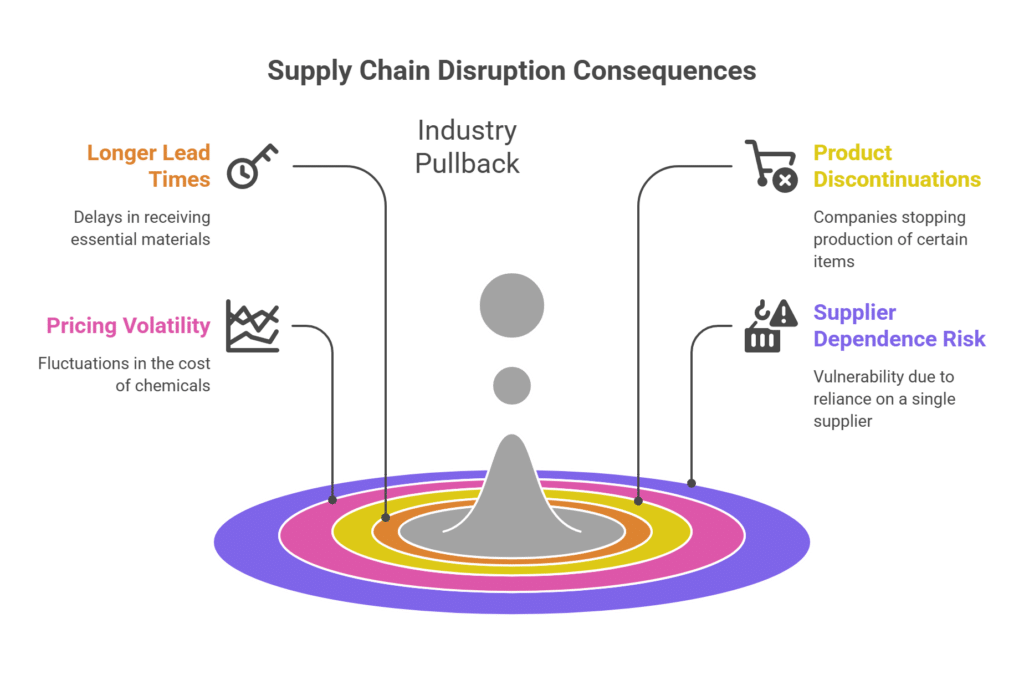
Deloitte’s analysis of more than 120 closures since 2022 adds the detail that matters most for the policy question. European integrated industrial ecosystems are disappearing, and the byproduct-feedstock links between units are breaking: a cracker closure tightens ethylene, which pressures styrene; a styrene closure leaves benzene without an outlet, which creates refinery storage constraints and strands pipelines [5]. The damage is not a series of independent plant losses. It is the progressive failure of a network.
And Deloitte states the paradox that the Commission is now attempting to solve:
“A fundamental paradox is that industry rationalization, necessary for financial health, can undermine the supply security that customers increasingly value.” [5]
Why the Shape of the Response Is Significant
The conventional policy instrument for industrial fragility is subsidy for new capacity. Build more, closer, with public support. That instrument is still present in European policy and it has its place.
But it is not what the Critical Raw Materials Centre primarily does. Its mandate is about material that already exists: holding it, locating it, connecting it, aggregating demand for it, and knowing where it is. That is a circulation strategy rather than a production strategy.
This is a meaningful intellectual shift, and it validates something the secondary materials market has argued from a commercial position for a long time. A great deal of supply security does not require new plants. It requires knowing what is already in the system and being able to move it to where it is needed. Europe has 37 million tonnes of closed capacity and, simultaneously, warehouses across the continent holding material that is written down, dormant, and destined for disposal. Those two facts sit uncomfortably together.
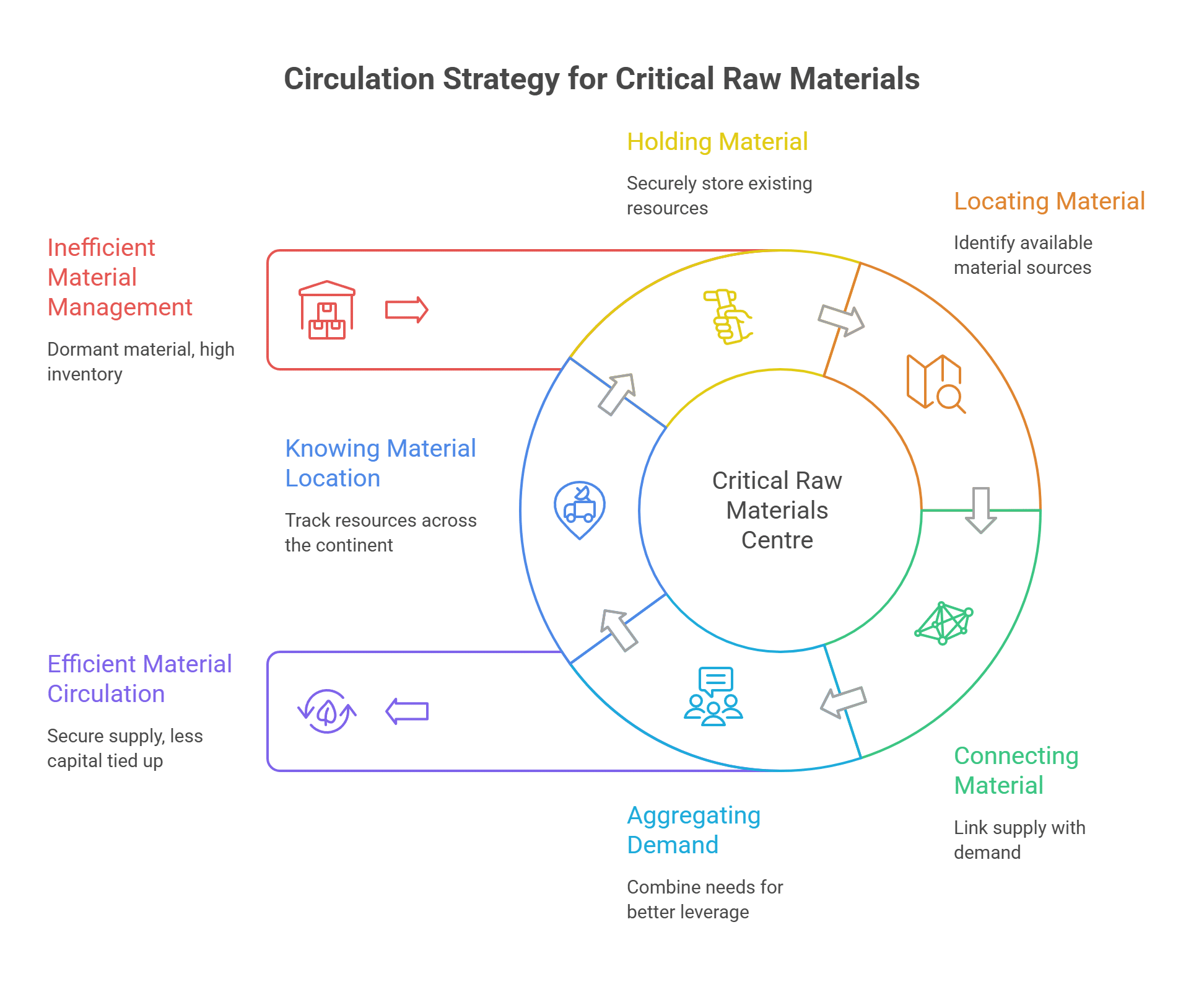
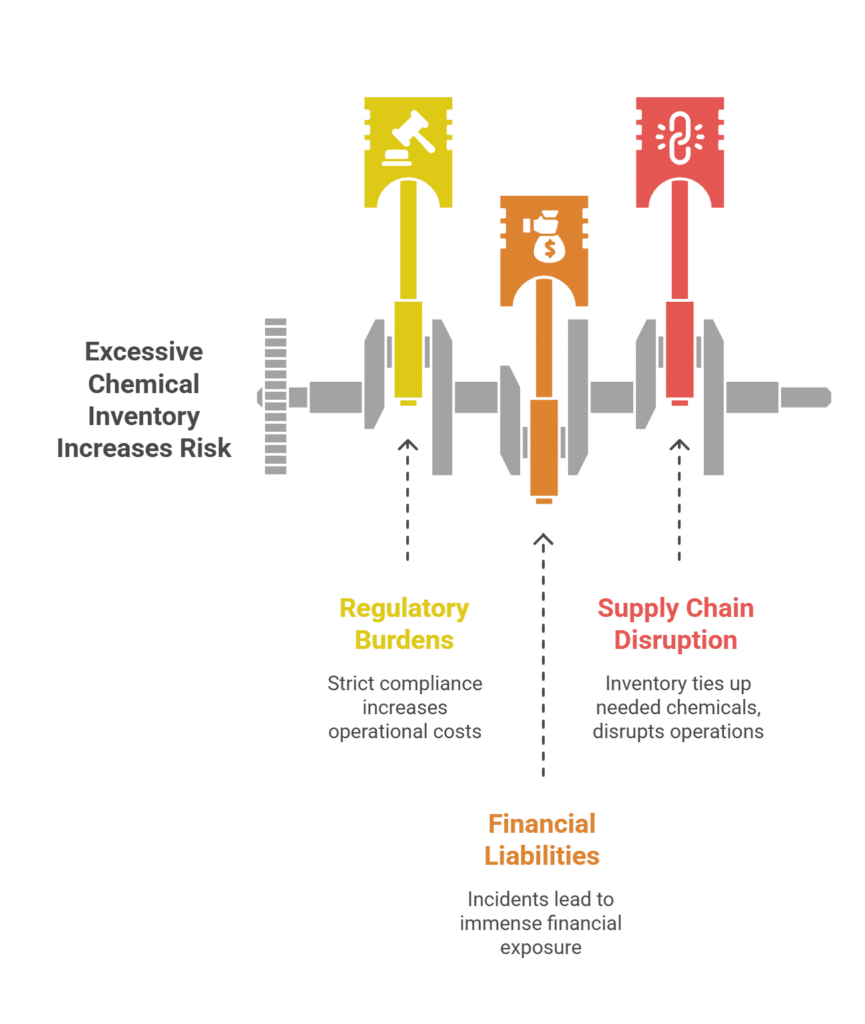
Deloitte’s finding that chemical companies ended 2025 holding an average of 94 days of inventory, more than 9 per cent above the prior five-year average, illustrates the point from the other direction [5]. The industry is already stockpiling. It is doing so unilaterally, expensively, and without coordination, because each company is hedging its own exposure. A functioning circulation mechanism would allow the same aggregate security with less capital tied up, because one company’s buffer is another company’s shortage cover.
Where the Policy Design Falls Short
Having credited the reasoning, it is worth being direct about the limitation, because the distinction matters for anyone deciding where to place their own reliance.
A public stockpile is slow. It requires legislative authority, procurement processes, storage infrastructure, custodial arrangements and release criteria, all of which take years to establish and are politically contested at each step. It is narrow, because a stockpile can only cover a defined list of strategic materials chosen in advance, and the list will always lag the actual pattern of shortage. It is expensive, because the carrying cost is borne by the public purse rather than recovered through transactions. And its release criteria are necessarily conservative, because releasing strategic stock in a non-crisis is politically difficult and releasing it too late is the standard failure mode of every strategic reserve ever established.
A commercial secondary market has the inverse profile. It is fast, because a transaction takes days. It is broad, because it covers whatever substances are actually being offered rather than a predetermined list. It is self-financing, because the carrying cost is recovered in the spread. And it clears continuously rather than at moments of declared emergency.
The two are not competitors and should not be framed as such. Public stockpiles are appropriate for genuine chokepoints where the market cannot be relied upon: materials with a single dominant supplier jurisdiction, or where a shortage would be simultaneously acute and strategically unacceptable. Commercial redistribution is appropriate for the very large volume of ordinary, perfectly usable material that is currently destroyed because nobody connected the holder to the user in time.
The risk in the current policy direction is that institutional attention flows entirely to the first category, which is highly visible and politically satisfying, while the second category, which is larger and cheaper to address, continues to be handled as a waste management problem rather than a supply problem.
Two Live Policy Items Worth Attention
Two specific developments deserve action rather than observation.
The first is an opportunity. The Commission has opened a public consultation on territorial supply constraints, running to 20 August 2026. These are practices used by certain large manufacturers to restrict retailers or wholesalers from purchasing goods in one EU country and reselling them in another, identified in the 2025 Single Market Strategy as one of the “Terrible Ten” most harmful barriers to the Single Market [1]. The Commission has committed to developing tools to address unjustified constraints in cases outside the scope of competition law, and the consultation explicitly invites evidence and practical experience from wholesalers and other value chain participants [1].
Anyone who has encountered a restriction on moving legitimately purchased material across an internal EU border has directly relevant evidence, and this is the window in which to submit it. Cross-border resale within the Single Market is a precondition for surplus redistribution working at European scale.
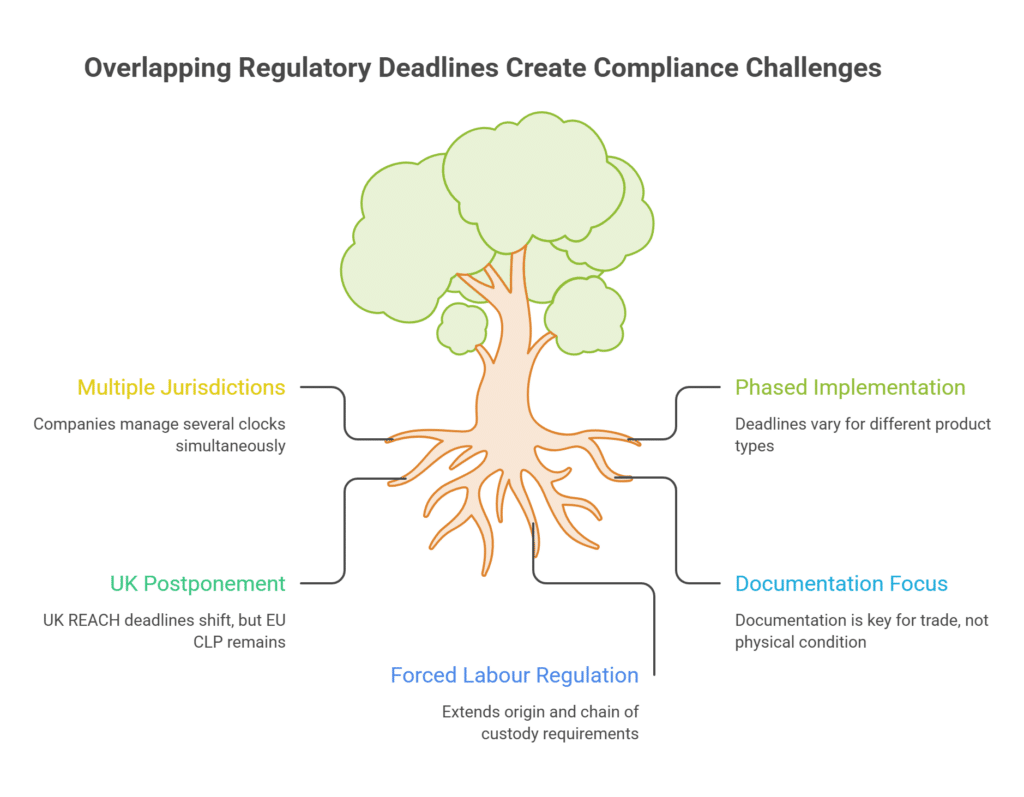
The second is an obligation. The EU Forced Labour Regulation establishes that from 14 December 2027, no product made with forced labour may be sold in the Single Market or exported from it, with the Commission noting that responsibility rests with companies to ensure their products are compliant, supported by a Forced Labour Single Portal, guidance, an SME preparedness checklist and supply chain traceability tools [1].
For the secondary market, this is consequential. Traceability of origin is exactly the dimension where surplus and secondary material has historically been weakest, because material may pass through several holders and its provenance documentation degrades with each transfer. From late 2027, provenance is not a commercial preference but a market access condition. The practical effect is to widen the gap between operators who maintain rigorous chain of custody documentation and those who do not, and it will remove the latter from the regulated segment of the market entirely.
We regard that as a positive development, and we said as much when discussing classification obligations in the first article of this series. A market where documentation is enforced is a market where quality operators can compete on quality.
What This Means Practically
For European sellers of surplus material, the policy direction is favourable and the timing is good. Redistribution is being recognised at the level of industrial strategy as a contributor to supply security rather than as a marginal waste-avoidance activity. That makes the internal argument easier: releasing dormant inventory is no longer only a working capital decision, it is consistent with the direction European industrial policy is taking. It should also prompt an inventory audit, because the material that qualifies for redistribution is the material whose documentation can support it.
For buyers, the useful conclusion is not to wait for the public mechanism. The Critical Raw Materials Centre is at its first stage, its full legislative toolkit is still being developed, and its scope is critical raw materials rather than chemicals generally. Whatever it eventually delivers, it will not be a source of intermediates for a formulation you need to run next quarter. The commercial market is available now, and the qualification work required to use it takes weeks that are better spent before a shortage than during one.
For everyone, the traceability trajectory is one-directional. Classification obligations tightened in 2026, forced labour provenance requirements arrive in 2027, and nothing on the horizon suggests a loosening. Whatever documentation standard you regard as sufficient today is the floor rather than the ceiling.
Closing the Series
Across these four articles a single pattern emerges, and it is not the one the industry usually discusses.
The surplus market is not primarily a discount market. It is an infrastructure function. It absorbs the consequences of regulatory transitions, as it will on 1 November. It absorbs the consequences of portfolio decisions made by new owners of restructured assets. It provides a hedge against trade policy that no overseas quotation can offer. And it performs, commercially and at speed, the same circulation function that the European Union is now building a public institution to perform institutionally.
At Surplus International we have argued that case for years from a commercial position, which is inevitably an interested one. It is genuinely useful to see a public institution reason its way to the same conclusion from an entirely different starting point.
Thank you to everyone who has read, disagreed and argued through this series. The next cycle will start from wherever the market has moved by then, which, on the evidence of the past eighteen months, will not be where anyone expects.
Frequently Asked Questions
Does the Critical Raw Materials Centre cover chemicals?
Its mandate is critical raw materials, as defined under the EU’s critical raw materials framework, rather than chemicals generally. Many chemical inputs and processing chains intersect with that list, and the Centre’s remit explicitly extends from extraction through to recycling, but companies should not assume that a given chemical intermediate falls within its scope. The significance for the chemical sector is the precedent and the reasoning rather than direct coverage.
Will the EU stockpile compete with commercial surplus traders?
We do not expect meaningful competition, for structural reasons. A public stockpile operates on a predetermined list of strategic materials, holds them against defined contingencies, and releases them under conservative criteria. A commercial secondary market handles whatever is actually offered, across thousands of substances, and clears continuously. The two address different problems. If anything, an institution that improves visibility into who holds what should make commercial matching easier rather than harder.
Why does the territorial supply constraints consultation matter for surplus material?
Because the ability to buy material in one member state and resell it in another is a precondition for a European secondary market operating at scale. Where manufacturers impose restrictions on cross-border resale, surplus material can become trapped in the country where it happens to sit, even though a buyer exists two borders away. The consultation, which closes on 20 August 2026, is the mechanism through which practical evidence of those restrictions can be put in front of the Commission.
How should we prepare for the Forced Labour Regulation as a buyer of secondary material?
Start by establishing what provenance documentation your current secondary suppliers can actually produce, rather than what they assert. From 14 December 2027 the obligation to ensure products are free from forced labour rests with the company placing them on the market, which means the documentation gap becomes your exposure rather than your supplier’s. The Commission has published guidance, an SME preparedness checklist and a list of supply chain traceability tools through its Forced Labour Single Portal, and the eighteen-month runway is intended to be used.
Is Surplus International positioned for these requirements?
Our due diligence covers material documentation, origin and intended use before any transaction proceeds, and for pharmaceutical grade material we work with certified suppliers and align transactions with GxP, FDA and EMA expectations with traceability maintained throughout. Where provenance or documentation is incomplete, we state that plainly rather than obscuring it, and all sales are conducted on clear AS-IS terms. We regard the tightening documentation environment as favourable to operators who take that discipline seriously.
References
[1] Single Market and Industry News, June 2026, covering the Critical Raw Materials Centre, IMERA, the Forced Labour Regulation preparation tools and the territorial supply constraints consultation. European Commission, DG GROW. https://ec.europa.eu/newsroom/growth/newsletter-archives/77032
[2] Chemical plant closures rate surges six-fold in Europe since 2022, new report finds. Cefic, 28 January 2026. https://cefic.org/news/chemical-plant-closures-surge-six-fold-in-europe-since-2022-reaching-37mt-new-report-finds/
[3] C&EN’s Global Top 50 chemical firms for 2026. Alexander Tullo, Chemical and Engineering News, 6 July 2026. https://cen.acs.org/business/finance/CENs-Global-Top-50-2026/104/web/2026/07
[4] Chemicals Sector Report: An Uneven Recovery. Allianz Trade Economic Research, July 2026. https://www.allianz-trade.com/en_global/economic-research/sector-reports/chemicals.html
[5] The domino effect: Implications of chemical plant closures on supply chains. Deloitte Center for Energy and Industrials, 27 May 2026. https://www.deloitte.com/us/en/insights/industry/chemicals-and-specialty-materials/reshaping-chemical-supply-chains-plant-closures.html