
The short version is that the duty rate applying to imported chemicals into the United States has stopped behaving like a fact and started behaving like a forecast. Once that happens, inventory that is already inside the border acquires a property that no overseas quotation can replicate.
The Position as It Stands
Chemicals enter the United States under Harmonized Tariff Schedule chapters 28 through 38, and the applicable rates as of late July 2026 vary from roughly 3 per cent to roughly 28 per cent depending on origin [1]. The base most-favoured-nation rate for most chemical lines sits near 3 per cent. What has changed is everything layered on top of it.
| Origin | Approximate effective rate on chemicals | Notes |
|---|---|---|
| India | ~3% | Base MFN, lowest among major suppliers [1] |
| Canada and Mexico | Duty-free | Under USMCA where rules of origin are met [1] |
| European Union | 15% flat, all-inclusive | Effective 1 July 2026, no MFN stacking, down from ~23% [1] |
| Japan, South Korea, UK, Switzerland | ~13.4% | [1] |
| China | ~28% | 3% base plus 25% Section 301 [1] |
EU pharmaceutical precursors move to MFN-only treatment from 1 September 2026, which is a meaningful change for anyone sourcing intermediates for regulated manufacture [1].
That table looks orderly. The path to it was not.
Why Nobody Can Model This
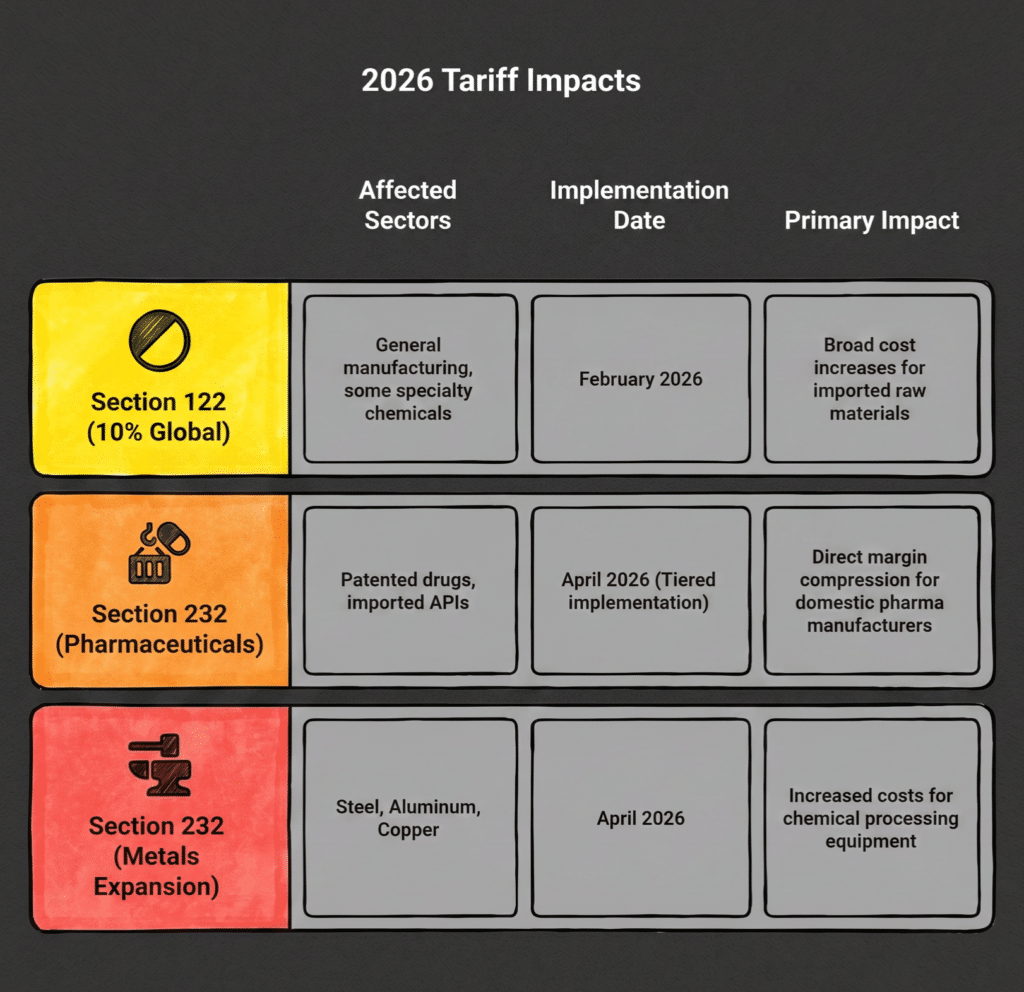
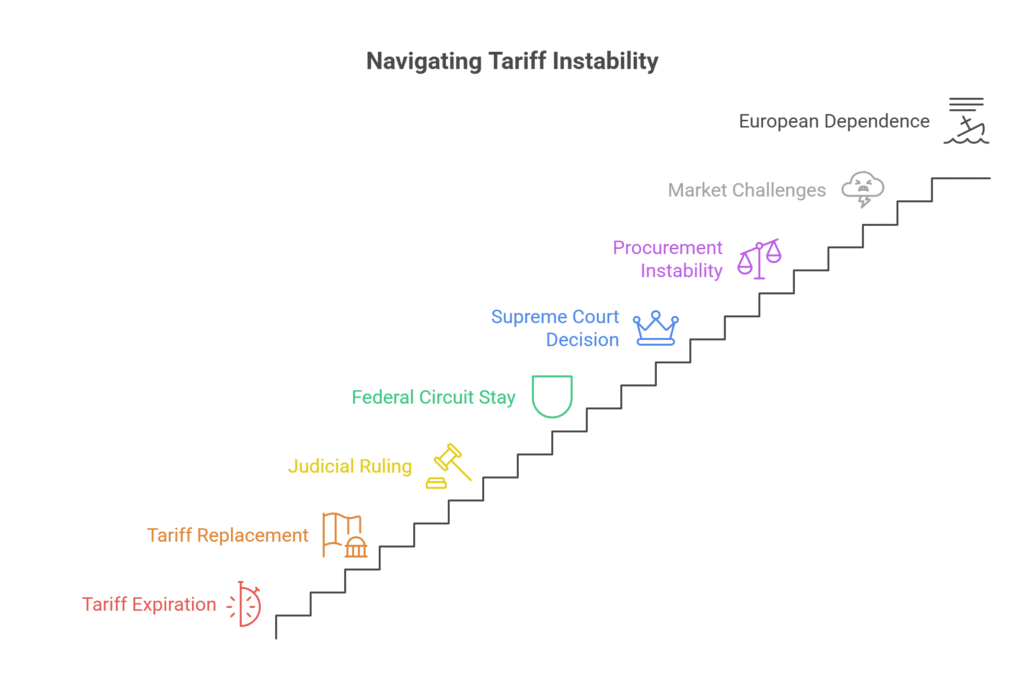
The 10 per cent Section 122 tariff reached its 150-day statutory limit and expired on 24 July 2026. On the same day it was replaced by a Section 301 tariff citing forced labour concerns, set at 10 or 12.5 per cent and applied across 60 trading partners [1]. Before that, the Court of International Trade had ruled Section 122 unlawful on 7 May 2026, the Federal Circuit stayed the injunction on 11 June, and collection continued while the appeal proceeded [1]. Separately, the Supreme Court struck down the 2025 tariffs imposed under the International Emergency Economic Powers Act, opening a refund pool reported at approximately $166 billion [1].
For a procurement function, the practical consequence is not the level of any individual rate. It is that the rate has three simultaneous sources of instability: a statutory clock that can expire it, a judicial process that can void it retroactively, and an executive mechanism that can replace it within a day of either happening.
A landed-cost model is a sum of known quantities. When one of the terms in that sum has a pending appellate decision attached to it, the model stops producing a number and starts producing a range. Most contracts are not written to accommodate a range.
This is happening against a market backdrop that already made forecasting difficult. Allianz Trade rates the chemical sector as a sensitive risk and titles its 2026 outlook “an uneven recovery,” identifying trade policy and industrial protectionism as a distinct risk channel through which tariffs and export controls raise input costs and disrupt established trade patterns [2]. The same analysis notes that Europe has shifted from self-sufficiency in polyolefins to growing import dependence as olefin capacity declines, which means European buyers are more exposed to trade policy than they were five years ago, not less [2].
The Argument for In-Region Material
Here is the reframing that follows, and it is one the surplus market has not made explicitly.
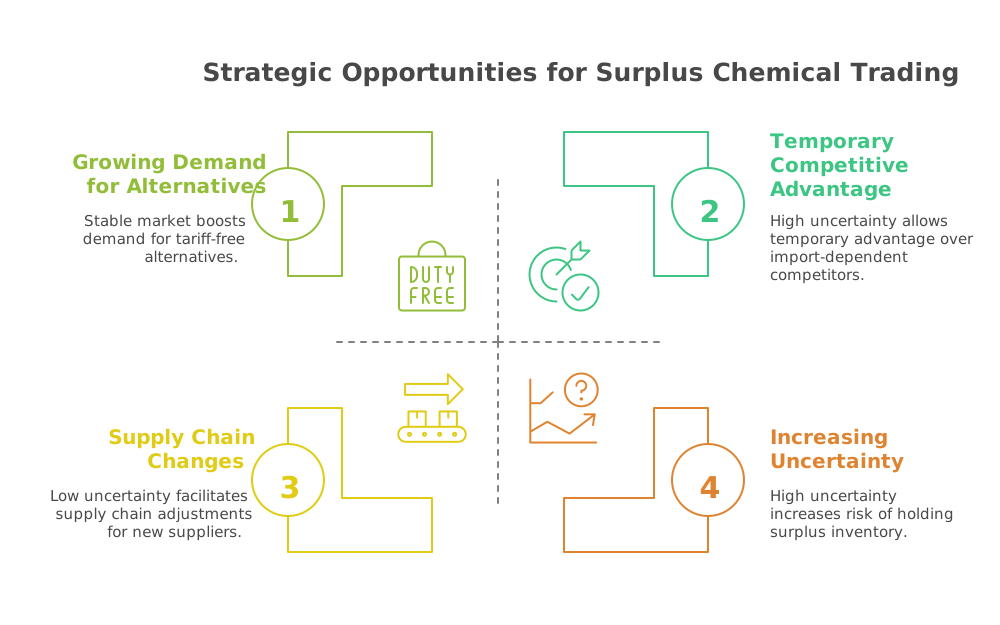
When you buy material that is already inside the destination border, already customs-cleared and already duty-paid, the duty exposure on that material is a settled historical fact. It was determined on the date of entry by the rules that applied on that date. No subsequent proclamation reopens it. No appellate ruling changes what you will pay for it going forward, because you are not importing it.
When you buy material from an overseas supplier for future delivery, you are buying a price plus an unresolved question. You may have a firm quotation, a firm freight rate and a firm delivery window, and still not know your true landed cost, because the duty component will be determined by rules that may not exist yet on the day the container arrives.
Those two things are not the same instrument, and they should not be compared on unit price alone. In-region, duty-paid inventory carries what is effectively an embedded option: certainty on a variable that is otherwise open. In a stable tariff environment that option is worth very little, which is why nobody used to price it. In the current environment it is worth a great deal, and it is systematically undervalued because procurement systems are built to compare unit prices rather than to compare certainty.
This is a financial argument rather than an operational one, which matters for how it should be made internally. The audience for it is the finance function, the treasury function and the trade compliance function, not only sourcing. Those are the people whose models are being broken by the volatility, and they are usually the ones who understand option value immediately when it is described in those terms.
The Inventory Behaviour Already Points This Way
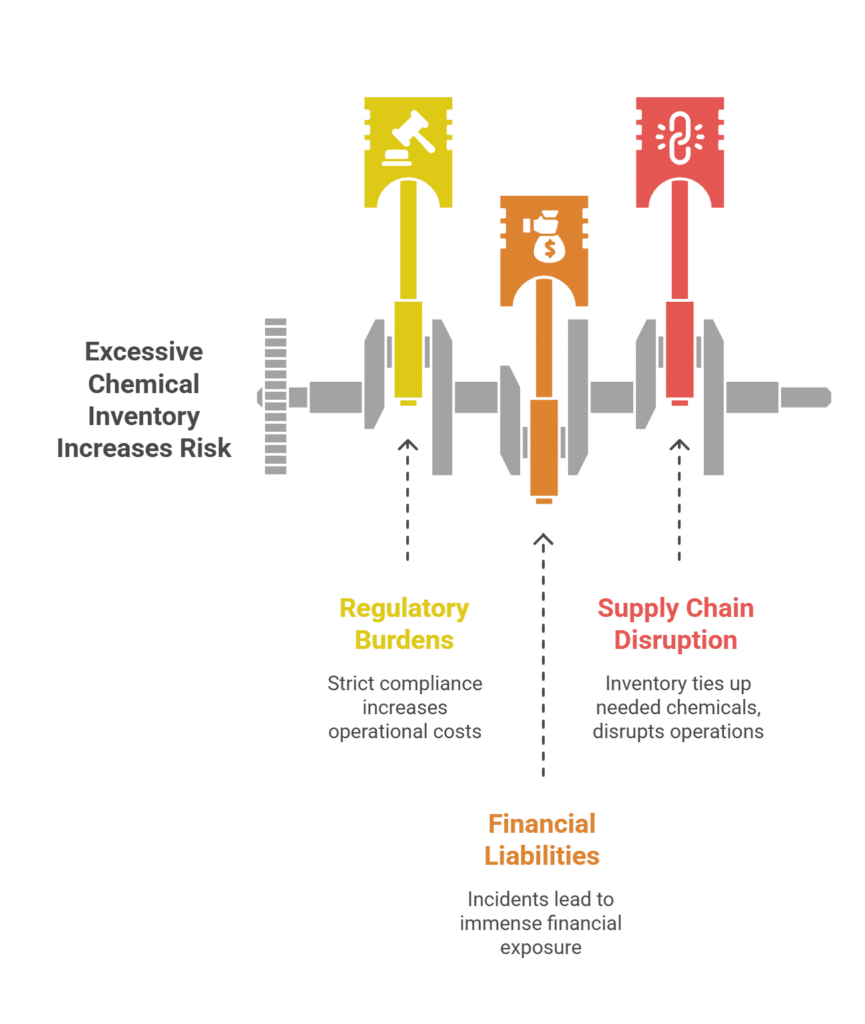
There is evidence that the industry has begun hedging without necessarily articulating why. Deloitte found that at the end of 2025, chemical companies were holding an average of 94 days of inventory, more than 9 per cent above the prior five-year average [3]. In conventional working capital terms that is inefficient. In 2026, when Middle Eastern energy and feedstock flows were disrupted, it turned out to be protective [3].
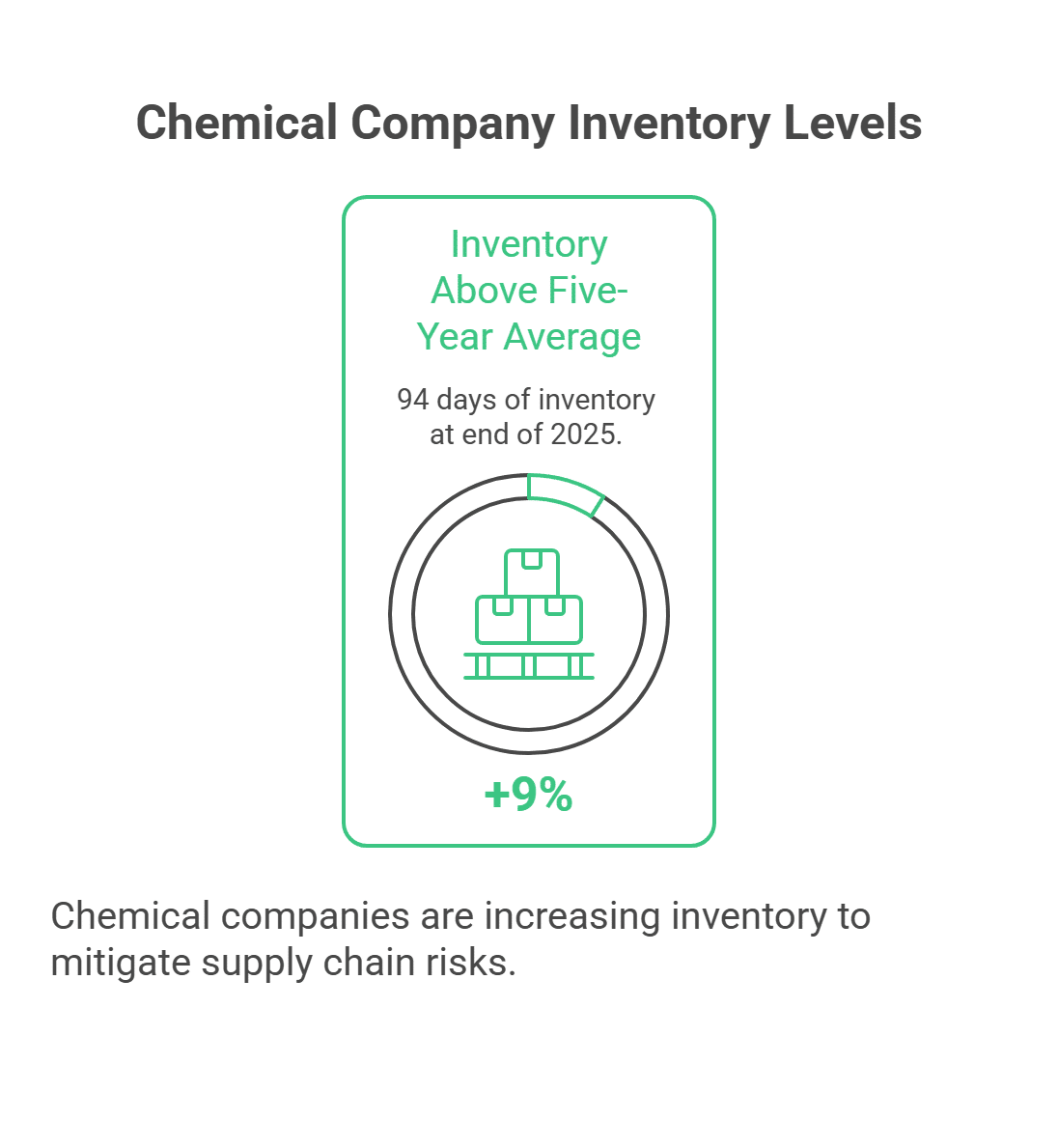
Deloitte frames the underlying shift as a move from just-in-time toward selective just-in-case buffering, supported by predictive analytics rather than blanket stockpiling [3]. The same report identifies the structural tension that makes this necessary:
“A fundamental paradox is that industry rationalization, necessary for financial health, can undermine the supply security that customers increasingly value.” [3]
Tariff volatility compounds that paradox. Rationalisation reduces the number of places a given material can be bought. Tariff instability makes buying from the remaining distant sources financially unpredictable. Together they push buyers toward holding more, closer, from more suppliers, which is precisely the demand profile that a functioning secondary market serves.
PwC’s midyear analysis captures the strategic response, quoting Michael Fiore:
“More broadly, companies are rethinking where they produce and invest, balancing cost with supply security, resilience and market access as they reshape their portfolios.” [4]
Market access, in that sentence, is largely a euphemism for tariff exposure.
What to Actually Do
Four steps are worth taking regardless of how the legal position resolves.
Treat the duty rate as an assumption, not an input. Any landed-cost model should carry the duty component as a named assumption with a date attached and a sensitivity range around it. If your current model shows a single duty figure with no date, it is out of date by construction.
Write tariff adjustment language into annual agreements. A fixed-price annual contract written in this environment allocates an unpriced risk to one party. Whether you are buying or selling, an explicit adjustment mechanism tied to a stated rate on a stated date is better for both sides than a dispute twelve months later.
Qualify secondary sources before you need them. This is the step most often skipped and the one with the longest lead time. Qualifying a new material source, particularly in a regulated application, takes weeks of documentation review and often a trial. Tariff changes take a day. A qualified list of alternatives, including secondary-market sources, is only useful if it exists before the disruption.
Ask where the material physically is, and when it cleared. For any offer, establish the location, the customs status and the entry date. Those three facts determine whether you are buying certainty or buying exposure, and they are rarely on the quotation sheet.
The Qualification Discipline Does Not Change
None of this loosens the standard that secondary-market material has to meet. Duty-paid status is a commercial advantage, not a substitute for due diligence, and material with an attractive customs position and incomplete documentation remains a transferred liability rather than a bargain.
The same five questions govern the decision. Does the assay meet the minimum specification for the intended application? Could impurities or degradation products affect performance in that specific use? Can the storage history and current condition be verified? Are the safety data sheet, certificate of analysis, origin records and chain of custody reliable and current under the framework applying on the date of transfer? And is the material legally transferable, as a product or as a by-product, in every jurisdiction the transaction touches?
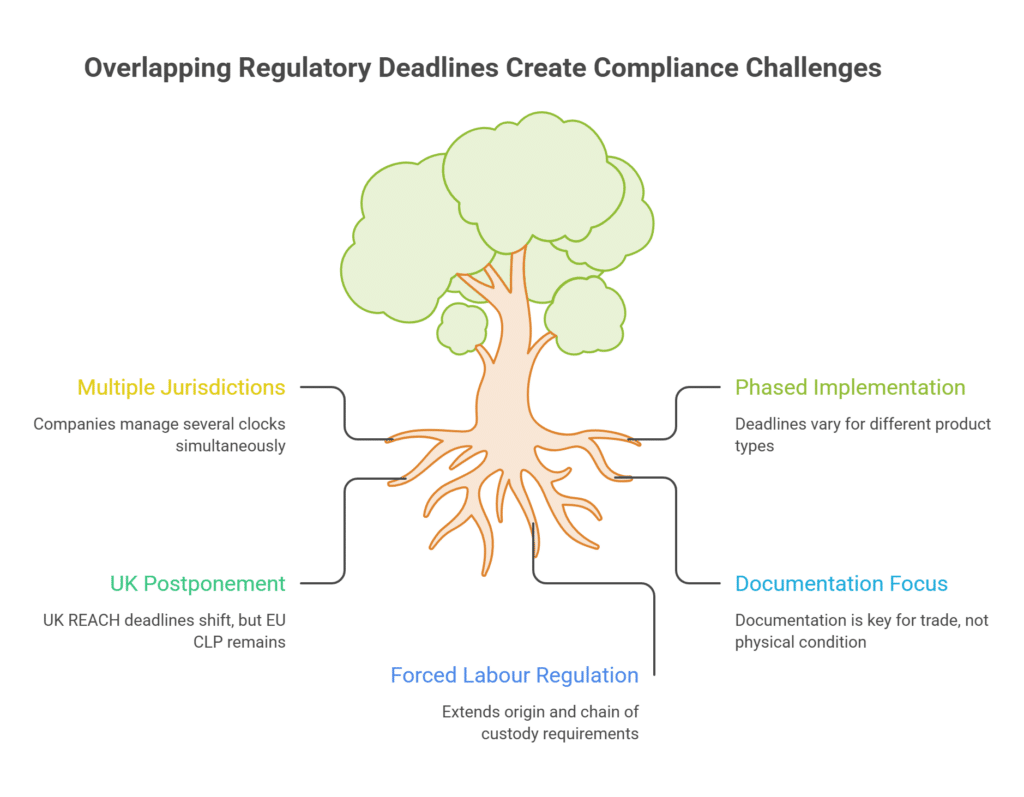
As we discussed in the first article in this series, that fourth question has become considerably more demanding with the EU CLP transition for existing substances arriving on 1 November 2026. Tariff certainty and documentary completeness are separate tests, and a batch needs to pass both.
The Broader Point
For most of the past three decades, the location of chemical inventory was a logistics question. You optimised for freight cost and lead time, and duty was a small, stable, predictable line item that you looked up once a year.
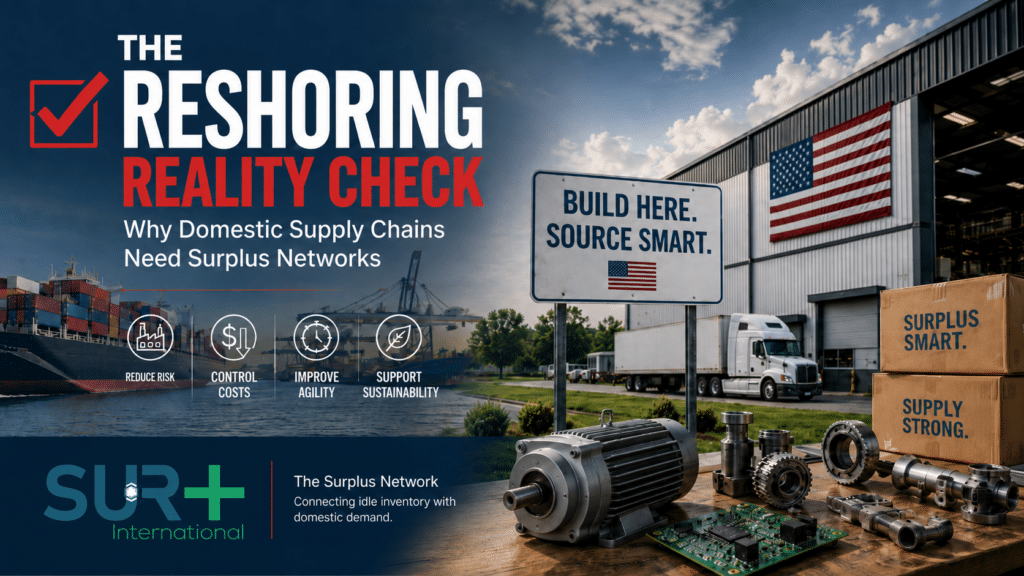
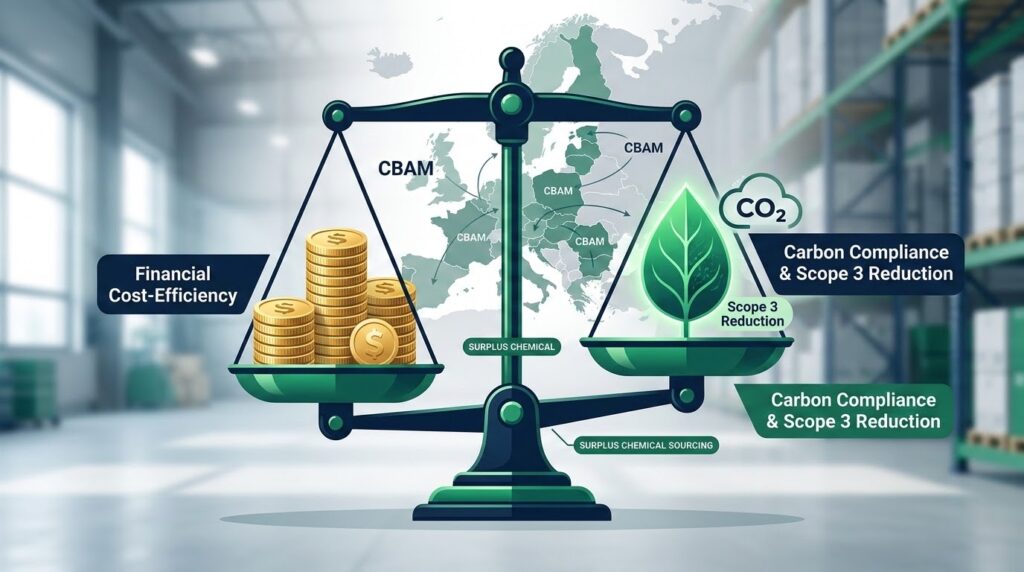
That is no longer true. Location has become a financial position. Material inside the border in a high-tariff corridor is worth more than the same material outside it, by an amount that has nothing to do with freight and everything to do with resolved uncertainty. The secondary market is where in-region, duty-paid material concentrates, which means the surplus market has acquired a function it did not previously have: it is now a hedge against trade policy, not only a source of cost savings.
At Surplus International we see this in the questions we are being asked. Two years ago the first question was price. Now it is increasingly where the material sits and what its customs status is. That is a more sophisticated question, and the buyers asking it are the ones whose 2027 budgets are most likely to survive contact with whatever the tariff regime looks like by then.
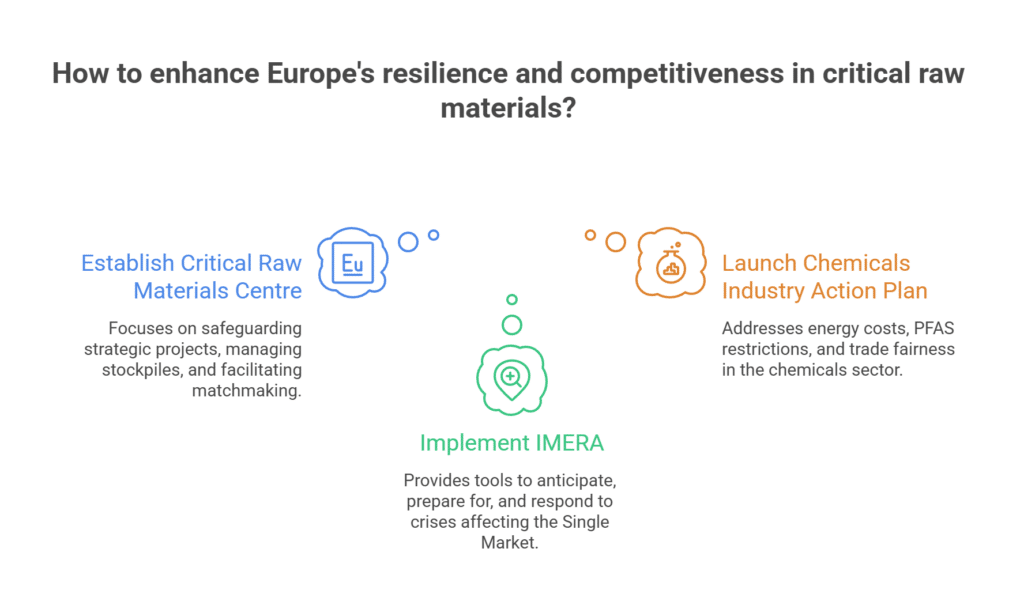
In our next article, we will examine a development that arrived with almost no attention in the chemical press: the European Commission’s new Critical Raw Materials Centre, whose stated mandate includes strategic stockpiles, matchmaking supply and demand across value chains, and joint purchasing. It is, in effect, a public sector description of the surplus redistribution model.
Frequently Asked Questions
Is it accurate to say a duty-paid drum is worth more than an identical drum overseas?
In terms of total cost certainty to a US buyer, yes, and the difference is the value of not carrying an open duty exposure. The physical material is identical. What differs is that one has a settled customs position and the other has a position that will be determined by rules in force on a future arrival date. How much that certainty is worth depends on the corridor, the current rate, and how long the delivery window is. In low-volatility corridors it is negligible. In corridors currently subject to litigation or statutory expiry, it is material.
Does this argument apply to buyers outside the United States?
The specific mechanics described here are US import rules, so the detail does not transfer. The principle does. Any buyer importing into a jurisdiction where duty rates are subject to active policy change faces the same problem, and the same conclusion follows: in-region, duty-paid material carries certainty that a landed-cost quote cannot. European buyers are increasingly exposed as Europe shifts from polyolefin self-sufficiency toward import dependence, and Indian buyers face the mirror image, since India’s low 3 per cent rate into the US makes Indian-origin material comparatively attractive while India’s own import bill remains exposed to other corridors.
Should we stop importing and buy only domestically available surplus?
No, and that would be the wrong conclusion. Virgin imported material remains essential for most volume requirements, and the surplus market cannot and does not replace primary supply. The argument is about the marginal decision and about portfolio construction: where a qualified in-region secondary source exists at a workable price, it deserves more weight in the comparison than a pure unit-price analysis gives it. Treat it as a hedge within a sourcing portfolio rather than as a replacement for it.
How quickly can Surplus International confirm the location and customs status of material?
Location and loading terms, whether EXW or FOB, are part of the standard information we require before listing any inventory, alongside quantity, minimum order quantity, target pricing and packaging. For material already in-region we can normally confirm location and status at the point of offer. Where customs documentation is incomplete or unclear, we say so rather than implying otherwise, and all sales proceed on clear AS-IS terms with full transparency about condition and documentation.
We hold surplus material in a US or European warehouse. Does this make it more valuable?
Potentially, yes, and it is worth reassessing. Dormant inventory that has been valued as a write-down candidate may be worth considerably more to a buyer in the same customs territory than the same material would fetch on a pure specification basis, precisely because the buyer avoids the duty uncertainty. If you are holding stock that has been sitting on the books at a nominal value, the current environment is a reasonable moment to test the market before, as we discussed in the first article of this series, the 1 November classification deadline changes the calculation in the other direction.
References
[1] Tariffs on Chemicals: Current US Import Duty Rates, HTS Chapters 28 to 38. TariffsTool, updated 24 July 2026. https://www.tariffstool.com/tariffs-on-chemicals
[2] Chemicals Sector Report: An Uneven Recovery. Allianz Trade Economic Research, July 2026. https://www.allianz-trade.com/en_global/economic-research/sector-reports/chemicals.html
[3] The domino effect: Implications of chemical plant closures on supply chains. Deloitte Center for Energy and Industrials, 27 May 2026. https://www.deloitte.com/us/en/insights/industry/chemicals-and-specialty-materials/reshaping-chemical-supply-chains-plant-closures.html
[4] Chemicals industry M&A: The trends ahead. Steve Ranger, SCI Chemistry and Industry, 30 July 2026. https://www.soci.org/news/2026/7/chemicals-industry-mergers-and-acquisitions-the-trends-ahead