
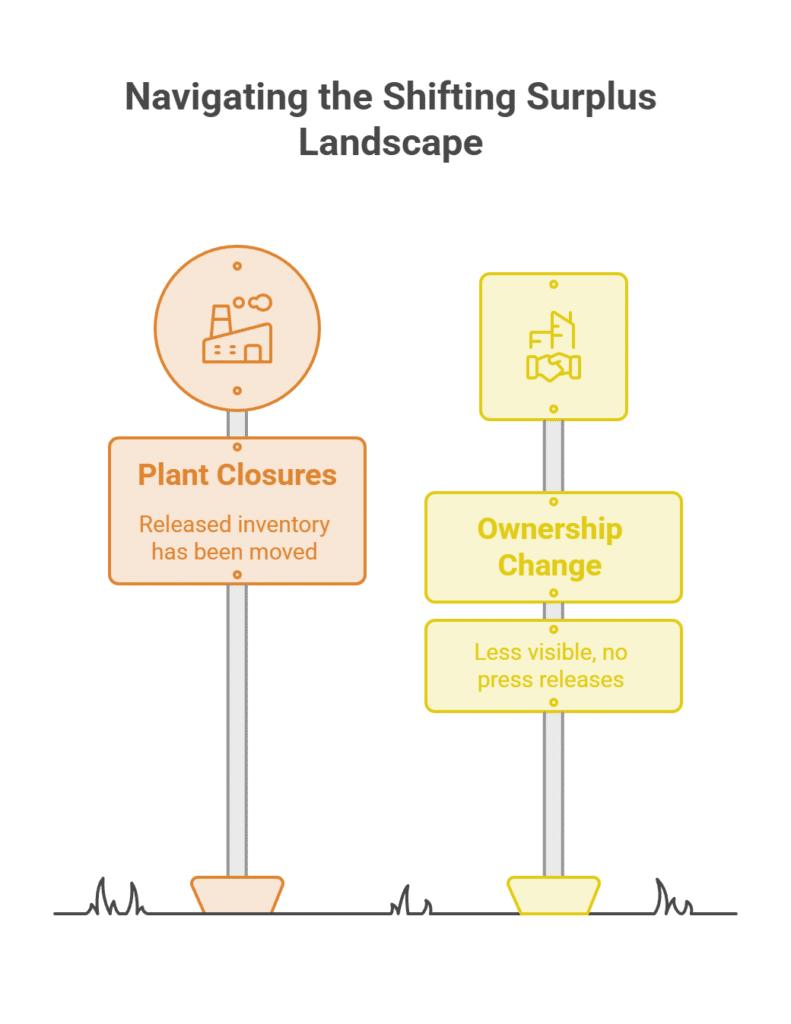
For the past two years, the surplus conversation has been driven by closures. The numbers justified it. Cefic’s Closures and Investments Radar found that European chemical plant closures reached a cumulative 37 million tonnes of capacity between 2022 and 2025, roughly 9 per cent of European production capacity, with 20,000 direct jobs lost and an estimated 89,000 indirect jobs at risk [1]. Announced annual investment capacity collapsed over the same period from 2.7 million tonnes in 2022 to 0.3 million tonnes [1]. Deloitte, analysing more than 120 publicly announced closures and mothballings globally since the start of 2022, found that total global closure announcements nearly doubled in 2025, with half of them steam crackers split roughly evenly between Asia Pacific and Europe [2].
That wave has largely worked its way through the market. The inventory it released has been identified, priced and in most cases moved. The next wave will come from somewhere different, and it will be less visible because it does not generate press releases.
It will come from ownership change.
What Distressed Divestitures Actually Reveal
Consider what has happened to European petrochemical assets in the past twelve months, and pay attention to the prices rather than the announcements.
SABIC agreed to sell its European petrochemical business to the industrial turnaround firm Aequita for $500 million. That business generated $3.6 billion in sales in 2025 and lost $1.4 billion doing so [3]. SABIC separately agreed to sell its engineering plastics business in Europe and the Americas, which makes polycarbonate, polybutylene terephthalate and ABS resins and was acquired as part of the GE Plastics purchase in 2007, to Mutares for $450 million. That business generated roughly $1.8 billion in sales in 2025 and lost more than $500 million [3].
LyondellBasell went further. Rather than receiving payment for four underperforming European facilities, it is paying Aequita $300 million to take them, comprising ethylene cracker complexes in France and Germany and polypropylene plants in England and Spain. In exchange it avoids the losses and $125 million a year in maintenance expense on ageing plants, while retaining a share of any future profits. Aequita is operating them as a new company called Velogy with approximately $2.9 billion in annual sales [3].
At the same time, consolidation is proceeding at the top of the market. Olin and Huntsman are advancing an all-stock merger to create OlinHuntsman, a North American chemicals company with more than $12 billion in annual revenue and a stated synergy target of around $400 million. Olin’s Form S-4 registration statement was declared effective on 14 July 2026, shareholder votes were set for 25 August 2026, and closing is targeted in 2027 [4] [5].
These are not the same event as a closure, and they do not produce the same consequences.
Why Ownership Change Produces More Surplus Than Closure Does
A closure is a clean, terminal decision. The plant stops, the remaining inventory is identified, and it is either transferred to a sister site, sold, or disposed of. It happens once, it happens on a known date, and it is announced.
Ownership change is a slower and much messier process, and it produces surplus in several distinct ways over an extended period.
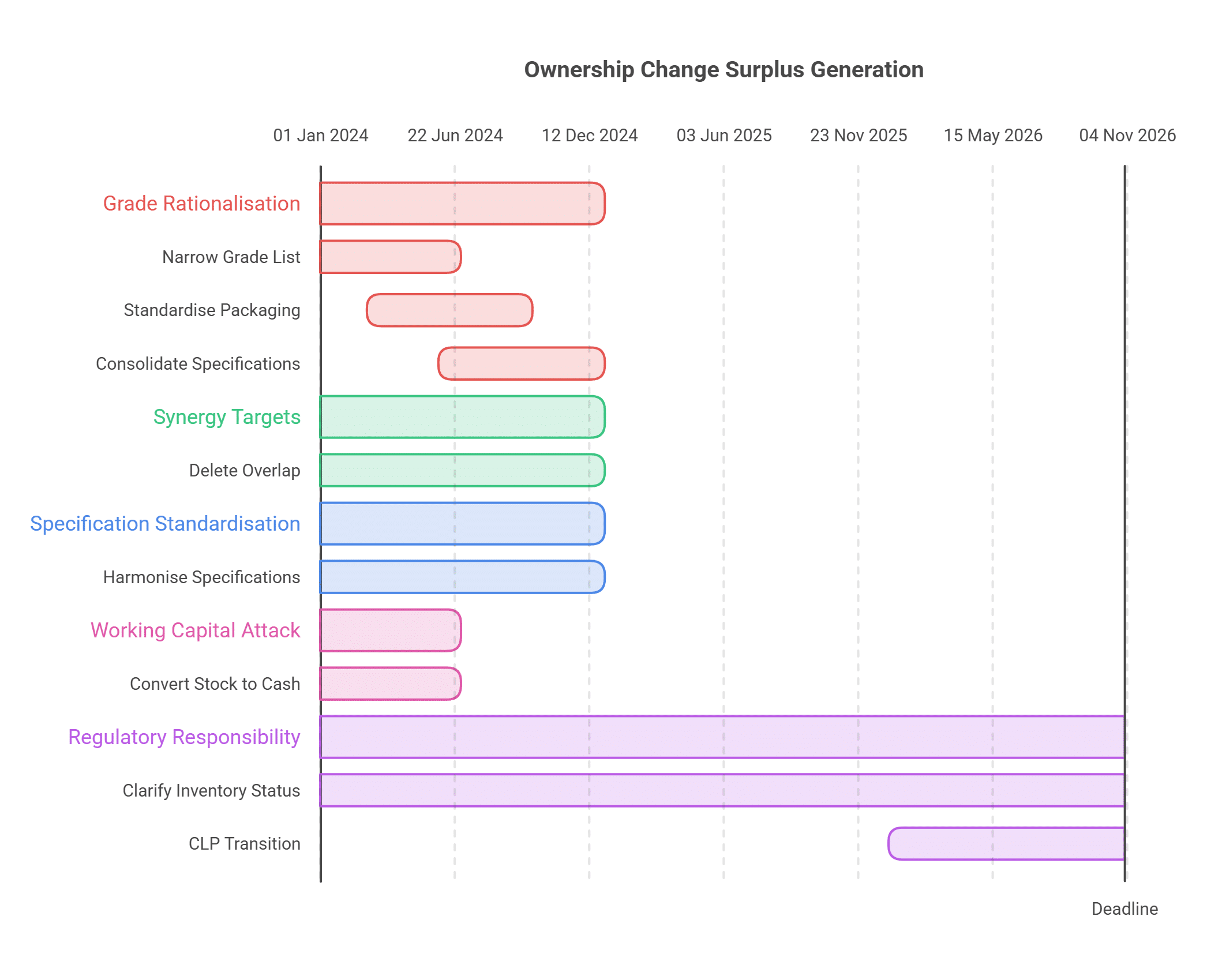
Grade rationalisation follows every transaction. A new owner inherits the full product list of the business it bought, including the long tail of low volume grades that existed for historical customer reasons. Turnaround investors in particular buy on a thesis of simplification. Within the first year they will typically narrow the grade list, standardise packaging formats, and consolidate specifications. Every grade that is deleted leaves behind whatever raw materials, intermediates and finished product were held against it.
Synergy targets are, in operational terms, a commitment to delete overlap. When a merger announces $400 million in synergies, part of that figure is procurement leverage and part is overhead, but a meaningful share is the elimination of duplicated product lines across the combined portfolio. Two companies that both made a similar intermediate will not continue to make it in two places. The losing site’s inventory, and its raw material position, becomes surplus.
Specification standardisation orphans material that is perfectly good. When a new owner harmonises internal specifications across acquired sites, material that met the old specification at one site may fall outside the new harmonised specification without having changed at all. This is one of the most common and least understood sources of genuinely on-spec surplus. The material has not degraded; the definition moved.
Working capital is the first thing a turnaround investor attacks. Inventory is cash sitting on a floor. An investor who has just paid a nominal price for a loss-making business, or been paid to take it, has an immediate and unambiguous incentive to convert slow-moving stock into cash. This is precisely the commercial motive that makes a redistribution channel useful, and it operates on a timescale of months rather than years.
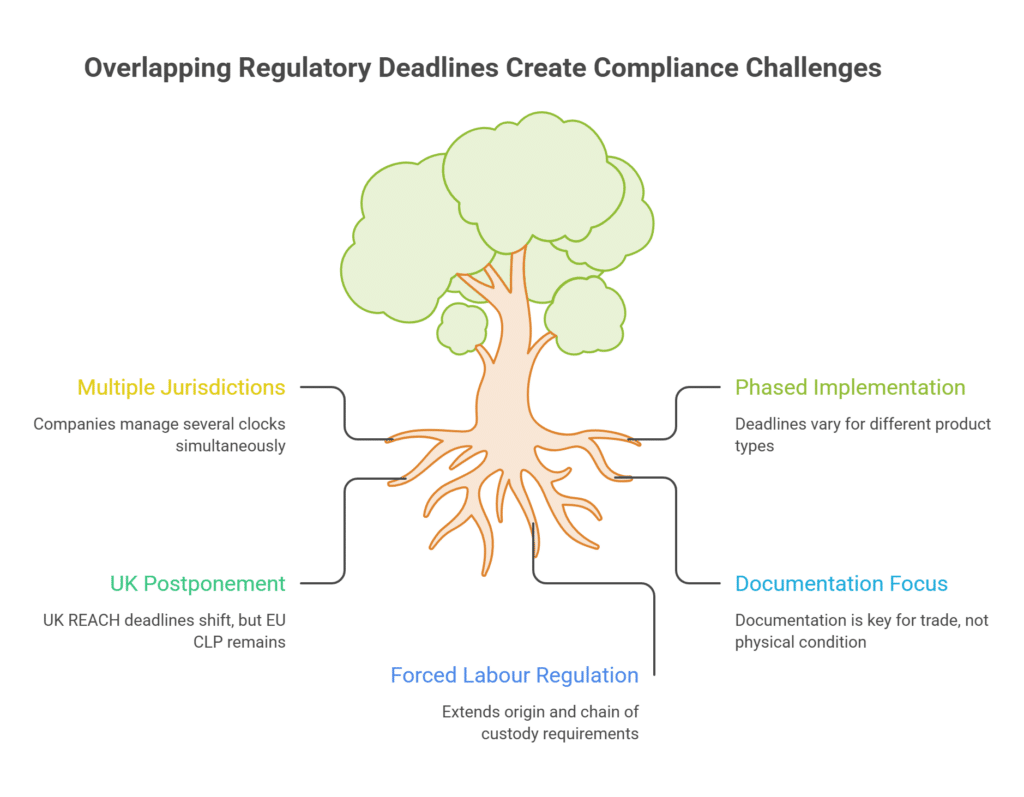
Regulatory responsibility transfers with the asset, and the receiving organisation often has an incomplete picture. As we discussed in the previous article, the classification and documentation status of inherited inventory is frequently unclear to the party that now owns it. With the CLP transition for existing substances arriving on 1 November 2026, that ambiguity has a deadline attached to it.
The Structural Backdrop Has Not Improved
None of this is happening against a recovering market. C&EN’s Global Top 50 survey, published in July 2026 and based on 2025 results, recorded total chemical sales of $965.8 billion for the fifty largest companies, a decline of 5.8 per cent, with 39 of the 50 posting lower sales [3]. Chemical operating profits for the 37 companies that disclosed them fell 19.5 per cent to $47.2 billion. Earnings declined at 25 companies and seven lost money outright [3]. Dow’s chemical operating profit fell 91.7 per cent to $158 million, a margin of 0.4 per cent; LyondellBasell’s fell 71 per cent; Sinopec recorded a $2.8 billion loss [3].
Capital expenditure across the 32 companies reporting it fell 7.8 per cent to $67.7 billion, and research and development spending across 29 companies fell 2.4 per cent, an unusual decline for an industry that normally protects its laboratories [3].
Yet capacity continues to arrive. Deloitte notes that more than 8 million tonnes of polyethylene capacity was expected to come online during 2026 from projects in China and the United States [2]. Asian producers, predominantly Chinese, brought 6.7 million tonnes of ethylene capacity online in 2025 and expected a further 6.6 million tonnes [3].
The consequence is that portfolio restructuring is not a one-off adjustment to a bad year. It is the operating condition of the industry, and the transaction pipeline reflects that. PwC’s midyear outlook recorded $67 billion of chemical M&A value on a trailing twelve month basis to the first quarter of 2026 across 552 deals, with eleven deals above $1 billion accounting for roughly 70 per cent of the total, describing a selective market where capital is available for scaled strategic assets while commodity-exposed businesses face deeper underwriting [6]. Michael Fiore of PwC framed the shift plainly:
“More broadly, companies are rethinking where they produce and invest, balancing cost with supply security, resilience and market access as they reshape their portfolios.” [6]
Every one of those reshaping decisions has an inventory consequence.
The Paradox Nobody Has Resolved
Deloitte identified the tension at the centre of all of this more sharply than anyone:
“A fundamental paradox is that industry rationalization, necessary for financial health, can undermine the supply security that customers increasingly value.” [2]
Producers need to simplify to survive. Buyers need optionality to operate. Those two requirements pull in opposite directions, and the gap between them is precisely the space a secondary market occupies.
The evidence that buyers are already hedging is visible in inventory behaviour. Deloitte found that at the end of 2025 chemical companies were holding an average of 94 days of inventory, more than 9 per cent above the prior five year average [2]. In a stable market that is expensive and inefficient. In 2026, with the disruption to Middle Eastern energy and feedstock flows, it turned out to be protective. The industry is quietly re-learning that just-in-case has a value that just-in-time accounting does not capture.
That extra buffer, however, is itself a future surplus source. Inventory held against a disruption that does not materialise, or that resolves faster than expected, becomes excess the moment the risk passes.
What This Means Practically
For buyers and procurement teams, the useful conclusion is about timing and attention. The material becoming available over the next four to six quarters will disproportionately come from businesses that have recently changed hands. Velogy, Mutares’ new plastics operation, and the combined OlinHuntsman entity if that transaction closes as targeted, are all organisations that will be actively narrowing what they produce. If you buy intermediates, polyolefins, engineering plastics or epoxy-chain materials, those portfolios are worth watching specifically, and it is worth being on a qualified buyer list before the rationalisation decisions are made rather than after.
For sellers and for the new owners of divested assets, the point is that inventory disposition should be part of the integration plan rather than a problem discovered during the first warehouse audit. A business bought at a nominal price cannot afford to pay for compliant destruction of material that a buyer somewhere would pay for. Redistribution recovers capital, removes the storage and compliance burden, and does so without the disposal cost. It is a working capital lever, and it is available immediately.
For everyone, the qualification discipline does not change. Material originating from a transferred asset is often extremely well characterised, because it was produced to a major producer’s specification in a major producer’s plant. But its documentation may have travelled less well than the material itself. The questions that matter are the same ones we set out during the sulfur disruption: does the assay meet the intended application’s minimum specification, could impurities or degradation products affect performance, can the storage history be verified, are the safety data sheet, certificate of analysis, origin and chain of custody records reliable, and is the material legally transferable in the relevant jurisdictions.
The Prediction
The closure story is largely told. The next two years of surplus supply will be shaped less by plants that stopped and more by portfolios that changed hands, and it will arrive quietly, as discontinued grades and standardised specifications rather than as announcements.
At Surplus International we are already seeing this shift in the origin of the material offered to us. Increasingly it comes not from a producer winding down a site but from an organisation working out what it actually wants to make now that it owns something it did not build.
For anyone who buys chemistry, the practical question is whether you will hear about that material before or after it has been committed elsewhere.
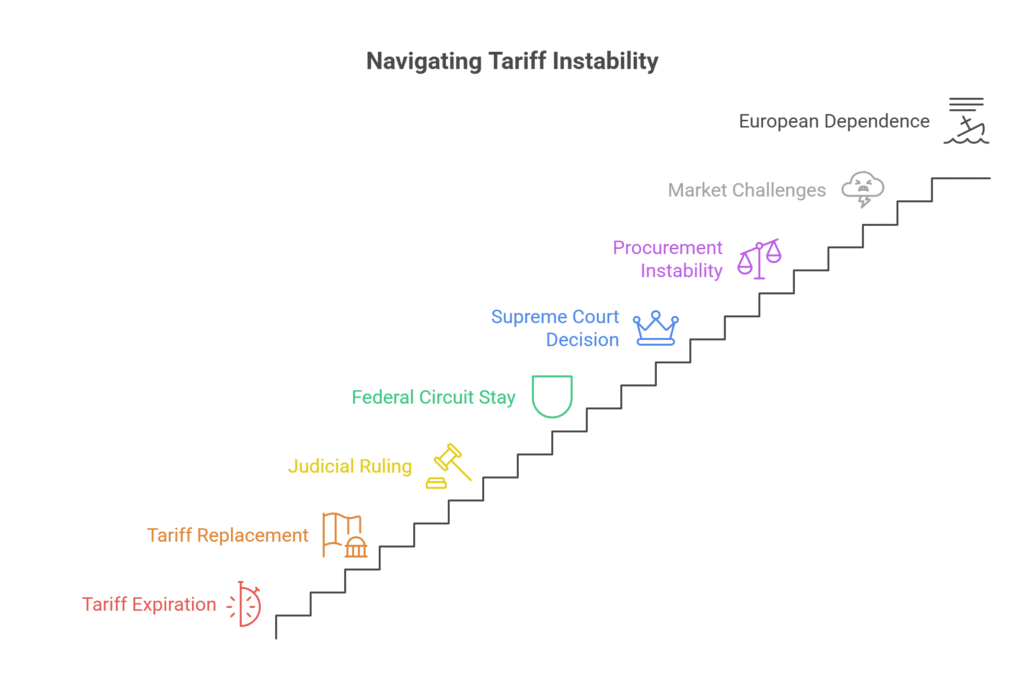
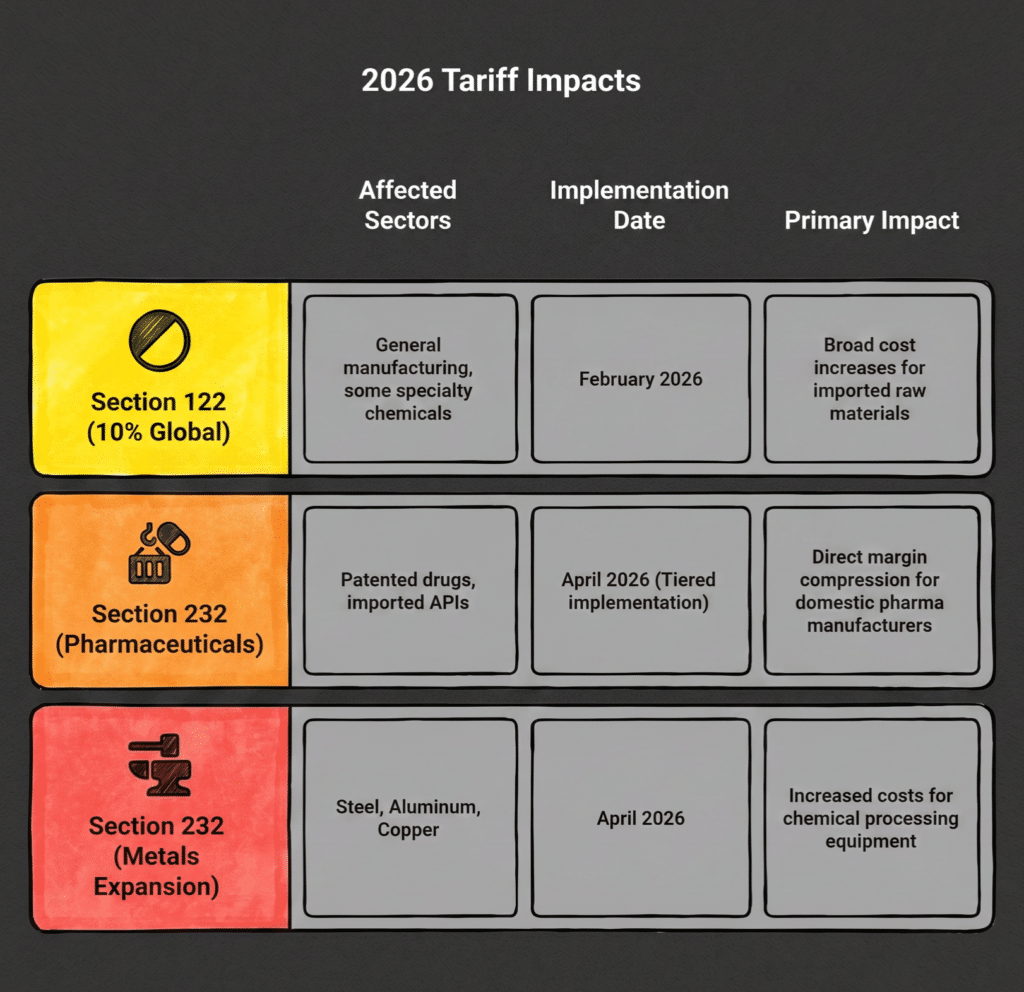
In our next article, we will examine why the current instability in chemical import tariffs, including the expiry of Section 122 in July 2026 and the flat 15 per cent EU arrangement effective 1 July, has given duty-paid material already inside the destination border an option value that a landed-cost quote cannot match.
Frequently Asked Questions
Why would a company pay someone to take a plant rather than simply close it?
Closure carries substantial costs: decommissioning, site remediation, redundancy obligations, and in integrated complexes the knock-on effect on neighbouring units that relied on the plant’s output or consumed its byproducts. Paying a turnaround specialist to take the asset transfers those liabilities along with the operations and avoids the immediate cash outflow of a shutdown, while preserving a share of any recovery. LyondellBasell’s arrangement with Aequita, which included avoiding $125 million a year in maintenance, illustrates the logic.
Is material from a divested or restructured business lower quality?
Generally no, and often the opposite. Material produced inside a major producer’s plant to that producer’s specification is typically very well characterised, with reliable certificates of analysis and documented production conditions. What can suffer during a transfer is the continuity of the records rather than the quality of the material. That is exactly why qualification should focus on documentation and chain of custody as much as on assay.
How far ahead of a rationalisation decision can availability be anticipated?
In our experience, grade pruning tends to surface between six and eighteen months after a transaction completes, once the new owner has completed its commercial review. That means the transactions completing through late 2026 and 2027 will generate their inventory consequences across 2027 and into 2028. Buyers who want first access are better served by establishing a qualified relationship early than by reacting to an offer list.
We are the new owner of a divested business. What do you need to assess our inventory?
Current inventory levels, minimum order quantities, target pricing, packaging details and logistics information including location and loading terms such as EXW or FOB. Where the material’s classification status is uncertain following the transfer, the available safety data sheets and certificates of analysis materially speed up the process. We work on clear AS-IS terms with full transparency, and we handle the complexities of cross-border chemical trade including the regulatory requirements applying in the destination market.
Does this affect buyers in India and the Far East differently?
It affects them favorably on availability. The rationalization is concentrated in North America and Europe, while much of the growing demand for cost-effective intermediates sits in India and across Asia. Our role is to connect those two positions, and the volume of material released by portfolio pruning over the next two years should improve both the range and the pricing available to buyers in those markets.
References
[1] Chemical plant closures rate surges six-fold in Europe since 2022, new report finds. Cefic, 28 January 2026. https://cefic.org/news/chemical-plant-closures-surge-six-fold-in-europe-since-2022-reaching-37mt-new-report-finds/
[2] The domino effect: Implications of chemical plant closures on supply chains. Deloitte Center for Energy and Industrials, 27 May 2026. https://www.deloitte.com/us/en/insights/industry/chemicals-and-specialty-materials/reshaping-chemical-supply-chains-plant-closures.html
[3] C&EN’s Global Top 50 chemical firms for 2026. Alexander Tullo, Chemical and Engineering News, 6 July 2026. https://cen.acs.org/business/finance/CENs-Global-Top-50-2026/104/web/2026/07
[4] Olin and Huntsman Announce S-4 Registration Statement in Connection with Planned Merger is Effective. Huntsman Corporation, 14 July 2026. https://www.huntsman.com/news/media-releases/detail/628/olin-and-huntsman-announce-s-4-registration-statement-in
[5] Olin Corporation merges with Huntsman Corporation. Interplas Insights, 6 July 2026. https://interplasinsights.com/plastics-industry-news/latest-plastics-industry-news/olin-corporation-merges-huntsman-corporation/
[6] Chemicals industry M&A: The trends ahead. Steve Ranger, SCI Chemistry and Industry, 30 July 2026. https://www.soci.org/news/2026/7/chemicals-industry-mergers-and-acquisitions-the-trends-ahead