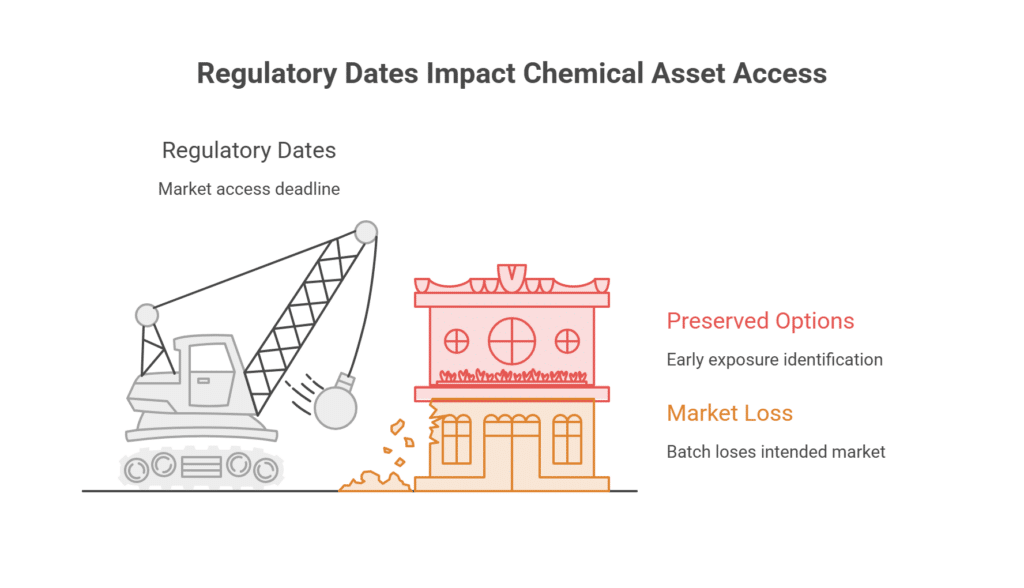

Under Commission Delegated Regulation (EU) 2023/707, which amended Annex I of the CLP Regulation, the European Union introduced new hazard classes covering endocrine disruptors for human health and the environment, and substances that are persistent, mobile and toxic or very persistent and very mobile [1]. The regulation entered into force on 20 April 2023 with staggered transition periods. Substances newly placed on the market have been subject to the new classification, labelling and safety data sheet requirements since 1 May 2025. Substances already on the market have until 1 November 2026 [2].
That is a date, not a market signal. It arrives regardless of how well the material was stored, how good the assay is, or how strong the underlying demand happens to be.
Two Kinds of Expiry
Anyone who manages chemical inventory understands physical shelf life. You track the manufacturing date, you monitor storage conditions, you retest when a certificate of analysis ages out, and you make a judgement about whether the material still performs.
Regulatory shelf life behaves differently, and most inventory systems are not built to see it. A material can be chemically indistinguishable from the day it was produced and still become commercially awkward, because the obligation attached to it has changed. Its classification is now incomplete under the current framework. Its label no longer reflects the required hazard information. Its safety data sheet describes a regulatory reality that has been superseded.
None of that makes the substance dangerous in any new way. The hazard was always there; the framework has simply caught up with it. But it does mean that a batch which could have been sold, shipped and documented with minimal friction in October may require reclassification work, a revised safety data sheet, and relabelling before it can move in November.
For a large, actively traded product line, that cost is absorbed into normal operations. For dormant inventory, the arithmetic can invert entirely. When the compliance cost of preparing a drum for sale approaches or exceeds the value of what is in the drum, the material stops being an asset in any practical sense. It becomes a decision that has been deferred, and the deferral has now acquired a deadline.
The Full Calendar Is Wider Than One Date
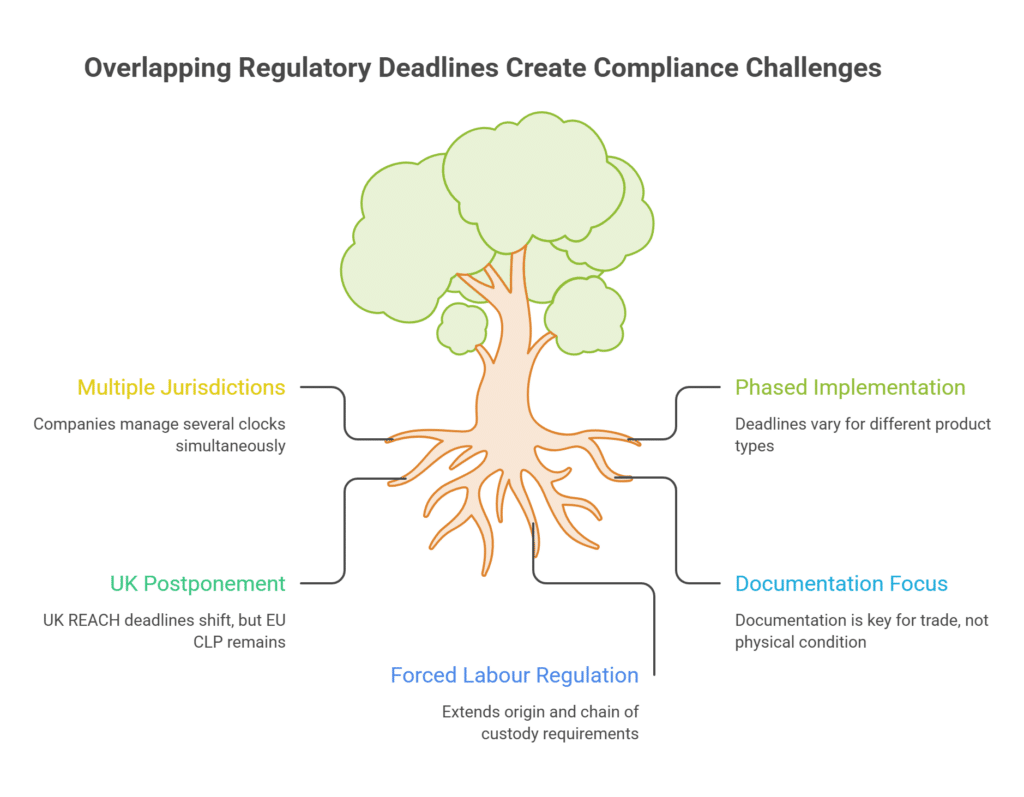
The CLP transition is the nearest deadline for European holders, but it sits inside a cluster of obligations landing across 2026 and 2027. Companies operating across multiple jurisdictions are managing several clocks at once.
| Framework | Scope | Deadline |
|---|---|---|
| EU CLP Annex I (Reg. 2023/707) | Substances already on the market, new hazard classes | 1 November 2026 [2] |
| EU CLP Annex I (Reg. 2023/707) | Mixtures already on the market | 1 May 2028 [2] |
| Turkey KKDIK | Registration for substances at or above 1,000 tonnes per annum | 31 December 2026 [3] |
| Turkey KKDIK | SIEF joint submission of interim registration | 30 September 2026 [3] |
| US OSHA Hazard Communication Standard | Mixtures newly placed on the market, updated SDS and labels | 19 November 2027 [4] |
| EU Forced Labour Regulation | Prohibition on products made with forced labour | 14 December 2027 [5] |
| Ukraine UA REACH | Pre-registration | 26 January 2027 [3] |
The United Kingdom moved in the opposite direction, postponing its three transitional UK REACH registration deadlines from 2026, 2028 and 2030 to 2029, 2030 and 2031 while an Alternative Transitional Registration model is developed [3]. That relieves pressure on one front, but it does not touch the CLP obligation for material sitting in EU warehouses, and Downstream User Import Notification and safety data sheet duties continue in the meantime.
The pattern that matters commercially is this: the documentation attached to a batch is becoming a larger determinant of whether that batch can be traded than the batch’s physical condition. That trend runs in one direction only. The EU Forced Labour Regulation, which prohibits products made with forced labour from being sold in or exported from the Single Market from 14 December 2027, extends the same logic to origin and chain of custody rather than hazard [5].
Why This Matters More for Surplus Than for Active Stock
Active product lines have owners. Someone is responsible for the grade, tracks its regulatory status, and has a budget for keeping its documentation current. When a classification change arrives, the work gets scheduled.
Surplus inventory usually has no such owner. It exists precisely because the commercial reason for holding it has gone: a production overrun, a cancelled order, a formulation change, a packaging change, a discontinued product line, or a bulk purchase that outlived the demand it was bought for. Nobody is assigned to it. It appears in the system as a quantity and a location, and it is reviewed when someone runs a warehouse audit or when the space is needed for something else.
This is where the label cliff does its damage. The material most likely to be caught by a classification transition is the material nobody is watching, and the material nobody is watching is the material least likely to be prepared in time.
Three specific situations deserve attention between now and November:
Legacy packaging and old labels. Where inventory sits in packaging printed before the current classification framework, the label is a physical artefact that has to be replaced rather than a file that has to be updated. That takes handling, labour, and in some cases a repack.
Material inherited through restructuring. The consolidation wave has moved a great deal of inventory between legal entities. When a business unit changes hands, regulatory responsibility for the stock in its warehouses changes with it, and the receiving organisation may not have a complete picture of what it now owns.
Small residual quantities of many different substances. A single substance with a large volume justifies the reclassification work on its own. Two hundred part-drums of forty different substances is a very different proposition, and it is a common profile for warehouses that have absorbed several years of production tails.
What Sellers Should Do Before November
The practical response is not complicated, but it does need to start now rather than in October.
Begin by identifying what is dormant. Any material with no outbound movement in twelve months, and no forecast demand, should be pulled into a separate review list regardless of its book value. Then, for each line, establish whether it falls within scope of the new hazard classes and whether its existing classification and safety data sheet already reflect them. This is a technical determination that depends on the substance, its intended use, and the available data, and it should be made by someone qualified to make it rather than assumed either way.
For material that is in scope and not yet compliant, the question becomes a straight comparison. What does it cost to reclassify, reissue documentation and relabel, and what is the material actually worth once that work is done? Where the answer favours the work, do the work. Where it does not, there are only two honest options: redistribute the material to a party who can use it and can handle the documentation, or write it off and pay to dispose of it.
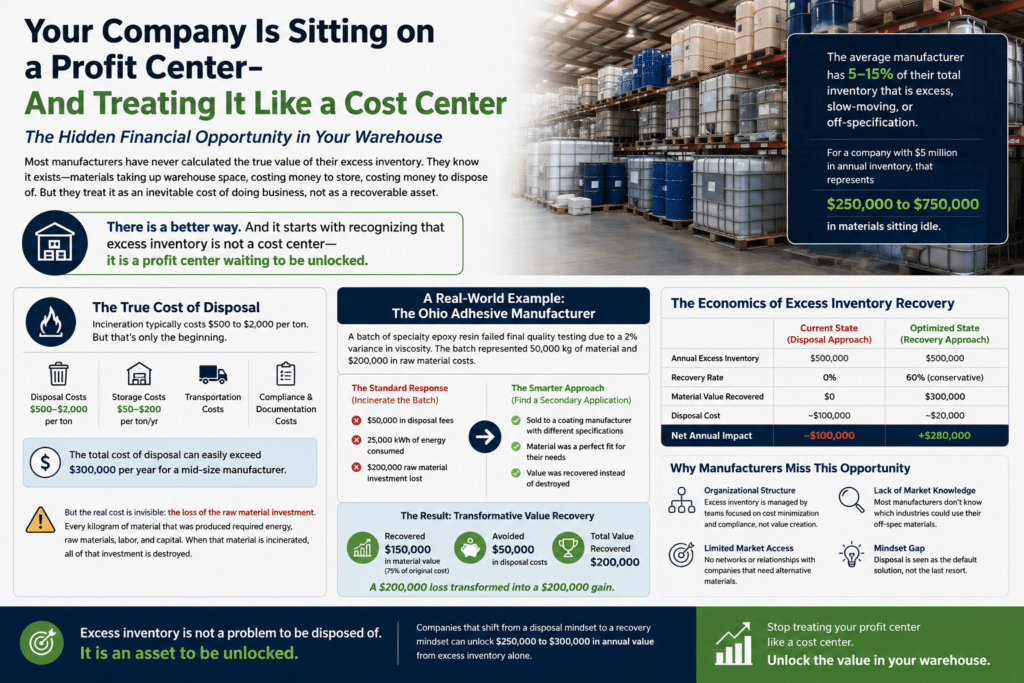
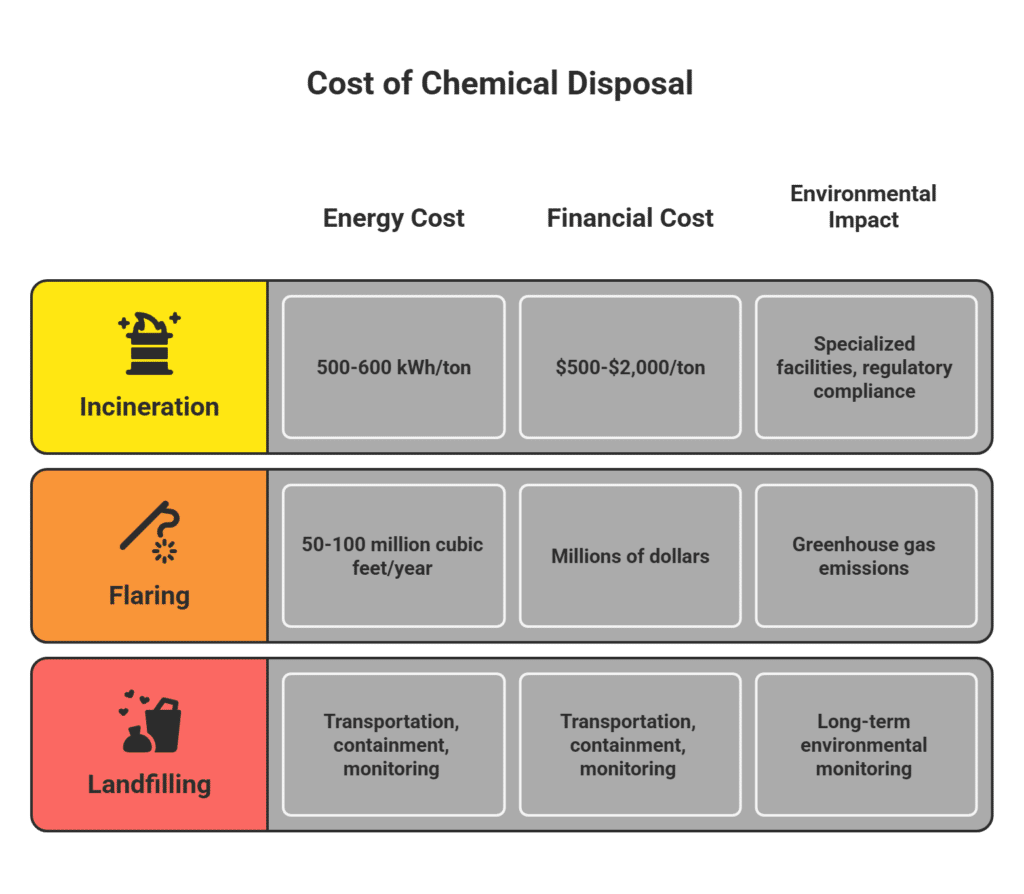
Disposal is the expensive option, and it is expensive twice. There is the direct cost of compliant destruction, and there is the loss of the embedded value and embedded energy in a material that somebody else could have used as a feedstock. The International Energy Agency notes that the chemical sector is among the largest industrial energy consumers, with a substantial share of that energy embodied in feedstock rather than burned as process heat [6]. Destroying usable material discards that investment entirely.
What Buyers Should Ask
For procurement teams sourcing from the secondary market, this transition is an opportunity, but only if the qualification discipline holds. Cheap material with incomplete documentation is not a bargain; it is a transferred liability.
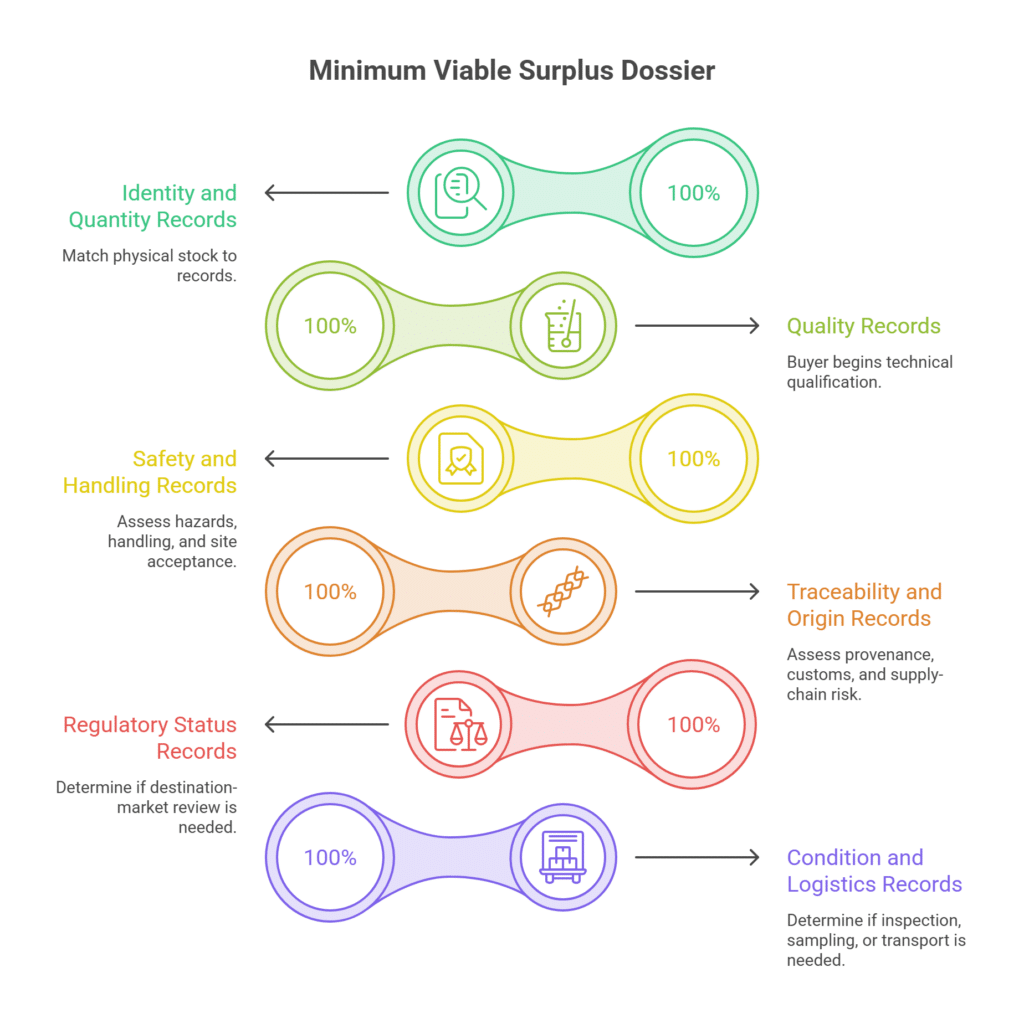
Before taking on a secondary batch in the current environment, five questions still govern the decision, and the fourth has become considerably more important than it was two years ago. Does the assay meet the minimum specification for the intended application? Could impurities or degradation products affect performance in that application? Can the storage history and present condition be verified? Are the safety data sheet, certificate of analysis, origin records and chain of custody reliable and current under the framework that will apply on the date of transfer? And is the material legally transferable as a product or by-product in every jurisdiction the transaction touches?
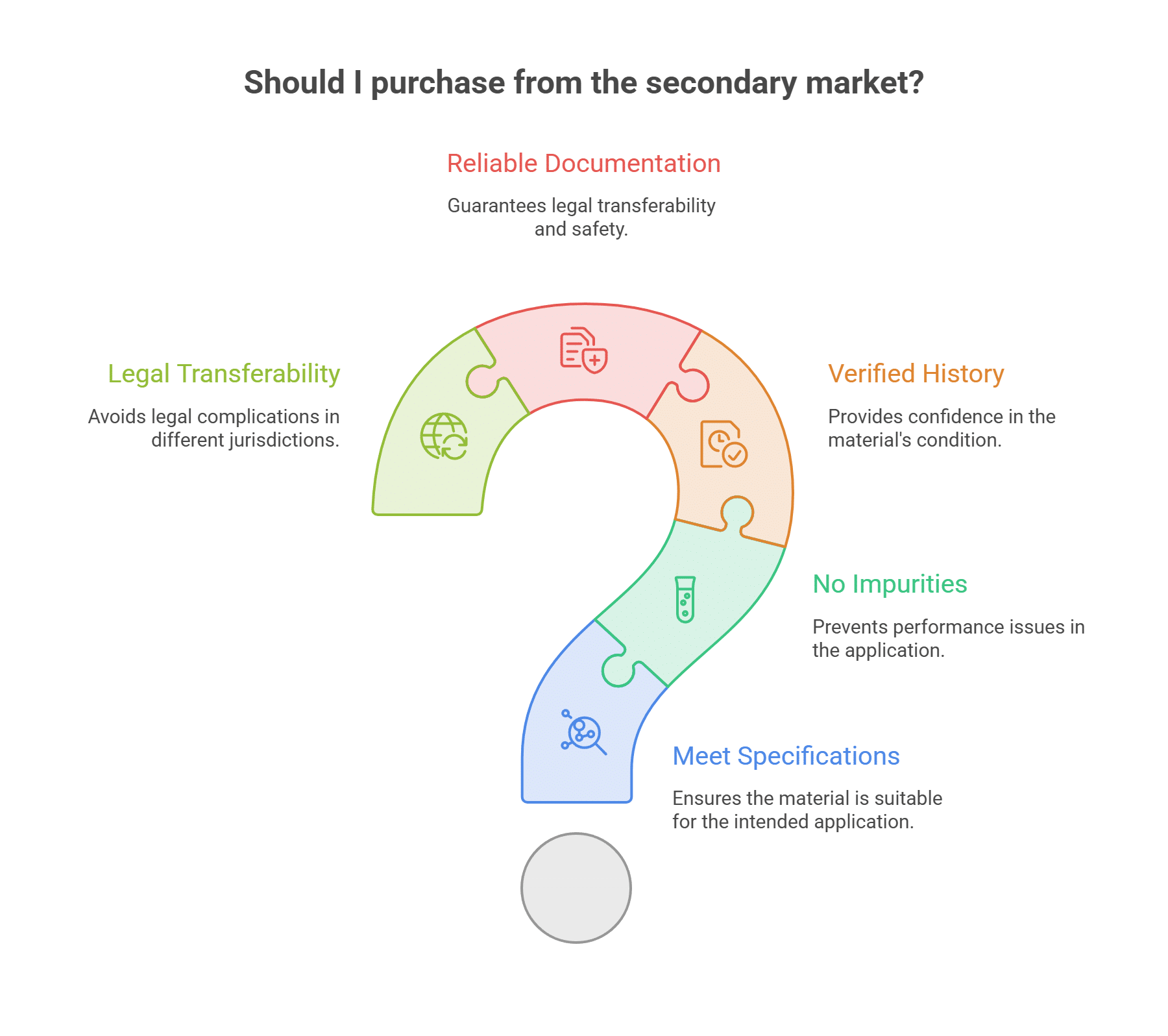
That fourth question is where the label cliff shows up in practice. A batch whose documentation was correct when it was produced may need updated classification before it can legitimately change hands after 1 November. A serious counterparty will have already done that work, or will tell you plainly that it has not been done and what remains outstanding. Anyone who cannot answer the question at all is telling you something too.
The Broader Point
The surplus market has historically been discussed in terms of price. Material is available below the cost of virgin product, disposal costs are avoided, warehouse space is freed. Those advantages are real and durable.
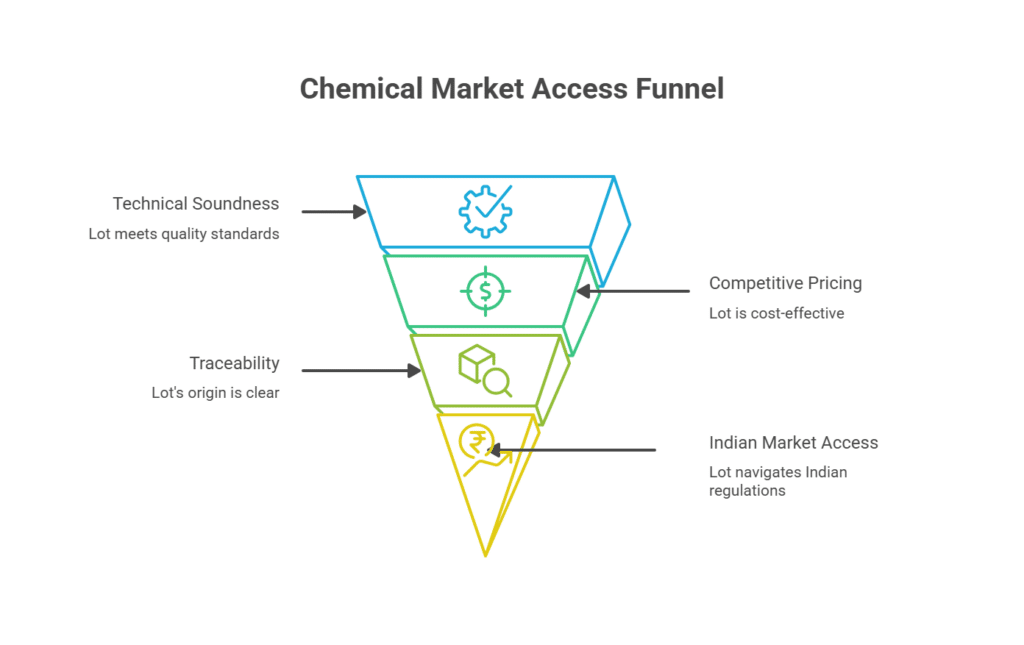
But the market is maturing into something more demanding. As classification frameworks tighten, as origin and chain of custody become enforceable rather than aspirational, and as buyers in regulated sectors such as pharmaceuticals, agriculture and cosmetics require full traceability, the ability to trade surplus material depends less on finding it and more on being able to document it. The gap between a professional redistribution channel and an opportunistic broker is widening, and 1 November is one of the dates where that gap becomes visible.
At Surplus International, we are seeing this reflected in the enquiries reaching us from Europe. The conversation used to begin with price. Increasingly it begins with paperwork: what documentation exists, what is missing, what can be reconstructed, and whether the material can legitimately move before the transition date. That is a healthier conversation, and it is the one worth having in the next three months rather than the next three years.
If you are holding dormant European inventory, the useful step this quarter is not a valuation. It is an audit.
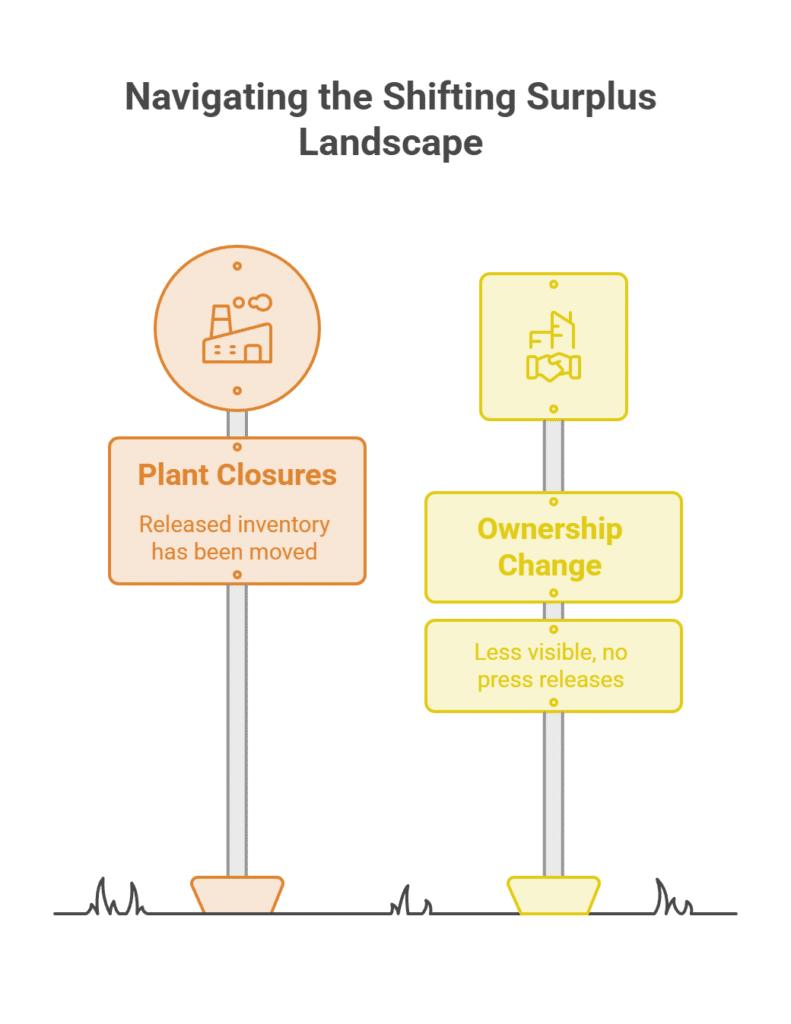
In our next article, we will look at where the next wave of surplus material is likely to originate, and why the answer is no longer plant closures but the portfolio pruning that follows large ownership changes such as the SABIC and LyondellBasell divestitures to Aequita and Mutares, and the pending Olin and Huntsman merger.
Frequently Asked Questions
Does the 1 November 2026 deadline apply to all chemicals in our European warehouse?
No. The transition applies to substances already on the market that fall within the scope of the new hazard classes introduced by Commission Delegated Regulation (EU) 2023/707, namely endocrine disruptors for human health and the environment, and persistent, mobile and toxic or very persistent, very mobile substances. Whether a given substance is in scope depends on its properties and the available data. Existing mixtures have a longer transition, until 1 May 2028. We recommend a scope assessment by a qualified regulatory function rather than a blanket assumption in either direction.
If our inventory is not compliant by the deadline, is it now waste?
Not necessarily, and this is an important distinction. A classification and documentation gap is an administrative deficiency, not a change in the material itself. In many cases the gap can be closed through reclassification, an updated safety data sheet and relabeling. The commercial question is whether that work costs less than the material is worth. Where it does not, redistribution to a party who can absorb the documentation work is generally preferable to disposal, both financially and environmentally.
How does Surplus International handle documentation for material affected by a regulatory transition?
Our due diligence process covers material documentation, origin and intended use before any transaction proceeds. For pharmaceutical grade materials we work with certified suppliers and align transactions with GxP, FDA and EMA expectations, providing traceability throughout. Where documentation is incomplete, we say so, and we assess what can be reconstructed and what cannot. Sales are conducted on clear AS-IS terms with full transparency about the condition and documentation status of the material.
We are a buyer in India or the Far East. Does an EU classification deadline affect us?
Directly, it affects the material you are offered rather than your own obligations, which are governed by your local framework. Indirectly it matters a great deal, because a European holder facing a reclassification cost on dormant stock has a strong incentive to move that material before the deadline rather than after. Availability in the coming months is likely to be better than usual, particularly for residual quantities and legacy packaging. The qualification discipline on your side should not relax because of it.
What information do you need to assess our surplus inventory?
To list stock we need current inventory levels, minimum order quantities, target pricing, packaging details and logistics information including location and loading terms such as EXW or FOB. Where a regulatory transition is in play, current classification status and any available safety data sheet and certificate of analysis materially improve the speed and the outcome of the process.
References
[1] Commission Delegated Regulation (EU) 2023/707 of 19 December 2022 amending Regulation (EC) No 1272/2008 as regards hazard classes and criteria for the classification, labelling and packaging of substances and mixtures. EUR-Lex. https://eur-lex.europa.eu/eli/reg_del/2023/707/oj
[2] 2026 Chemical Regulatory Outlook for Europe, the US, and Key Markets. REACH24H, updated 21 July 2026. https://en.reach24h.com/news/insights/chemical/chemical-regulatory-outlook-europe-americas-2026
[3] 2026 Chemical Regulatory Outlook for Europe, the US, and Key Markets (Turkey KKDIK, Ukraine UA REACH and UK REACH sections). REACH24H, updated 21 July 2026. https://en.reach24h.com/news/insights/chemical/chemical-regulatory-outlook-europe-americas-2026
[4] Final Rule to Amend the Hazard Communication Standard. US Occupational Safety and Health Administration. https://www.osha.gov/hazcom/rulemaking
[5] Commission launches first tools to prepare for ban on products made with forced labour. Single Market and Industry News, European Commission, June 2026. https://ec.europa.eu/newsroom/growth/newsletter-archives/77032
[6] Global Critical Minerals Outlook 2026, Executive Summary. International Energy Agency. https://www.iea.org/reports/global-critical-minerals-outlook-2026/executive-summary