
This is a critical strategic mistake.
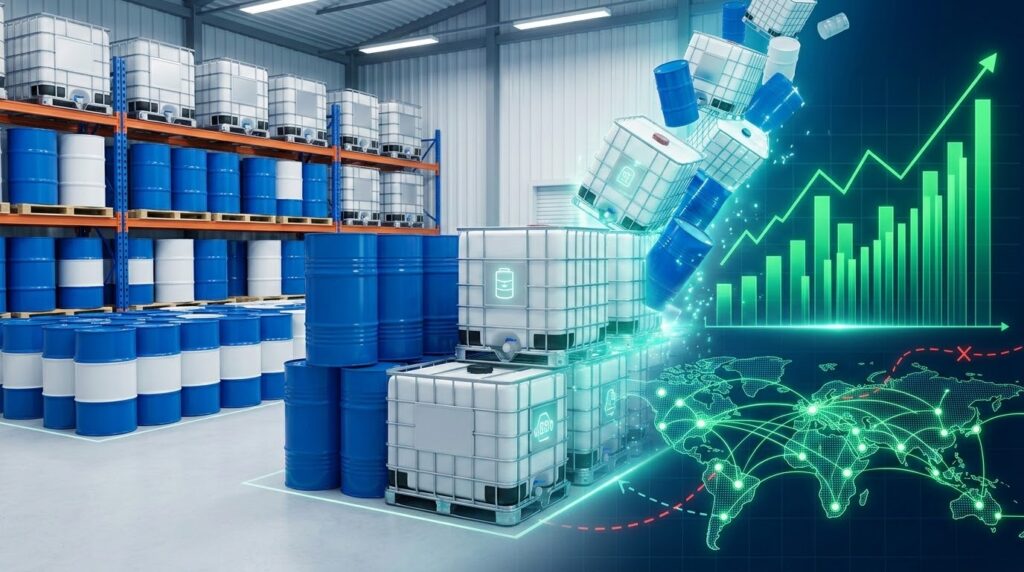
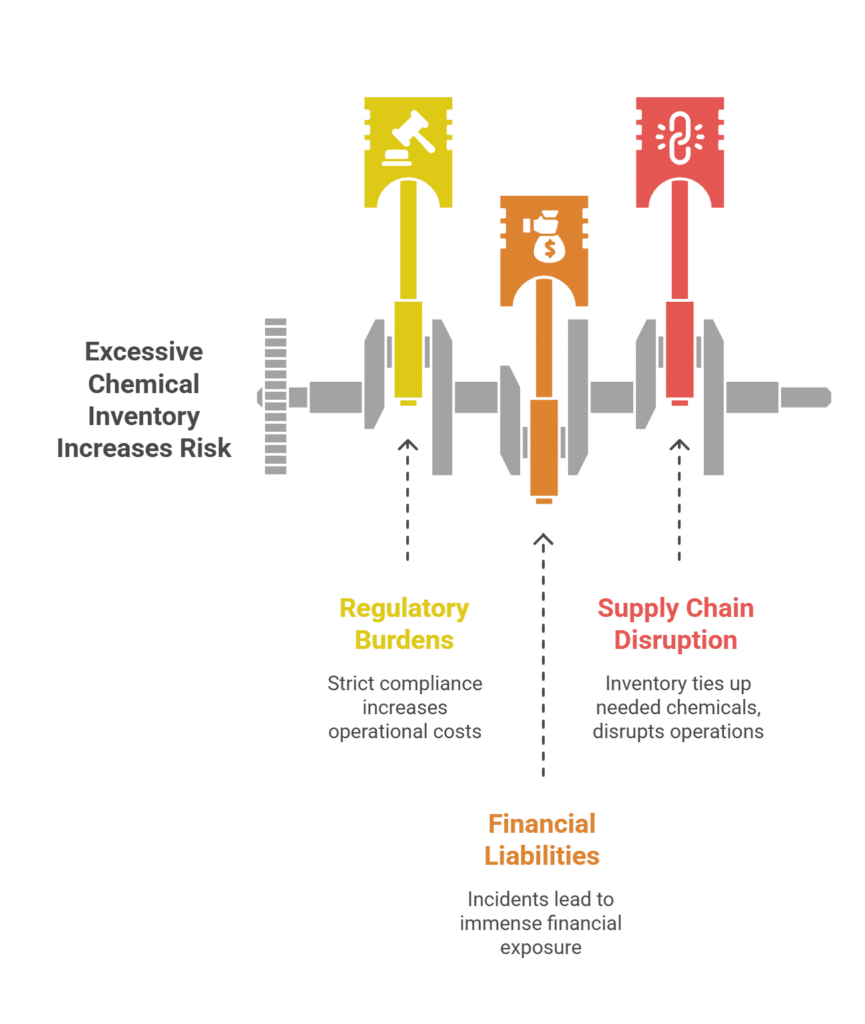
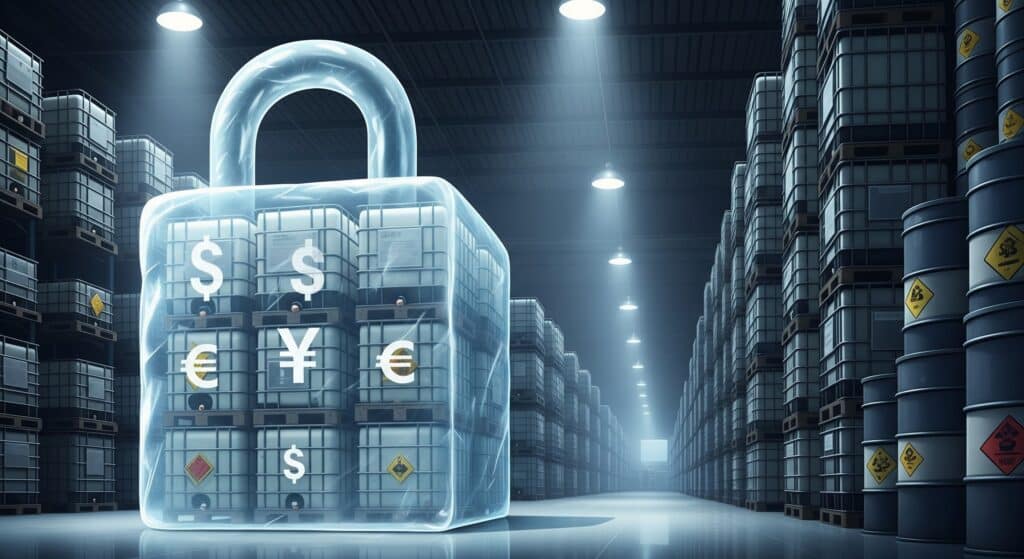
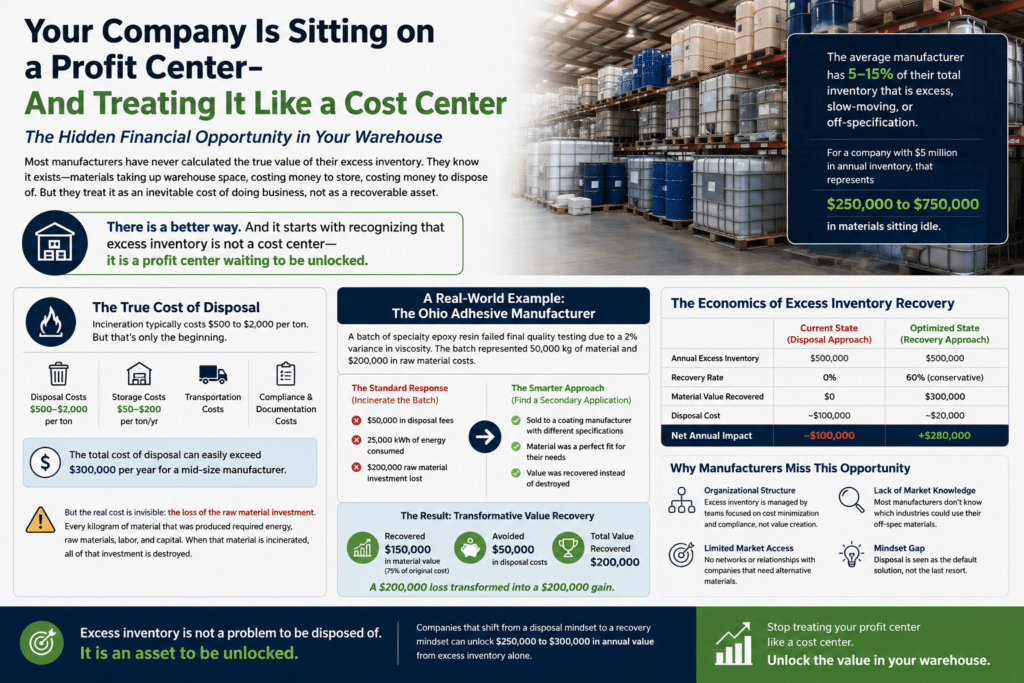
The average manufacturer has 5-15% of their total inventory that is excess, slow-moving, or off-specification. For a company with $5 million in annual inventory, that represents $250,000 to $750,000 in materials sitting idle. Yet most companies respond to this situation with a single approach: disposal. They incinerate it, landfill it, or pay specialized waste management companies to handle it. The result is predictable: the material is destroyed, the raw material investment is lost, and the company pays disposal fees on top of everything else.
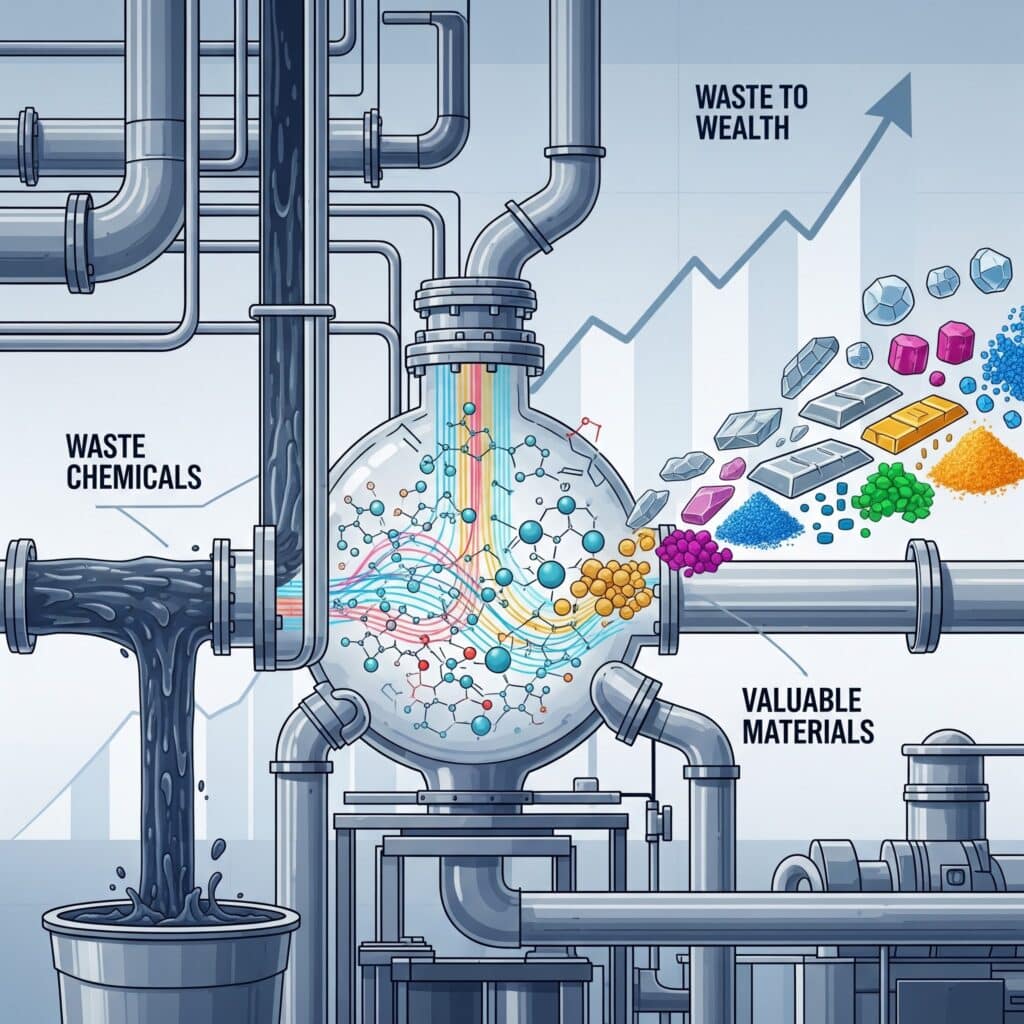
There is a better way. And it starts with recognizing that excess inventory is not a cost center- it is a profit center waiting to be unlocked.
The True Cost of Disposal
To understand why this matters, let’s examine what disposal actually costs.
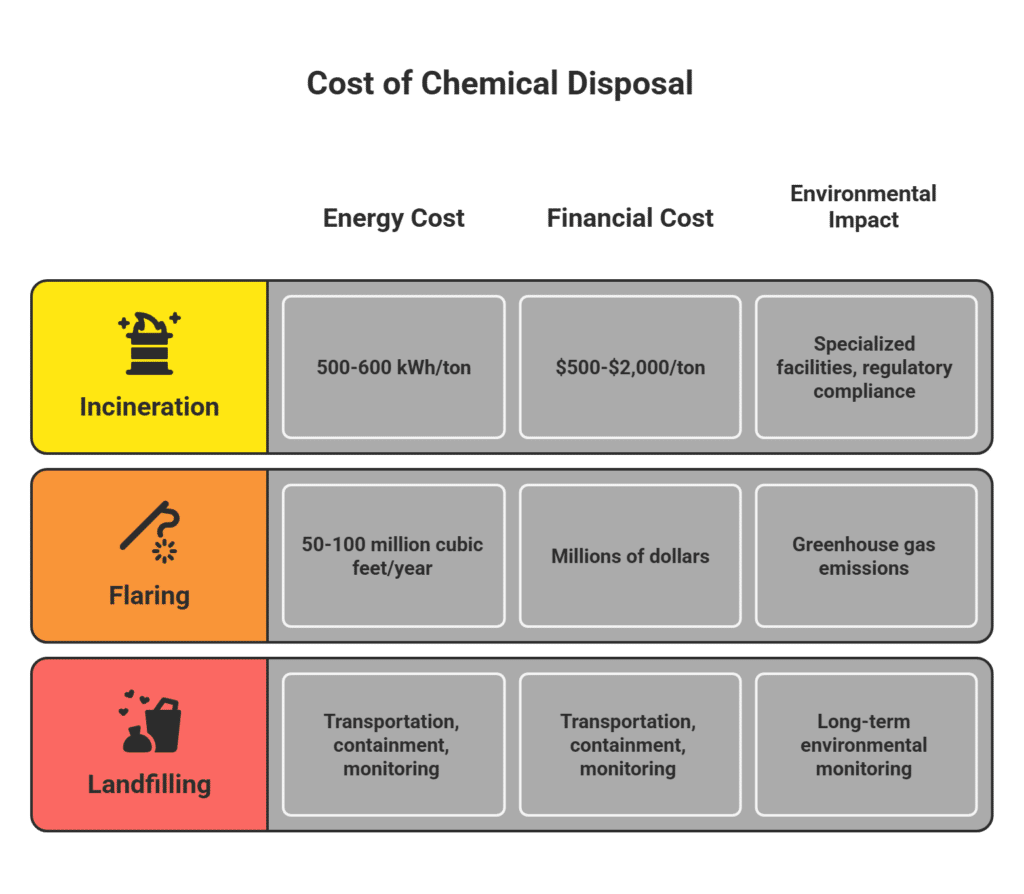
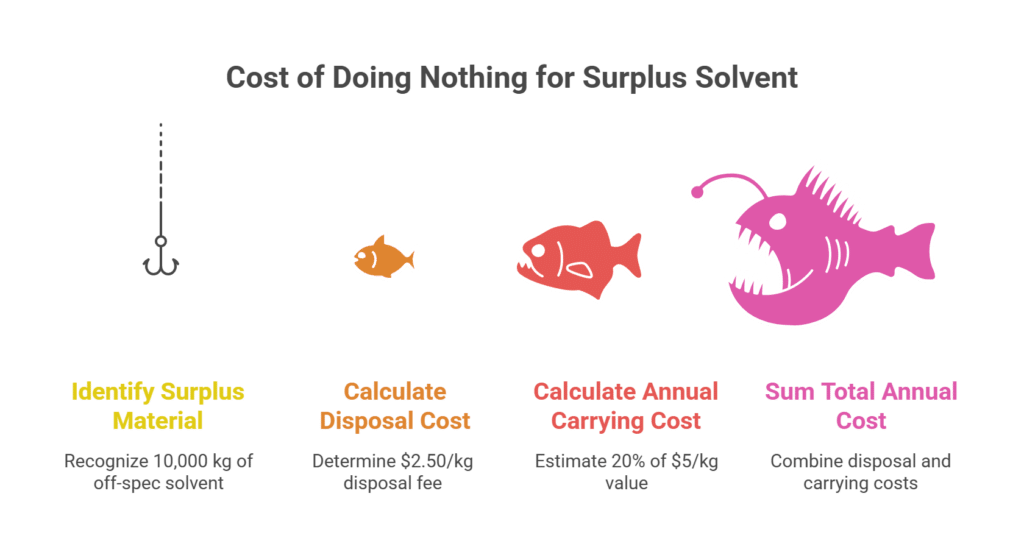
Incineration, the most common method for disposing of excess chemicals, typically costs $500 to $2,000 per ton. For a manufacturer disposing of 100 tons of off-specification materials annually, this represents $50,000 to $200,000 in direct disposal costs. But this is only the beginning. There are also storage costs ($50-$200 per ton annually), transportation costs, regulatory compliance costs, and documentation costs. The total cost of disposal can easily exceed $300,000 per year for a mid-size manufacturer.
But the real cost is invisible: the loss of the raw material investment. Every kilogram of material that was produced required energy, raw materials, labor, and capital. When that material is incinerated, all of that investment is destroyed. A batch of specialty epoxy resin that cost $200,000 in raw materials to produce is gone- not recovered, not repurposed, simply destroyed.
This is the fundamental problem with treating excess inventory as a disposal challenge rather than an opportunity challenge.
A Real-World Example: The Ohio Adhesive Manufacturer
Consider the case of an adhesive manufacturer in Ohio who faced this exact situation in 2025.
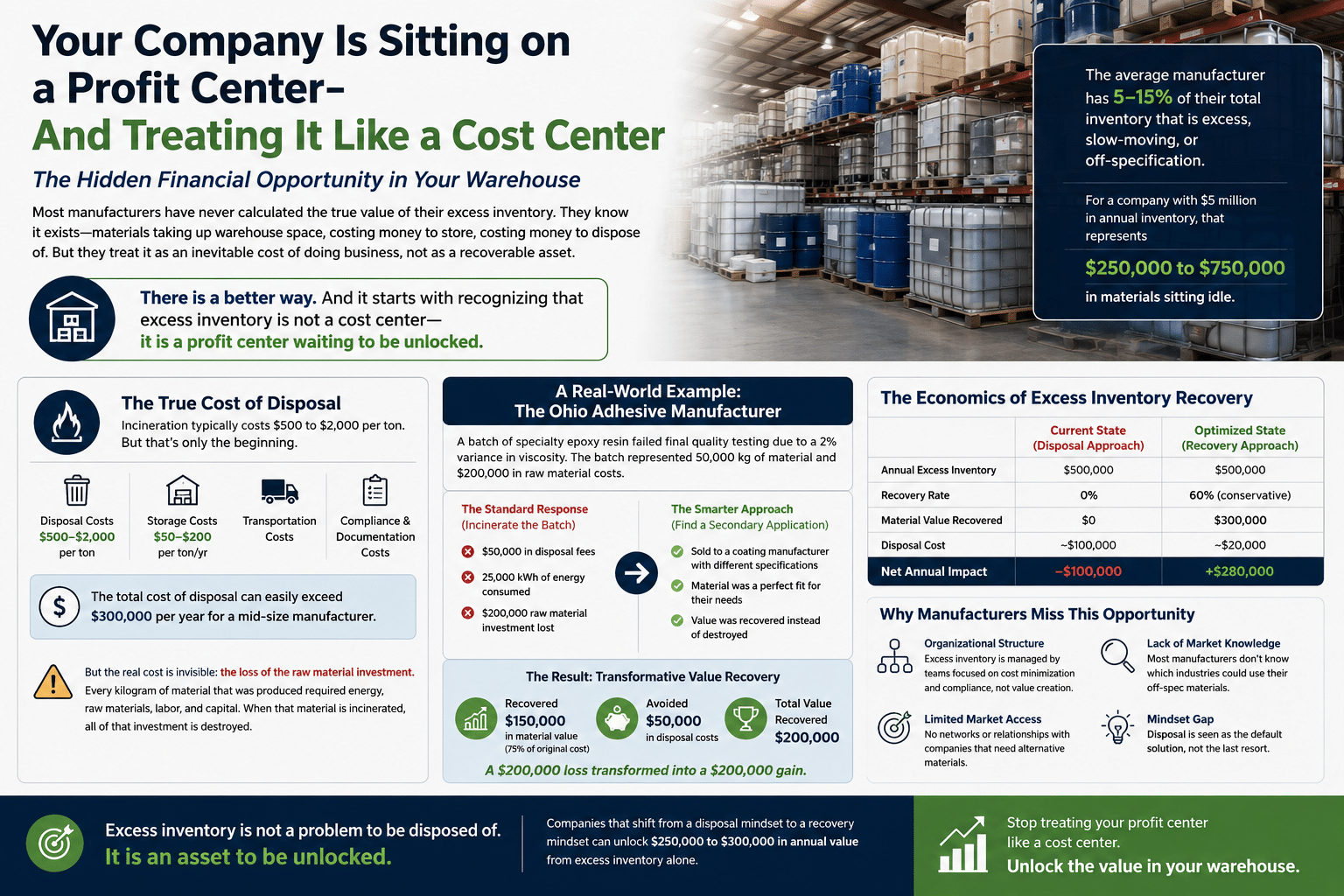
A production run of specialty epoxy resin had failed final quality testing due to a 2% variance in viscosity from the target specification. The batch represented 50,000 kg of material and $200,000 in raw material costs. By any standard measure, this was a failed batch. The material did not meet the original specification, so it could not be sold to the original customer.
The standard response would have been straightforward: incinerate the batch. This would have cost approximately $50,000 in disposal fees and consumed 25,000 kWh of energy in the incineration process. The complete loss of the $200,000 raw material investment would have been accepted as a cost of manufacturing.
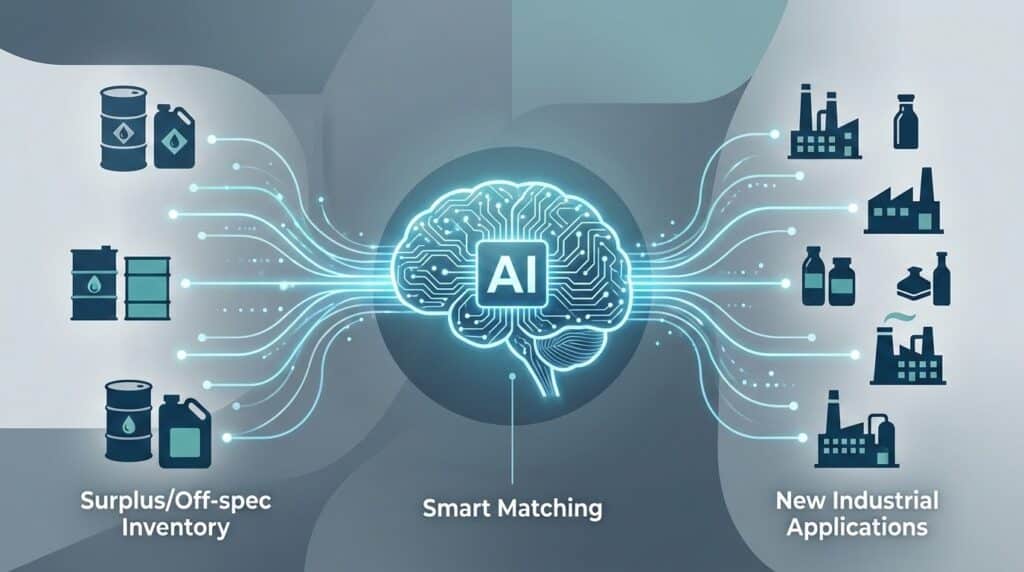
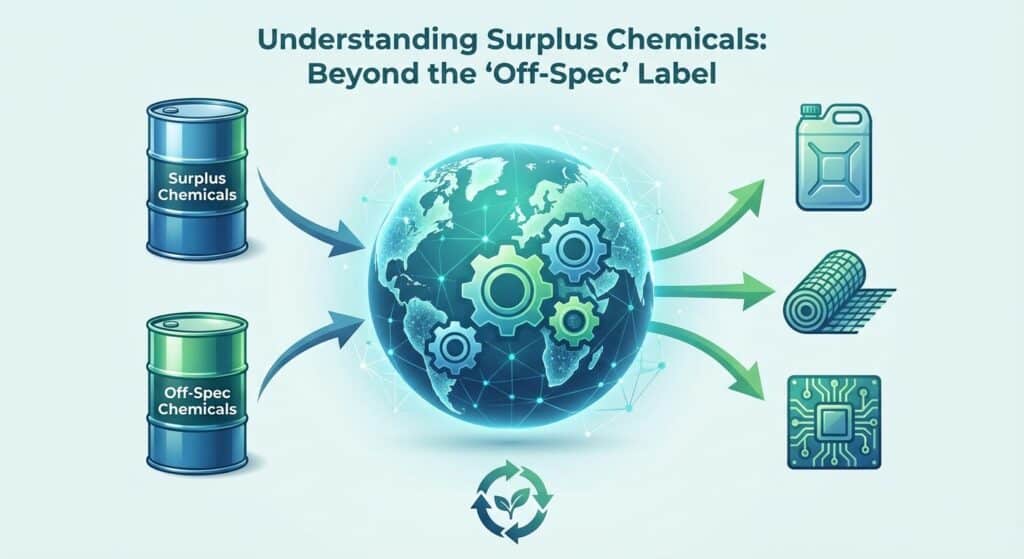
But the manufacturer chose a different path. Instead of accepting the loss, they worked with a network of industry partners to identify a secondary application for the material. The key insight was simple: while the material did not meet the original specification, it was perfectly suited for a different application. A coating manufacturer required an adhesive precursor with similar chemical properties but more relaxed viscosity tolerances. The failed batch was ideal.
The result was transformative:
- Recovered $150,000 in material value (75% of the original raw material cost)
- Avoided $50,000 in disposal costs
- Total value recovery: $200,000
In a single transaction, the manufacturer transformed a $200,000 loss into a $200,000 gain. The material that was supposed to be destroyed became revenue.
The Economics of Excess Inventory Recovery
This example is not an outlier. It represents a systematic opportunity that exists across manufacturing industries.
Consider the financial mathematics for a typical manufacturer:
Current State (Disposal Approach):
- Annual excess inventory: $500,000 (10% of $5M total inventory)
- Disposal cost: $500-$2,000 per ton (average $1,000/ton)
- Storage cost: $50-$200 per ton annually (average $100/ton)
- Total cost: ~$100,000 annually
- Raw material value recovered: $0
Optimized State (Recovery Approach):
- Annual excess inventory: $500,000
- Recovery rate: 60% (conservative estimate)
- Material value recovered: $300,000
- Disposal cost for unrecoverable material: ~$20,000
- Net value recovery: $280,000
The difference is not marginal. It is transformative. A company that shifts from a disposal mindset to a recovery mindset can unlock $250,000 to $300,000 in annual value from excess inventory alone.
Why Manufacturers Miss This Opportunity
If the financial opportunity is so clear, why do most manufacturers continue with disposal-based approaches?
The answer lies in organizational structure and expertise. Excess inventory management typically falls under the purview of operations, procurement, or waste management teams. These teams are optimized for cost minimization and compliance, not for value creation. Their goal is to dispose of the material safely and legally, not to find secondary markets or alternative applications.
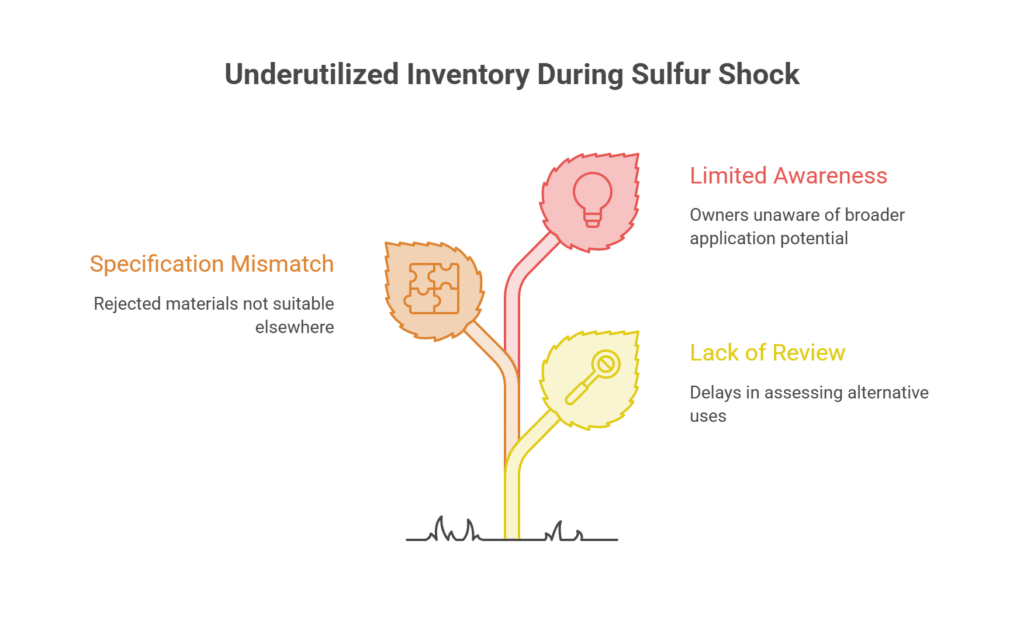
Additionally, identifying secondary applications for off-specification materials requires market knowledge that most manufacturers do not possess. A pharmaceutical company knows the pharma market intimately, but may not know that their off-specification solvent is perfectly suited for use in adhesive manufacturing or coating production. Without this market knowledge, the material appears to have no value.
This is where specialized expertise becomes critical. Companies that have deep networks across multiple industries can identify secondary applications that individual manufacturers would never discover on their own. They understand where off-specification materials from one industry can be perfectly suited for another. They know the regulatory requirements for different applications. They understand pricing and market dynamics. This expertise is what transforms excess inventory from a cost center into a profit center.
The Strategic Imperative: From Disposal to Recovery
The shift from disposal-based thinking to recovery-based thinking represents a fundamental change in how manufacturers approach excess inventory. Rather than asking “How do we dispose of this material safely and cost-effectively?”, the question becomes “What is this material worth, and where can it create value?”
This shift has multiple benefits beyond the immediate financial recovery:
Financial Impact: Direct value recovery of 40-70% of raw material costs, plus avoided disposal costs.
Operational Impact: Reduced warehouse space requirements, improved inventory turnover, better cash flow management.
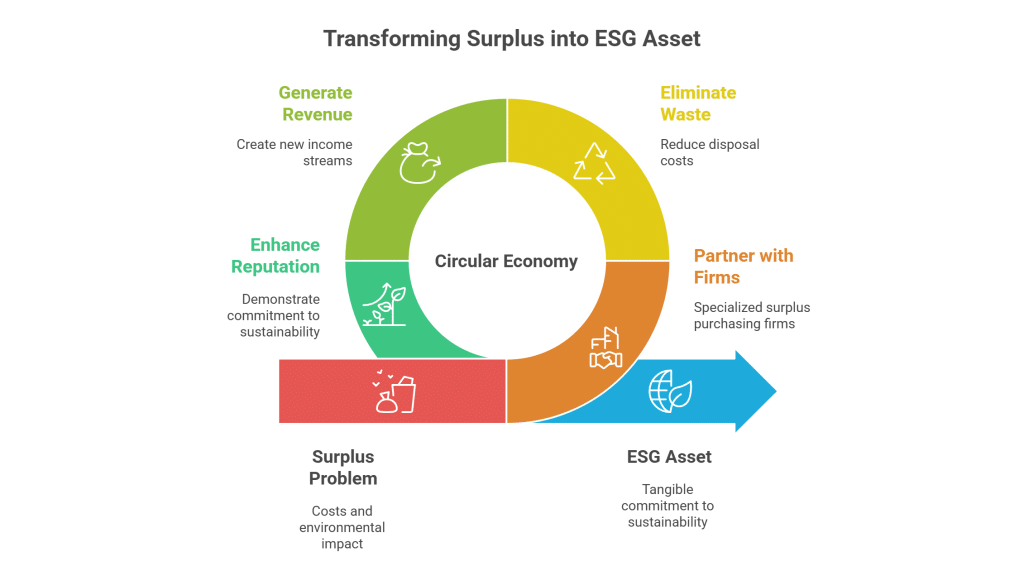
Environmental Impact: Reduced waste going to landfills or incinerators, lower energy consumption, reduced carbon footprint. This directly supports corporate sustainability goals and ESG commitments.
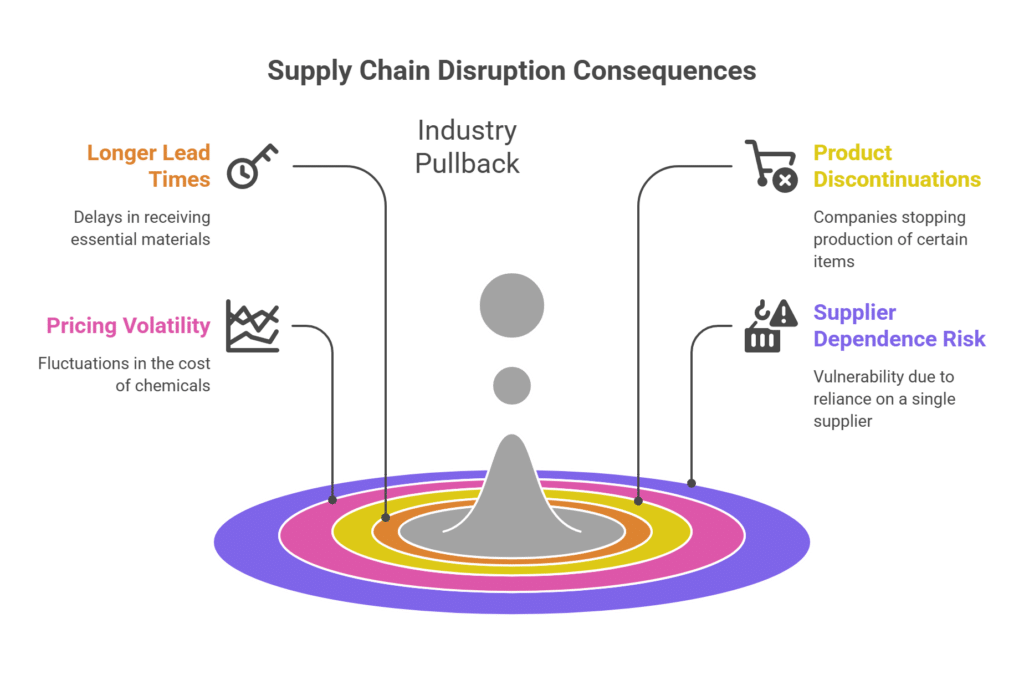
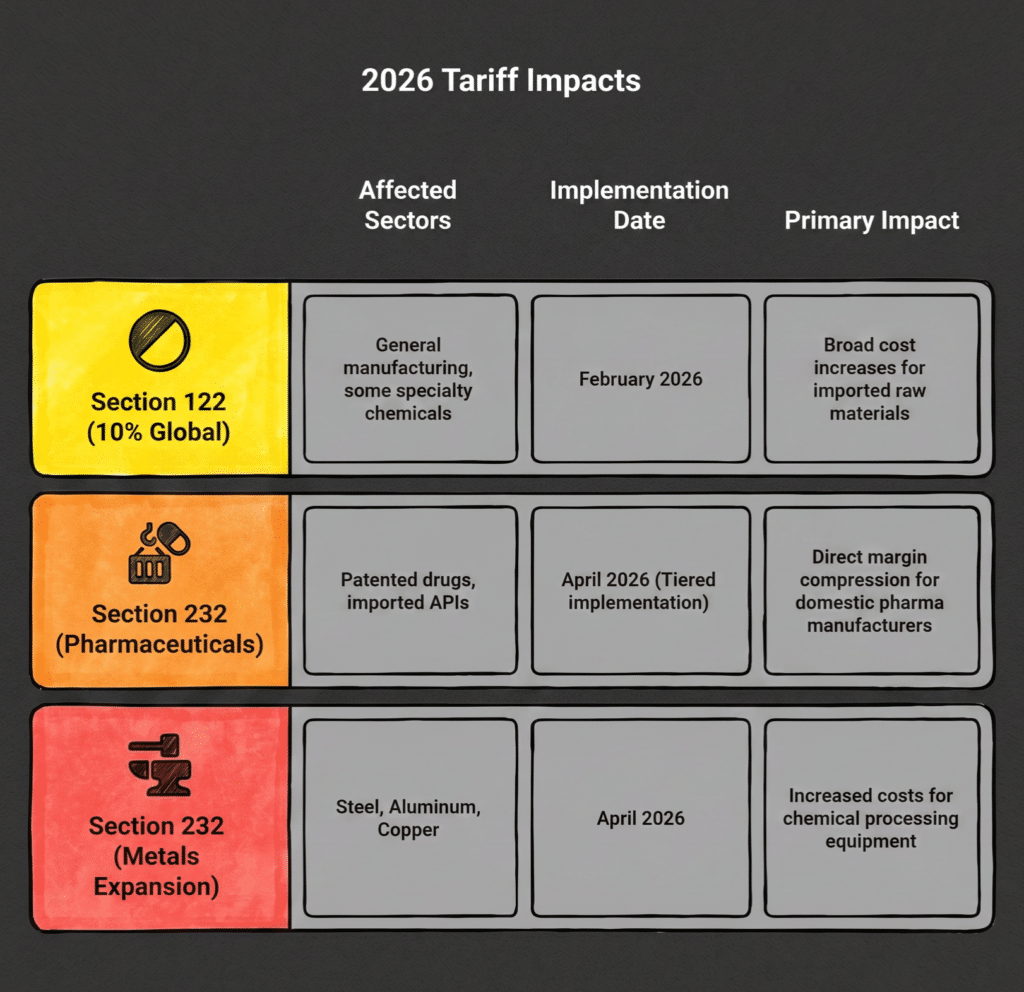
Strategic Impact: Building resilience in supply chains by developing relationships with secondary markets and alternative suppliers. This is particularly important in the current environment of tariff volatility and supply chain disruption.
How to Calculate Your Excess Inventory Value
To understand the opportunity in your own organization, start with a simple calculation:
- Identify your total annual inventory value. This is typically found in your financial statements or inventory management system.
- Estimate the percentage that is excess or slow-moving. Industry averages range from 5-15%, but your company’s percentage may be higher or lower depending on your industry and manufacturing processes.
- Calculate the dollar value. If your annual inventory is $5 million and 10% is excess, that is $500,000.
- Apply a recovery rate. Conservative estimates suggest 40-60% of excess inventory can be recovered through secondary market placement. Using 50%, that is $250,000 in potential value.
- Compare to current disposal costs. If you are currently spending $100,000 annually on disposal, the net opportunity is $150,000.
For many manufacturers, this calculation reveals a significant financial opportunity that has been invisible in their current accounting systems.
Taking Action: From Opportunity to Reality
Recognizing the opportunity is the first step. Capturing it requires action.
The most effective approach is to work with partners who have the market knowledge and networks to identify secondary applications for your excess materials. These partners understand the regulatory requirements for different industries, know the pricing dynamics of secondary markets, and have relationships with potential buyers.
The process typically involves:
- Inventory assessment: Identifying which excess materials have secondary market potential
- Specification analysis: Understanding what applications the materials could serve
- Market identification: Finding potential buyers in secondary markets
- Regulatory compliance: Ensuring all documentation and compliance requirements are met
- Logistics coordination: Managing packaging, transportation, and delivery
- Value realization: Converting the material into revenue
This is not a one-time transaction. It is an ongoing process that becomes part of your supply chain strategy. As you build relationships with secondary market partners and develop expertise in identifying secondary applications, the recovery rate improves and the process becomes more efficient.
The Bottom Line
Your company is sitting on a profit center. The question is whether you will treat it as a cost center or as an opportunity.
The Ohio adhesive manufacturer chose to see their failed batch as an opportunity rather than a loss. The result was $200,000 in value recovery. That same opportunity exists in your organization, waiting to be discovered.
The first step is recognizing that excess inventory has value. The second step is taking action to recover it.
If you would like to explore how much value might be hidden in your excess inventory, contact us for a confidential assessment. We help manufacturers recover value from excess, slow-moving, and off-specification materials- transforming what appears to be waste into measurable financial recovery.
Your profit center is waiting!