
The 2026 Tariff Landscape: How Trade Barriers are Reshaping the Off-Spec Chemical Market
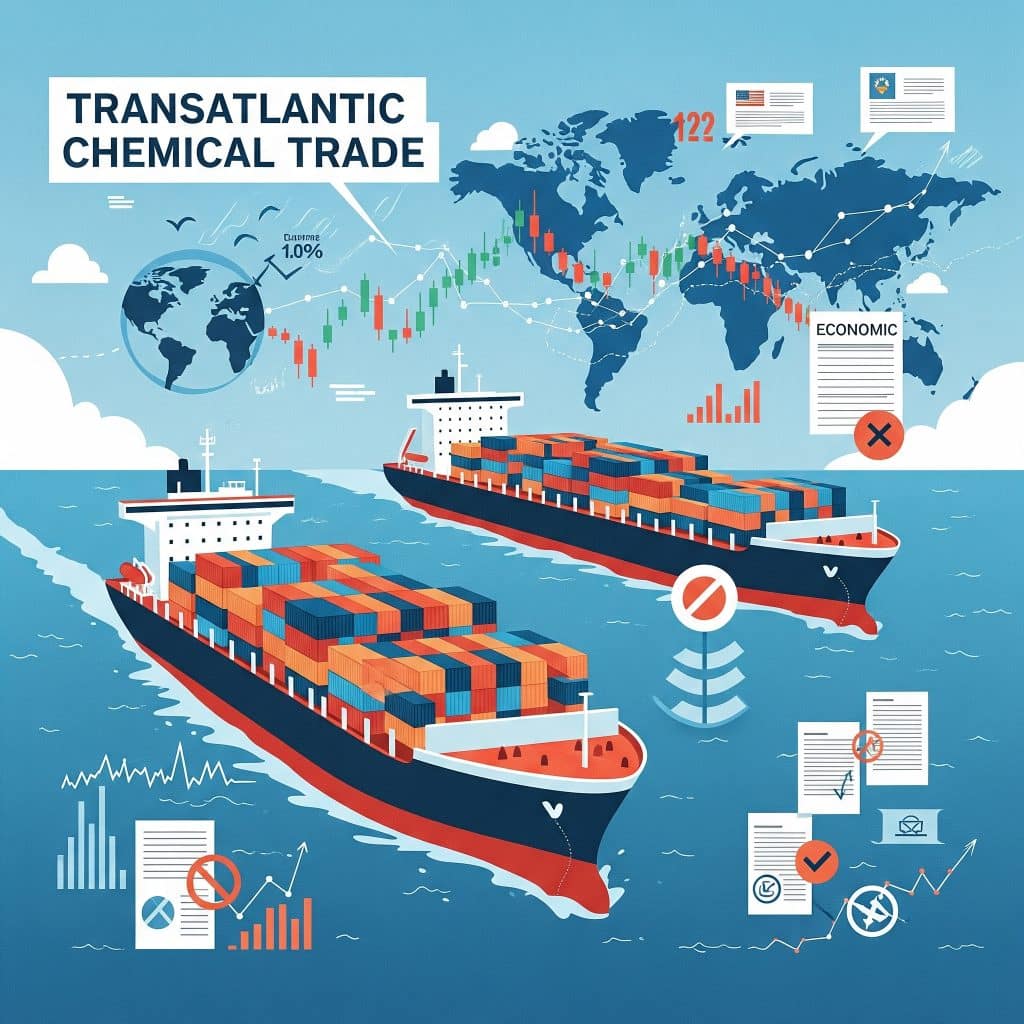
The 2026 overhaul of U.S. trade policy, including new Section 232 tariffs on pharmaceuticals and Section 122 duties, has created unprecedented volatility in chemical supply chains. While some bulk chemicals were spared, the ripple effects of increased costs for imported active pharmaceutical ingredients (APIs) and specialty compounds are forcing procurement leaders to rethink their strategies. Sourcing domestic off-spec and surplus chemicals has emerged as a critical hedge against these international trade barriers, offering price stability, supply chain resilience, and a buffer against sudden regulatory shifts.
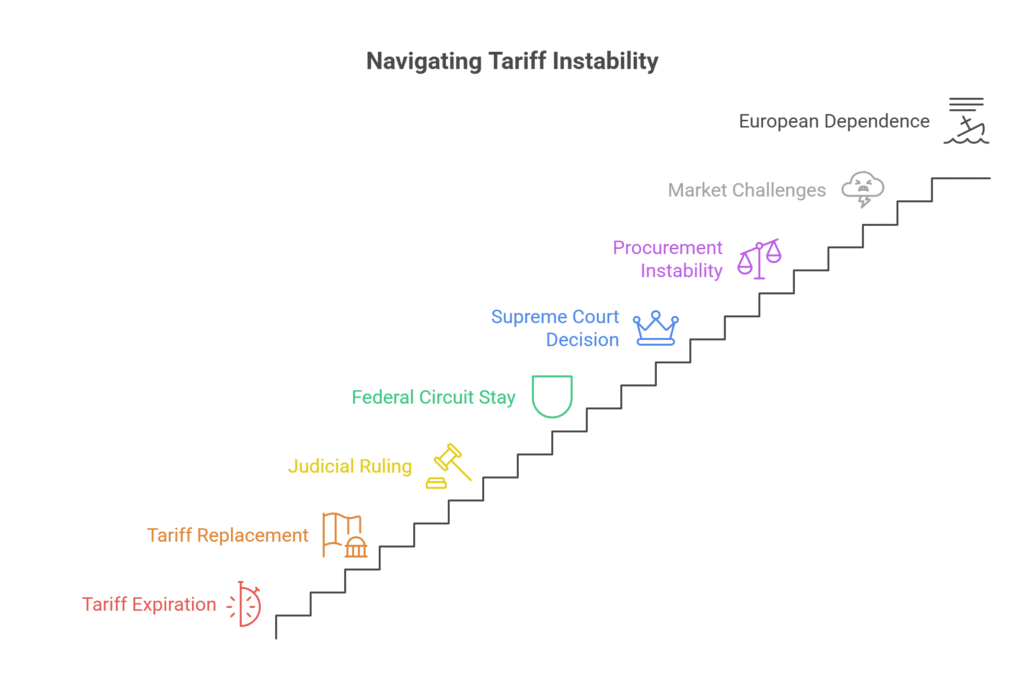
The first quarter of 2026 delivered a seismic shock to global supply chains. Following a Supreme Court ruling that struck down emergency tariffs, the Trump administration rapidly pivoted, implementing a new 10% global tariff under Section 122 and expanding Section 232 tariffs to include patented pharmaceuticals and active pharmaceutical ingredients (APIs) [1] [2].
For procurement directors and supply chain managers in the chemical and pharmaceutical sectors, the era of predictable, low-cost international sourcing is over. As companies scramble to secure reliable feedstocks without destroying their margins, a previously overlooked strategy is gaining immense traction: the strategic sourcing of domestic off-spec and surplus chemicals.
The New Reality of Chemical Imports
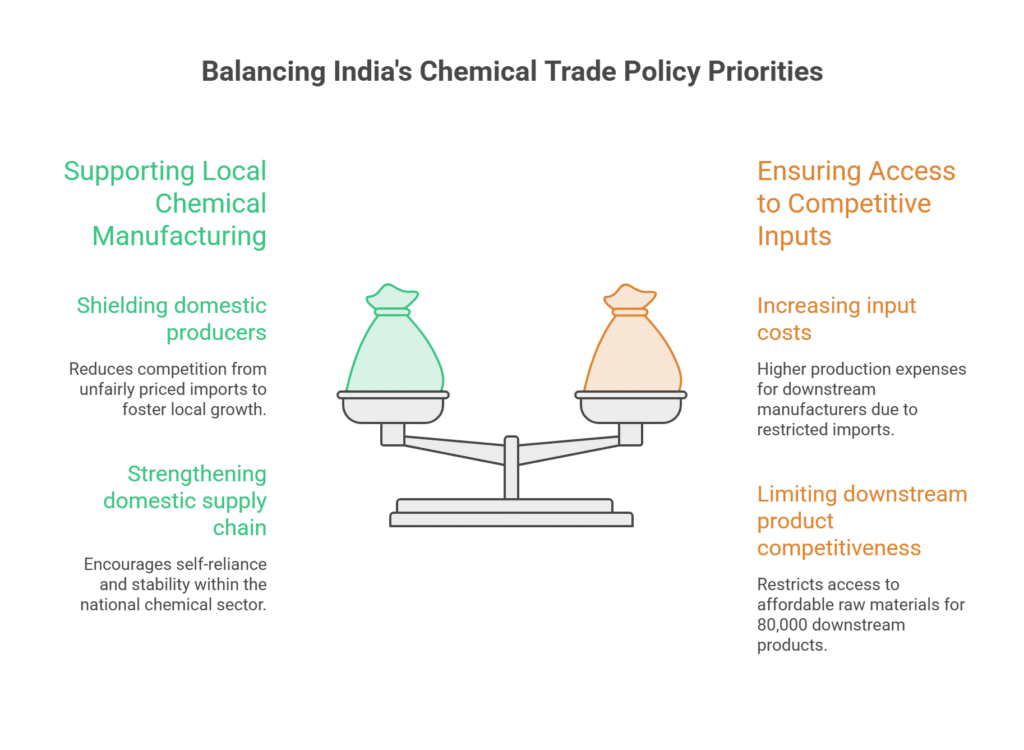
The 2026 tariff landscape is complex and highly segmented. While the American Chemistry Council (ACC) successfully lobbied to exempt many essential bulk chemicals from the broad 10% Section 122 duties, the targeted Section 232 tariffs have hit the pharmaceutical and specialty chemical sectors hard [3] [4].
Effective April 2026, imported patented pharmaceuticals and associated APIs face tiered tariff rates, fundamentally altering the cost structure for domestic drug manufacturers [2]. This policy shift is designed to force a reshoring of critical manufacturing, but the immediate reality is a supply chain squeeze.
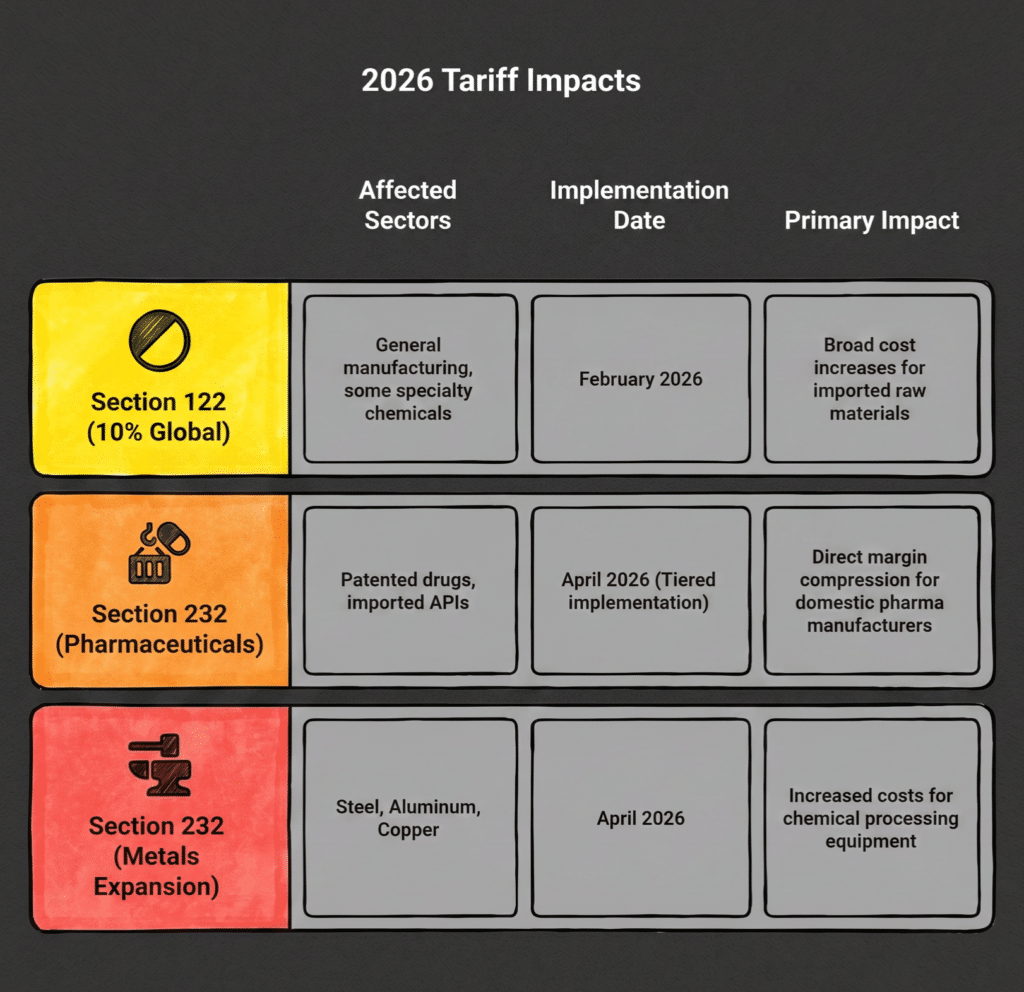
Summary of Key 2026 Tariff Impacts
| Tariff Action | Affected Sectors | Implementation Date | Primary Impact |
|---|---|---|---|
| Section 122 (10% Global) | General manufacturing, some specialty chemicals | February 2026 | Broad cost increases for imported raw materials; bulk chemicals mostly exempt [1]. |
| Section 232 (Pharmaceuticals) | Patented drugs, imported APIs | April 2026 (Tiered implementation) | Direct margin compression for domestic pharma manufacturers relying on foreign APIs [2]. |
| Section 232 (Metals Expansion) | Steel, Aluminum, Copper | April 2026 | Increased costs for chemical processing equipment and infrastructure [5]. |
The Domestic Off-Spec Advantage
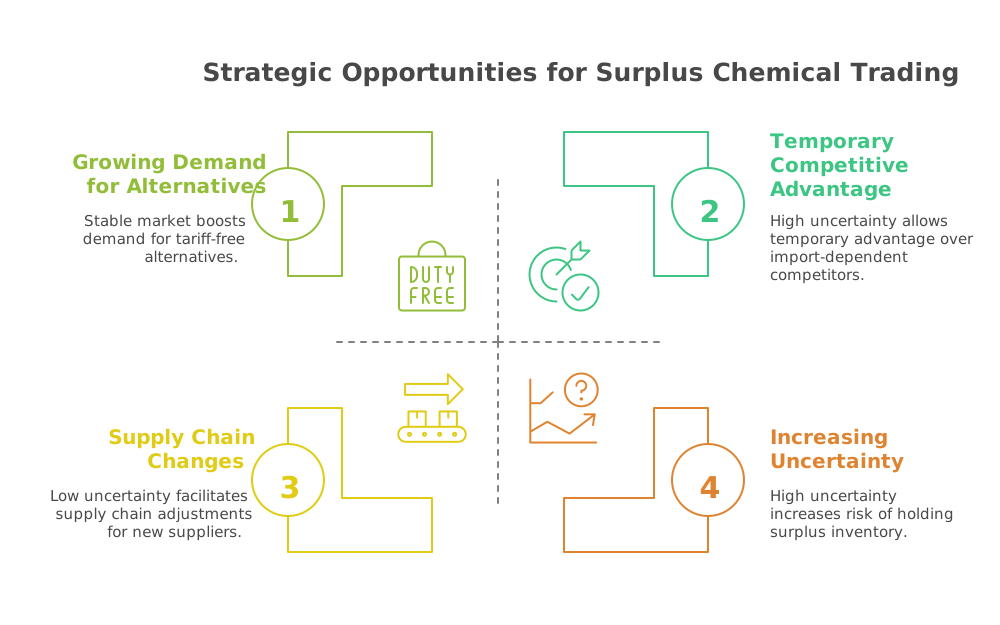
In this environment of heightened trade friction, domestic off-spec and surplus chemicals offer a powerful strategic advantage. When international supply lines are threatened by sudden tariffs or geopolitical standoffs, domestic surplus inventory provides a vital buffer.
1. Price Stability in a Volatile Market
Tariffs immediately inflate the cost of imported virgin chemicals. Conversely, the pricing of domestic off-spec chemicals is largely decoupled from international trade disputes. Because these materials are already within U.S. borders and are priced based on their “off-spec” status rather than virgin commodity indices, they offer significant cost savings and price predictability.
For example, a mid-sized resin manufacturer facing a sudden 10% cost increase on imported specialty solvents due to Section 122 tariffs can offset that margin loss by sourcing a domestic surplus solvent that slightly deviates from virgin purity standards but performs perfectly in their specific application.
2. Supply Chain Resilience and Speed
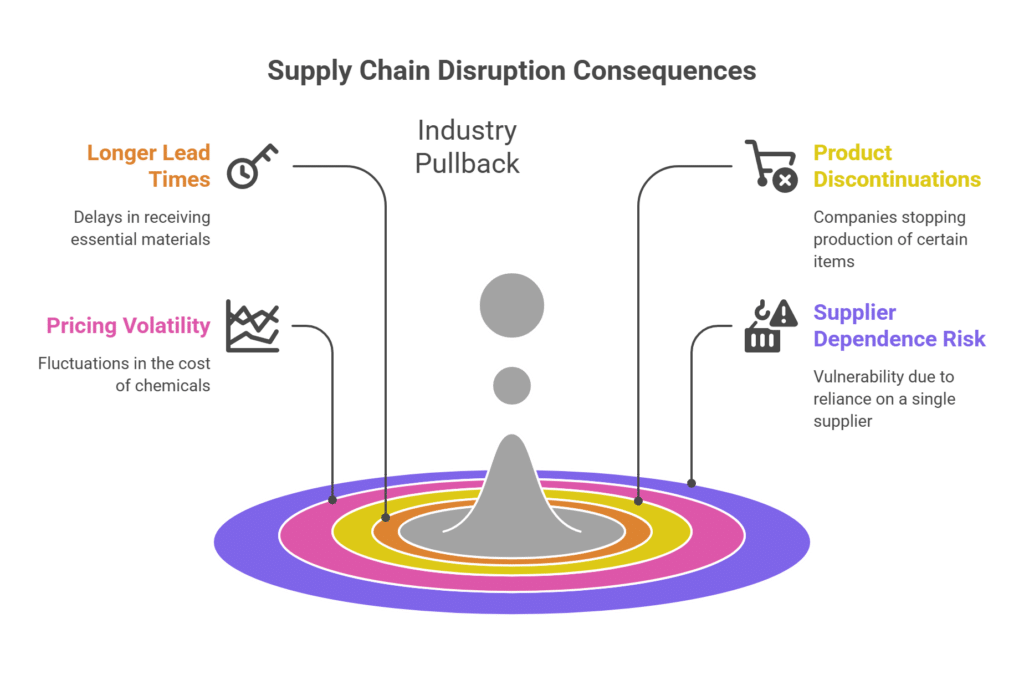
The 2026 tariffs have not only increased costs but also introduced administrative delays at ports of entry as customs officials navigate the new tiered structures. Domestic surplus chemicals eliminate cross-border friction entirely.
Consider the pharmaceutical sector. With new Section 232 tariffs hitting imported APIs, domestic manufacturers are under immense pressure [2]. While finished APIs have strict regulatory requirements, chemical intermediates used earlier in the synthesis process offer more flexibility. By sourcing surplus chemical intermediates domestically, manufacturers can bypass international shipping delays and tariff-related bottlenecks, ensuring continuous production.
3. Hedging Against Future Policy Shifts
Trade policy in 2026 has proven to be highly reactive. Relying on international supply chains leaves companies vulnerable to the next executive order or retaliatory sanction. Building a robust network for sourcing domestic surplus chemicals acts as an insurance policy.
By partnering with established surplus chemical traders, companies can gain real-time visibility into available domestic inventory, allowing them to pivot quickly when international routes become financially unviable.
Real-World Application: The Solvent Squeeze
In March 2026, a major U.S. coatings manufacturer faced a critical shortage of a specific industrial solvent. Their primary European supplier was hit by the new Section 122 tariffs, and the resulting price hike threatened to wipe out the manufacturer’s Q2 profit margins.
Instead of absorbing the cost or halting production, the procurement team worked with a surplus chemical network to identify a domestic batch of off-spec solvent. The solvent had been rejected by a semiconductor manufacturer due to a minor variance in moisture content—a variance that was completely irrelevant to the coatings manufacturer’s formulation. By purchasing this domestic surplus batch, the coatings company bypassed the tariff, secured the material at a 30% discount compared to the new imported price, and maintained their production schedule.
Looking Ahead: The Reshoring Reality
The explicit goal of the 2026 tariff policies is to drive domestic manufacturing. As more production capacity comes online in the U.S., the volume of domestic off-spec and surplus chemicals will naturally increase.
Prediction: By the end of 2027, we will see the emergence of formalized, AI-driven domestic exchanges specifically dedicated to trading off-spec chemical intermediates, driven entirely by the need to bypass international tariff volatility. Companies that integrate chemical reuse and surplus sourcing into their procurement strategies today will hold a decisive competitive advantage in this reshored future.
References
[1] Alliance Chemical. (2026). “Chemical Industry Mostly Spared as Trump Pivots to Section 122 Tariffs After Supreme Court Ruling.” https://alliancechemical.com/blogs/news/chemical-industry-mostly-spared-as-trump-pivots-to-section-122-tariffs-after
[2] The White House. (2026). “Adjusting Imports of Pharmaceuticals and Pharmaceutical Ingredients Into the United States.” https://www.whitehouse.gov/presidential-actions/2026/04/adjusting-imports-of-pharmaceuticals-and-pharmaceutical-ingredients-into-the-united-states/
[3] American Chemistry Council. (2026). “ACC Statement on Supreme Court Tariff Ruling.” https://www.americanchemistry.com/chemistry-in-america/news-trends/press-release/2026/acc-statement-on-supreme-court-tariff-ruling
[4] Chemical & Engineering News. (2026). “Chemicals mostly spared under new Trump tariff plan.” https://cen.acs.org/business/economy/Chemicals-mostly-spared-under-new/104/web/2026/02
[5] Norton Rose Fulbright. (2026). “Section 232 spotlight: Overhauled metals tariffs and new pharmaceutical tariffs.” https://www.nortonrosefulbright.com/en-us/knowledge/publications/d2cd8123/section-232-spotlight-overhauled-metals-tariffs-and-new-pharmaceutical-tariffs