The AI Revolution in Pharmaceutical Manufacturing: From Lab to Supply Chain
The pharmaceutical industry stands at an inflection point. As artificial intelligence (AI) transitions from pilot projects to enterprise-wide implementation, companies are discovering that AI is not merely a technological upgrade- it is a fundamental reshaping of how medicines are discovered, manufactured, and delivered to patients. This transformation has profound implications for pharmaceutical manufacturers, supply chain professionals, and procurement leaders who must navigate this rapidly evolving landscape.
The Strategic Imperative: Why AI Matters Now
The pharmaceutical industry has long been characterized by complexity, regulatory rigor, and the need for precision. AI addresses these challenges in ways that traditional optimization methods cannot. According to Sanofi CEO Paul Hudson, “We are in a new era powered by AI across business functions. 2026 promises accelerated momentum of AI-powered transformation in the pharmaceutical industry.” [1]
This shift is not speculative. In January 2026, Eli Lilly and NVIDIA announced a $1 billion, five-year joint AI lab in San Francisco, specifically designed to make computational models a core component of drug R&D infrastructure. [2] This investment signals that major pharmaceutical companies are moving beyond experimentation into sustained, large-scale AI deployment.
The market opportunity is substantial. According to Credence Research Inc., the AI in chemicals market is valued at $1.465 billion in 2024 and is projected to reach $11.891 billion by 2032, representing a compound annual growth rate (CAGR) of 29.92%. [3] This explosive growth reflects the broad applicability of AI across the pharmaceutical and chemical value chain.
AI in Drug Discovery and Development: Accelerating Innovation
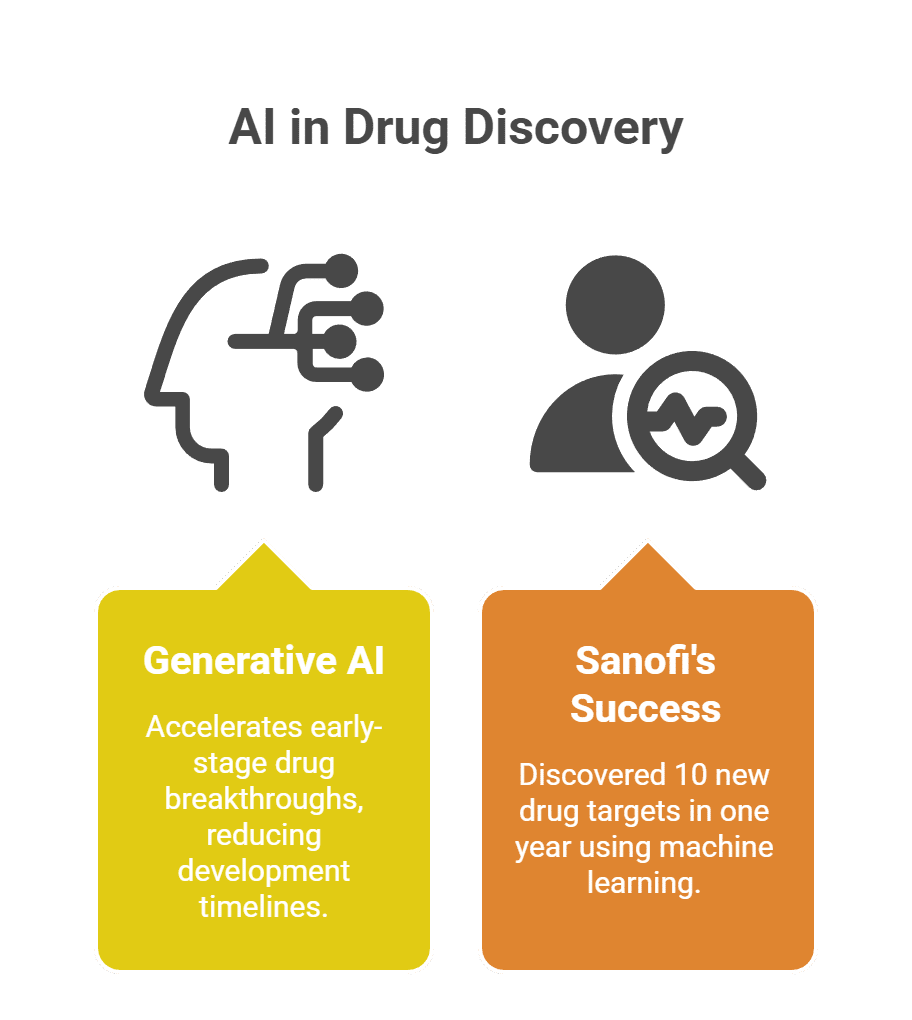
The most visible application of AI in pharmaceuticals is drug discovery. Generative AI has demonstrated the ability to accelerate early-stage drug breakthroughs, reducing development timelines by 25% or more. [4] At Sanofi, this is not theoretical- the company has discovered 10 completely new drug targets in just one year by combining machine learning with data integration and lab research. [5]
Beyond target discovery, AI is transforming clinical trial recruitment, one of the most persistent bottlenecks in drug development. AI-powered patient recruitment tools have improved clinical trial enrollment rates by 65%, automating patient eligibility screening through electronic health records, clinical notes, and lab results. [6] This capability has compressed recruitment timelines from months to weeks or even days.
The financial impact is equally compelling. AI-driven tools are reducing R&D costs by an estimated 50% by accelerating early-stage discovery and generating scientific insights that would take human researchers significantly longer to uncover. [7] This cost reduction has major implications for the viability of precision medicine and personalized therapeutics, making previously uneconomical treatments commercially feasible.
How does AI actually discover new drug targets?
AI systems analyze vast datasets of genetic, proteomic, and clinical information to identify patterns and relationships that humans might miss. Machine learning models can process millions of molecular combinations and predict which ones are likely to be effective against specific disease targets, dramatically accelerating the discovery process.
What is the competitive advantage for companies that adopt AI early?
Early adopters gain access to a larger pipeline of potential drug candidates, faster time-to-market for new therapies, and lower development costs. In an industry where patent cliffs and market exclusivity windows are critical, these advantages translate directly to competitive positioning and revenue.
Are there regulatory concerns with AI-discovered drugs?
Yes, regulatory bodies like the FDA and EMA are still developing frameworks for AI-assisted drug discovery. However, companies that proactively engage with regulators and document their AI processes are positioning themselves favorably for future approvals.
AI-Driven Manufacturing: Precision, Efficiency, and Quality
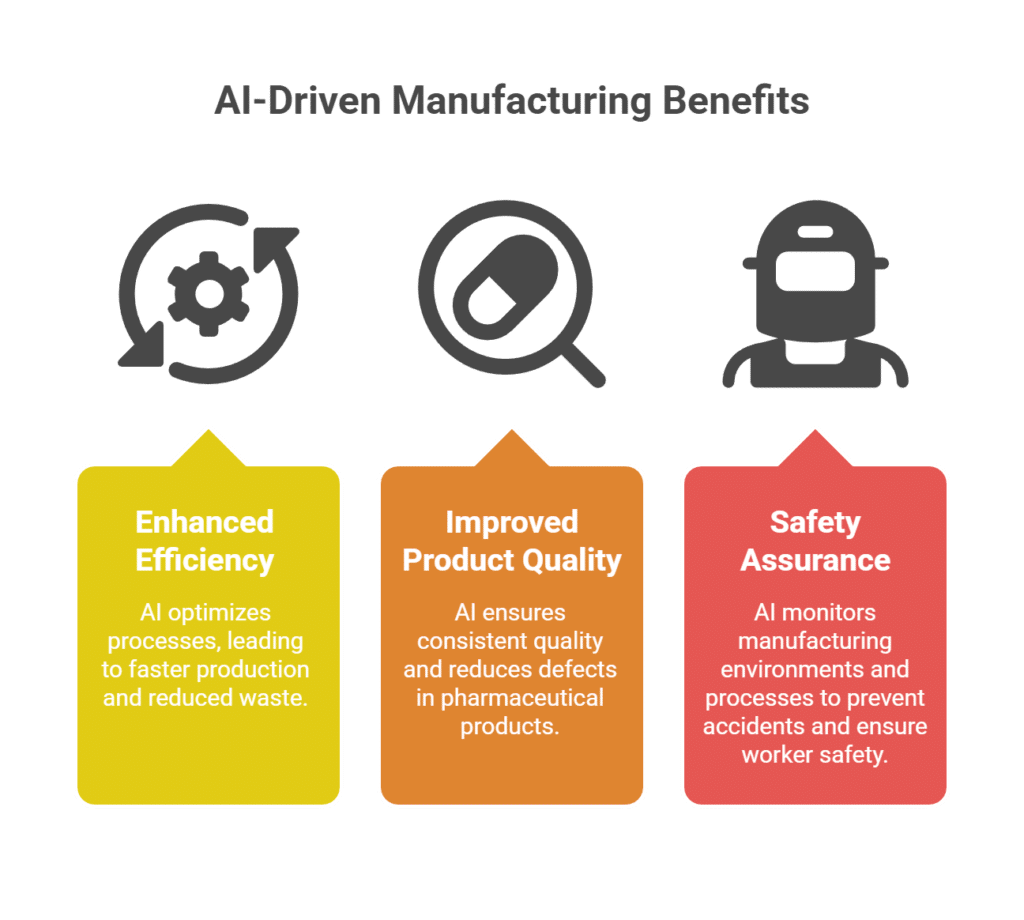
While drug discovery captures headlines, the real operational transformation is happening in manufacturing. AI is providing end-to-end support in pharmaceutical manufacturing through enhanced efficiency, improved product quality, and safety assurance. According to McKinsey, AI-driven analytics can significantly maximize yield, ensuring patients receive critical medicines faster while improving the cost and sustainability of manufacturing operations. [8]
At Sanofi, AI is embedded directly into manufacturing decision-making. The company uses AI agents to assess whether a drug should advance to the next trial phase, not by providing a simple yes/no answer, but by fully contextualizing each decision. The AI agent compares each asset’s prospects against others in development and assesses opportunity costs relative to alternative uses of capital. [9] This represents a fundamental shift from AI as a tool to AI as a strategic decision-maker.
Real-time monitoring and predictive maintenance are other critical applications. AI systems continuously analyze sensor data from reactors, distillation columns, and other manufacturing equipment, identifying micro-variations in temperature, pressure, and other parameters that could indicate quality issues before they occur. This predictive capability enables manufacturers to maintain consistent, reliable output while reducing waste and downtime.
The implications for surplus chemical management are significant. As AI optimizes manufacturing processes, companies often generate unexpected surpluses or need to adjust feedstock mixes. Additionally, the transition to AI-driven manufacturing frequently creates transition inventory as companies upgrade their systems and processes. Strategic sourcing of surplus chemicals becomes increasingly valuable in this context, allowing manufacturers to test new processes, validate AI-optimized production parameters, and manage inventory during system transitions.
How does AI improve pharmaceutical manufacturing quality?
AI systems monitor hundreds of parameters in real-time, detecting anomalies that might indicate quality issues. By identifying problems early, AI enables corrective action before products are compromised, reducing waste and ensuring regulatory compliance.
What is the ROI for AI implementation in manufacturing?
Companies report significant improvements in yield optimization, reduced waste, faster production cycles, and lower energy consumption. Sanofi, for example, has avoided $300 million in revenue risk through AI-driven supply chain management. [10]
What are the main barriers to AI adoption in manufacturing?
High upfront costs, data infrastructure requirements, talent gaps, and cybersecurity concerns are the primary barriers. However, companies that invest in these areas typically see payback within 2-3 years.
Supply Chain Resilience: The Hidden Power of AI
Perhaps the most transformative application of AI is in supply chain management. The pharmaceutical supply chain is complex, global, and vulnerable to disruption. AI addresses this vulnerability through enhanced visibility, real-time tracking, and predictive analytics.
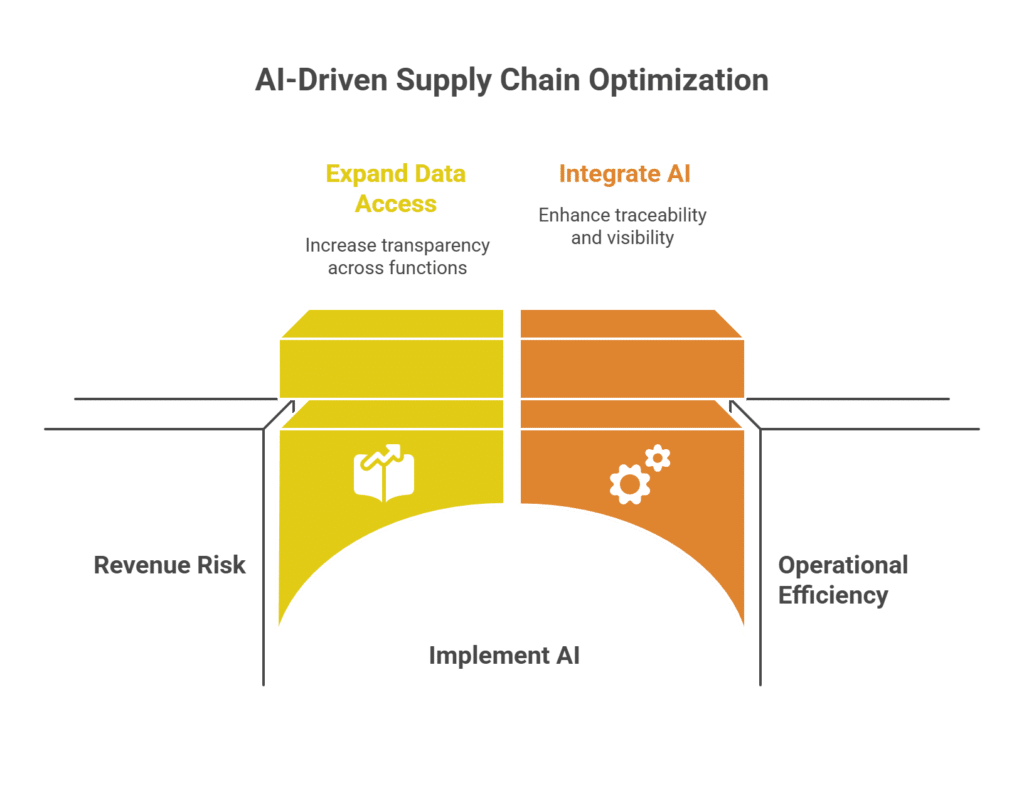
At Sanofi, AI-driven supply chain management has enabled the company to avoid $300 million in revenue risk and predict 80% of low inventory risks before they occur. [11] By expanding access to data and increasing transparency across functions, organizations can make better-informed decisions in a timely manner. The impact is tangible: 68% of supply chain organizations have already integrated AI to enhance traceability and visibility, resulting in a 22% increase in operational efficiency. [12]
This supply chain optimization has direct implications for surplus chemical sourcing. As AI systems optimize inventory levels and predict demand with greater accuracy, manufacturers have less need for safety stock and buffer inventory. However, this also means that when surpluses do occur- whether from demand forecasting errors, production optimization, or supply chain rebalancing- they are often valuable, high-quality materials that can be profitably recovered through strategic sourcing partnerships.
How does AI predict supply chain disruptions?
AI systems analyze historical data, real-time supplier information, logistics data, and external factors (weather, geopolitical events, etc.) to identify patterns that precede disruptions. This enables companies to take preventive action before problems occur.
What is the connection between AI supply chain optimization and surplus chemicals?
As AI optimizes inventory levels and production schedules, manufacturers may generate surpluses from demand forecast adjustments or production optimization. Additionally, companies transitioning to AI-driven supply chain systems often need to divest legacy inventory. Strategic surplus sourcing becomes a tool for managing these transitions profitably.
How does AI improve supplier qualification and management?
AI systems can analyze supplier performance data, quality metrics, delivery records, and financial stability to provide comprehensive supplier risk assessments. This enables companies to make more informed decisions about supplier relationships and diversification.
The Broader Market Context: Overcapacity and Opportunity
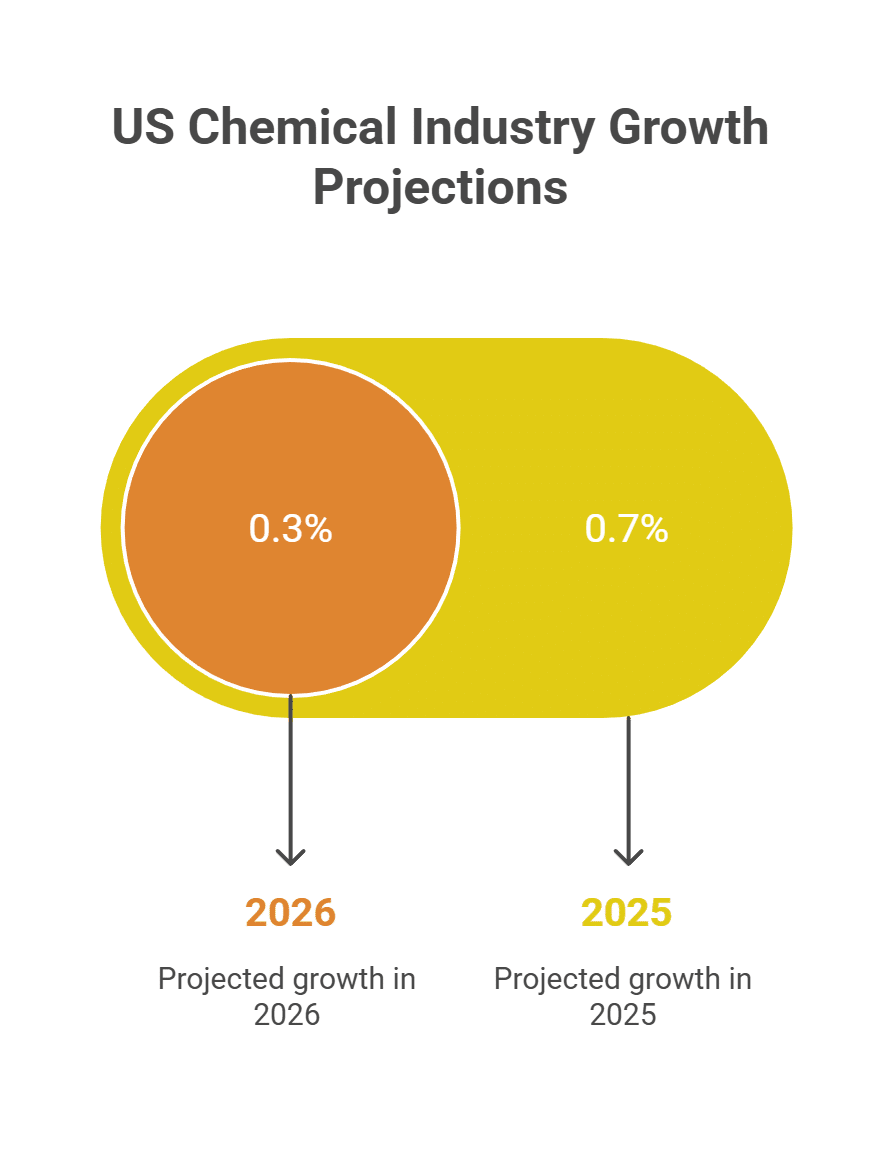
It is important to understand AI adoption within the context of the broader pharmaceutical and chemical markets. The global chemical industry is currently facing significant overcapacity, with the US chemical industry projected to grow only 0.3% in 2026, down from 0.7% in 2025. [13] In this environment, AI becomes a tool not just for innovation but for survival- enabling companies to optimize operations, reduce costs, and manage inventory more effectively.
For procurement professionals and supply chain leaders, this creates a paradoxical opportunity. While AI-driven optimization reduces the need for buffer inventory, the companies that successfully implement AI often generate valuable surpluses during the transition period. Additionally, the cost pressures created by overcapacity make surplus sourcing increasingly attractive as a cost mitigation strategy.
Strategic Implications for (Pharmaceutical) Surplus Traders
The AI revolution in pharmaceutical manufacturing creates several strategic opportunities for companies that specialize in surplus chemical sourcing:
- Transition Inventory Management: As companies upgrade to AI-driven manufacturing systems, they often have legacy inventory that needs to be divested. We strive to position ourselves as a strategic partner for managing these transitions profitably!
- Process Validation and Testing: Companies implementing new AI-optimized manufacturing processes often need to source materials for validation testing. Surplus chemicals offer a cost-effective way to conduct these tests without committing to long-term supplier contracts.
- Supply Chain Resilience: As AI systems optimize inventory levels, companies have less buffer stock. When surpluses do occur, they are often high-value materials that can be profitably recovered through strategic sourcing partnerships.
- Feedstock Flexibility: AI-driven manufacturing enables companies to adjust feedstock mixes and production parameters more dynamically. Surplus sourcing becomes a tool for managing this flexibility without long-term commitments.
Conclusion: The Future of Pharmaceutical Manufacturing
The integration of AI into pharmaceutical manufacturing is not a distant future scenario- it is happening now, at scale, with major companies making billion-dollar commitments. This transformation will reshape the competitive landscape, create new opportunities for cost reduction and innovation, and fundamentally change how pharmaceutical companies manage their supply chains.
For procurement professionals, supply chain directors, and operations managers, understanding this transformation is critical. The companies that successfully navigate the AI revolution will be those that view surplus sourcing not as a cost-cutting measure but as a strategic tool for managing the complexity, risk, and opportunity created by AI-driven manufacturing.
References
[1] Hudson, P. (2026, February 10). “Sanofi CEO: The enterprise AI shift will reshape pharma in 2026.” Fortune. Retrieved from https://fortune.com/2026/02/10/sanofi-ceo-paul-hudson-predictions-2026-ai-transformation/
[2] TechLifeSci. (2026, February). “How 2026 Started: First-Weeks Readout on AI, Pharma, & Policy.” Retrieved from https://www.techlifesci.com/p/how-2026-started
[3] PCI Magazine. (2026, February 1). “Market Report Tracks Rising AI Investment Across Chemical Operations.” Retrieved from https://www.pcimag.com/articles/114373-market-report-tracks-rising-ai-investment-across-chemical-operations
[4] Boston Consulting Group. (2025). “Agentic AI in Biopharma: Game-Changing Efficiency.” Retrieved from https://www.bcg.com/publications/2025/agentic-ai-in-biopharma-game-changing-efficiency
[5] Hudson, P. (2026, February 10). “Sanofi CEO: The enterprise AI shift will reshape pharma in 2026.” Fortune. Retrieved from https://fortune.com/2026/02/10/sanofi-ceo-paul-hudson-predictions-2026-ai-transformation/
[6] ScienceDirect. (2025). “AI-powered patient recruitment tools improve clinical trial enrollment rates by 65%.” Retrieved from https://www.sciencedirect.com/science/article/pii/S1386505625003582
[7] ScienceDirect. (2025). “AI-driven tools reduce R&D costs by an estimated 50%.” Retrieved from https://www.sciencedirect.com/science/article/pii/S037851732500626X
[8] McKinsey & Company. “Human-Machine Harmonization to Upgrade Biopharma Production.” Retrieved from https://www.mckinsey.com/capabilities/operations/our-insights/human-machine-harmonization-to-upgrade-biopharma-production
[9] Hudson, P. (2026, February 10). “Sanofi CEO: The enterprise AI shift will reshape pharma in 2026.” Fortune. Retrieved from https://fortune.com/2026/02/10/sanofi-ceo-paul-hudson-predictions-2026-ai-transformation/
[10] Pharmaceutical Executive. “Practical Gains for Pharma AI Use.” Retrieved from https://www.pharmexec.com/view/practical-gains-for-pharma-ai-use
[11] Pharmaceutical Executive. “Practical Gains for Pharma AI Use.” Retrieved from https://www.pharmexec.com/view/practical-gains-for-pharma-ai-use
[12] Global Trade Magazine. “AI in Supply Chain Industry Booms USD 157.6 Billion Revenue by 2033.” Retrieved from https://www.globaltrademag.com/ai-in-supply-chain-industry-booms-usd-157-6-billion-revenue-by-2033/
[13] American Chemistry Council. (2026, February 6). “Weekly Chemistry and Economic Trends.” Retrieved from https://www.americanchemistry.com/chemistry-in-america/news-trends/weekly-economic-report/2025/weekly-chemistry-and-economic-trends-02-06-26