
In an increasingly interconnected global economy, the strategic management of chemical inventories offers unparalleled opportunities for efficiency and sustainability. For manufacturing companies in North America and Europe holding surplus chemical inventory, or procurement managers in chemical-dependent industries in developing nations, India, and the Far East, understanding complex international trade regulations is paramount. Japan, a key market known for its stringent quality and safety standards, presents both challenges and lucrative prospects for essential oil exports. This guide provides an authoritative overview of the essential oil export regulations for Japan, with a particular focus on MSDS and SDS requirements, ensuring your operations remain compliant, efficient, and environmentally responsible.
At Surplus International, we believe in integrating sustainability into every solution we provide, transforming surplus chemicals into valuable resources. Our uncompromising customer care ensures seamless, confidential, and professional service, assisting businesses in navigating intricate global trade requirements, much like the detailed compliance needed for exporting essential oils to Japan.
Understanding Japan’s Regulatory Landscape for Essential Oils
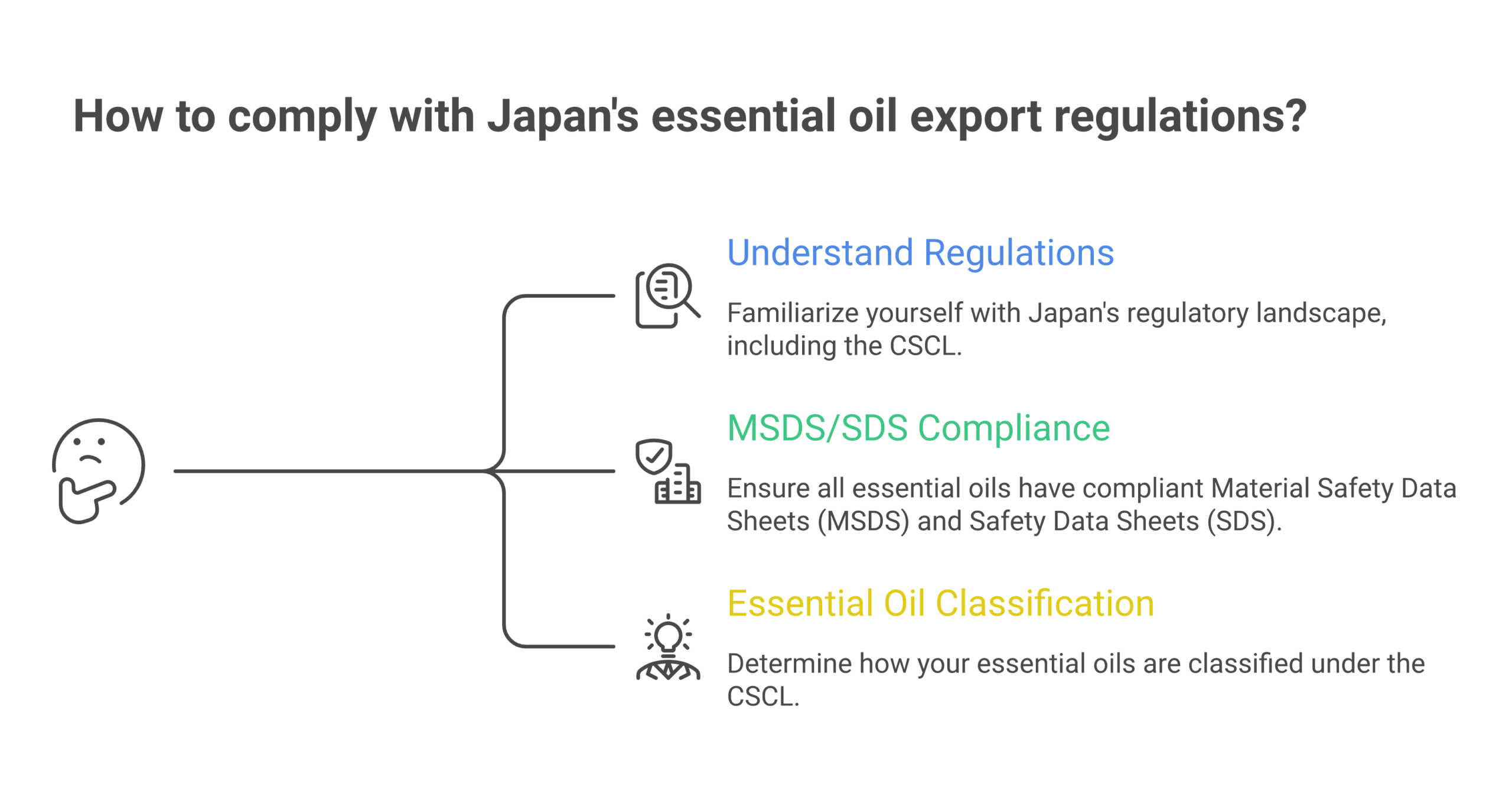
Japan’s regulatory framework for chemical substances is robust and designed to protect human health and the environment. Exporting essential oils requires meticulous attention to various laws, depending on the oil’s intended use and chemical composition. Businesses must proactively understand these nuances to avoid costly delays and non-compliance penalties, securing a competitive edge in this vital market. This includes a thorough understanding of the requirements for general chemical exports, as detailed in our guide to exporting excess chemicals from North America and Europe to Asia.
The Chemical Substances Control Law (CSCL) and Essential Oils
The Chemical Substances Control Law (CSCL), administered primarily by the Ministry of Economy, Trade and Industry (METI), the Ministry of Health, Labour and Welfare (MHLW), and the Ministry of the Environment (MOE), is the cornerstone of Japan’s chemical management. For essential oils, the application of CSCL depends on whether the oil is considered a chemical substance’ under its definitions, particularly regarding classification as a new chemical substance, an existing chemical substance, or a substance designated for specific controls. While many essential oils are natural extracts, their individual chemical constituents may be subject to CSCL requirements, especially if they are novel, or fall under categories like Type I (persistent, highly bioaccumulative, and human toxic/ecotoxic) or Type II (persistent and bioaccumulative, or human toxic/ecotoxic) Chemical Substances, or Monitoring Chemical Substances.
Comprehensive compositional analysis is therefore paramount to determine the regulatory status of an essential oil or its components. Misclassification or a lack of understanding can lead to significant delays, rejections, or even severe penalties. For exporters, this means not just understanding the oil’s botanical origin, but also its exact chemical fingerprint. It’s crucial for exporters to work closely with their Japanese importers, as the importer often holds primary responsibility for navigating CSCL notifications and registrations. The importer will rely heavily on accurate data from the exporter, including CAS numbers for all significant components, purity levels, and any known hazardous properties. Even minor impurities or additives within an essential oil blend can trigger unexpected regulatory hurdles if not properly identified and assessed under CSCL.
Successful navigation of Japan’s essential oil market
Ultimately, successful navigation of Japan’s essential oil market demands a proactive and meticulous approach to compliance. Beyond the GHS-aligned MSDS/SDS, which must be precisely tailored to Japanese specifications, a thorough understanding of CSCL implications for each specific product is indispensable. Engaging with regulatory experts and establishing robust communication channels with Japanese partners will ensure that all documentation is accurate, up-to-date, and meets the stringent requirements, thereby facilitating smooth customs clearance and preventing costly disruptions to your export operations.